

Archive position — measured, not model output
0 likes on Devpost
2,263 of the 7,850 archived projects have more likes, and 5,587 share exactly 0 — so this project's #7,242 place in the like-ranked listing is a tie-break inside that group, not a ranking.
Projects (log scale)
Likes on Devpost. ▲ marks this project's group.
Show the figures
| Likes | Projects | Share of archive |
|---|---|---|
| 0 | 5,587 | 71.2% |
| 1 | 1,758 | 22.4% |
| 2 | 284 | 3.6% |
| 3–4 | 132 | 1.7% |
| 5–9 | 75 | 1.0% |
| 10+ | 14 | 0.2% |
 User Stories BotA demo video on every pull request
Get a demo video on every new feature
GitHub App that watches your pull requests and records a narrated, captioned demo.
Save time on demo prep and make informed decisions faster with a video walkthrough of every new feature.
Executive Summary
What the company appears to be
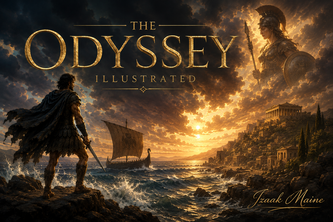
The Odyssey Illustrated is a self-contained AI publishing system built by one developer (Izaak Maine) that transforms public-domain literary works into illustrated graphic novels using reusable workflow abstractions. It is not a commercial product or service but a proof-of-concept project submitted to an OpenAI hackathon.
What changed
The author shifted from viewing AI publishing as a prompt-writing challenge to seeing it as a software engineering problem of workflow architecture. This led to the creation of a scalable, reusable system for long-form AI-assisted publishing.
Single most important open question
Is there evidence that this system can be scaled beyond one person or one prototype, and whether there is any commercial or educational demand for such a tool?
What The Product Actually Is
The description states that The Odyssey Illustrated is a proof-of-concept project that uses AI to generate an illustrated graphic novel from Homer’s The Odyssey. It is not a product or service but a demonstration of how reusable workflow abstractions can be used in long-form AI publishing.
It includes:
- A 228-page illustrated PDF
- A 15-second teaser video
- Four reusable workflow stages:
- Editorial workflow (bchat)
- Book planning (GPT)
- Scene planning (GPT)
- Illustration generation (GPT)
- Publishing (bookc)
- Promotion (teaser)
The system is described as being built with Open Source tools and Go-based utilities, and it uses image generation via GPT.
Not evidenced There is no evidence of revenue, customers, or commercial use beyond the author’s own demonstration.
Positioning & Claim Evolution
The author claims that this project demonstrates:
- That long-form AI publishing is primarily a workflow architecture problem, not a prompt-writing one.
- That reusable workflow abstractions can scale to large works like The Odyssey (24 books, 228 pages).
- That the system can be applied to other public-domain texts.
The positioning evolved from:
- Initial goal: Create an illustrated edition of The Odyssey that modern readers would enjoy.
- Final realization: The real contribution is a reusable publishing architecture for AI-assisted long-form content creation.
Inference This suggests the author sees potential in applying this system to other works, but no evidence supports whether others have adopted or are interested in doing so.
Target Customer & ICP
The description states that the project is a proof-of-concept, not a commercial offering. The author’s stated goal was to lower barriers for publishing educational content and make classic literature more accessible.
No explicit customer segment is defined beyond:
- Educators or institutions interested in creating illustrated editions of public-domain works
- Developers or creators working on AI-assisted publishing systems
Not evidenced There are no identified customers, target users, or market segments beyond the author’s own use case.
Business Model & Pricing Evidence
The description does not provide any information about:
- Revenue streams
- Pricing models
- Commercialization plans
- Monetization strategy
It is a self-contained prototype, not a product with a business model.
Not evidenced No evidence of any business model or pricing structure exists in the provided text.
Technical & Delivery Signals
The system uses:
- GPT for planning and illustration generation
- bchat (Open Source) for editorial workflow architecture
- bookc (Go-based tool) for PDF publishing
- teaser (Go-based tool) for promotional video generation
It is described as:
- Reusable across multiple books
- Scalable due to stable workflow abstractions
- Built with open-source tools and Go-based utilities
Inference The architecture appears designed for reusability, but no evidence of adoption or integration into other systems is provided.
Traction & Maturity Signals
The project:
- Was submitted as a hackathon entry (OpenAI 2026)
- Demonstrates one completed book (The Odyssey)
- Adapts 24 books into a 228-page graphic novel
- Uses four reusable workflow abstractions
- Includes open-source repositories for supporting tools
Not evidenced
There is no evidence of:
- Adoption by others
- User feedback or engagement
- Commercial traction or revenue
- Iteration beyond the prototype stage
Competitive Context
The description does not mention any direct competitors. It positions itself as a novel approach to AI-assisted publishing, focusing on workflow architecture rather than prompt engineering.
It is described as potentially useful for:
- Educational publishers
- Public-domain content creators
- AI tooling developers
Not evidenced No competitive landscape or existing solutions in this space are mentioned.
Open Questions & Risks
Key risks and open questions include:
- The project is a single-person prototype, not a scalable product.
- No evidence of adoption, traction, or commercial interest.
- The system is described as not yet production-ready—it’s a proof-of-concept.
- The author's own write-up suggests the system was built for personal learning and demonstration, not for market deployment.
Inference If this system were to be commercialized, it would face challenges in scaling beyond one developer and maintaining quality across multiple works.
Questions the description leaves open
- What is the actual scalability of the workflow architecture? Can it be reused without significant manual intervention?
- Has anyone else adopted or built upon this system?
- Are there plans to monetize or commercialize this tooling?
- How does the system handle narrative fidelity and editorial control at scale?
- What are the limitations of using GPT for long-form content planning and illustration generation?
Overall Assessment
Not evidenced There is no evidence that this project has any commercial traction, revenue, or customer base.
This is a self-contained prototype, not a product or service with a business model. It represents an interesting technical approach to AI-assisted publishing but lacks indicators of market readiness or demand.
If the author intends to build a scalable system or product, further development and evidence of adoption would be required before any investment or partnership consideration.
User Stories BotA demo video on every pull request
Get a demo video on every new feature
GitHub App that watches your pull requests and records a narrated, captioned demo.
Save time on demo prep and make informed decisions faster with a video walkthrough of every new feature.
Source
Submitted to the OpenAI 2026 hackathon on Devpost. Project home on Devpost. Back to the full gallery on Devpost.
This competitive analysis was produced by top-founders.com (opens in a new tab)
Generated by a language model from this project's public Devpost page — its tagline, the author's own write-up and any built-with tags listed there — as captured in August 2026. Short quotations are the author's words. It is an opinion on the idea as a business, not on the people behind it, and it reflects the description as published then. If the project has moved on, request a correction below. The analysis is not independent research and contains no verified traction, revenue or customer data.
An independent guide by KFG International LLC — not affiliated with, endorsed by, or connected to Devpost or OpenAI.