

Archive position — measured, not model output
1 like on Devpost
505 of the 7,850 archived projects have more likes, and 1,758 share exactly 1 — so this project's #1,355 place in the like-ranked listing is a tie-break inside that group, not a ranking.
Projects (log scale)
Likes on Devpost. ▲ marks this project's group.
Show the figures
| Likes | Projects | Share of archive |
|---|---|---|
| 0 | 5,587 | 71.2% |
| 1 | 1,758 | 22.4% |
| 2 | 284 | 3.6% |
| 3–4 | 132 | 1.7% |
| 5–9 | 75 | 1.0% |
| 10+ | 14 | 0.2% |
 User Stories BotA demo video on every pull request
Get a demo video on every new feature
GitHub App that watches your pull requests and records a narrated, captioned demo.
Save time on demo prep and make informed decisions faster with a video walkthrough of every new feature.
Executive Summary
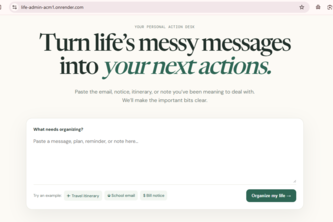
The company appears to be a solo-developer project named Life Admin, submitted as part of the OpenAI 2026 hackathon. The author describes it as an AI-powered assistant that transforms unstructured messages into organized action plans with tasks, deadlines, priorities, and next steps.
The product is presented as a lightweight web application built using HTML, CSS, JavaScript, Node.js, and optionally the OpenAI API. It allows users to paste text from various sources (emails, travel itineraries, school notices, etc.) and receive structured outputs including summaries, dates, priorities, and action checklists.
The single most important open question is: What is the actual commercial viability of this concept?
The description states that the project was built in a hackathon timeframe with no revenue or customer data. It has not demonstrated any traction, adoption, or monetization strategy beyond the author's own vision for future features. The product is self-reported as functional but lacks evidence of real-world usage or performance metrics.
Confidence Level: Low
This analysis is based entirely on the self-reported description provided by the author — no third-party verification or historical data exists. All claims are treated as stated by the author, not proven facts.
What The Product Actually Is
- The description states that Life Admin is a lightweight web application.
- It allows users to paste unstructured text such as travel itineraries, school emails, bill notices, personal notes, and general announcements.
- The application analyzes content and generates:
- A concise summary
- Priority level assessment
- Important dates and deadlines
- Structured action checklist
- Suggested next step
- It includes a recent history feature powered by browser localStorage, allowing users to revisit previous analyses.
- The tool is built using:
- HTML, CSS, JavaScript
- Node.js
- Optional integration with OpenAI API
- Browser LocalStorage for persistence
- A demo mode is implemented that produces structured results even without an API key.
Inferred: The product functions as a personal productivity assistant focused on transforming information overload into actionable items. It operates in a browser-based environment and does not require backend databases or accounts.
Positioning & Claim Evolution
- The author states the goal was to reduce information overload and help users understand what matters most.
- The tagline claims: “AI that transforms overwhelming messages into organized action plans with tasks, deadlines, priorities, and next steps in seconds.”
- The project is positioned as an AI-powered assistant for personal organization, targeting individuals who receive many unstructured messages daily.
Inferred: There is no evidence of prior positioning or evolution. This appears to be a new concept introduced by the author during a hackathon. No claims about market fit, competitive differentiation, or prior user feedback are presented.
Target Customer & ICP
- The description states that the tool targets people who receive important information through emails, travel itineraries, school notices, bill reminders, and personal messages.
- These users are described as those who find such messages long, unstructured, and difficult to act upon quickly.
Inferred: The ICP is likely individuals seeking personal productivity solutions, possibly working professionals or parents managing multiple communications channels. However, there is no evidence of specific persona development, user research, or segmentation beyond general categories.
Business Model & Pricing Evidence
- No pricing model or business model is described.
- There is no mention of monetization strategies, subscription plans, freemium tiers, or revenue streams.
- The tool is presented as a personal utility, not a commercial product with defined customers or sales processes.
Not evidenced: Any indication of how the project intends to generate value or income from its users.
Technical & Delivery Signals
- Built using:
- HTML, CSS, JavaScript
- Node.js
- Optional OpenAI API integration
- Browser LocalStorage for history management
- Features include:
- Example message templates
- Loading states
- Results cards
- History management
- A demo mode is implemented to ensure functionality without API access.
- The author mentions using OpenAI Codex during development, which accelerated implementation and debugging.
Inferred: The technical stack suggests a lightweight, client-side solution with optional server-side AI processing. The use of localStorage implies no persistent data storage beyond the browser, indicating limited scalability or persistence across devices.
Traction & Maturity Signals
- The project was built within a hackathon timeframe.
- It includes:
- End-to-end MVP
- Polished UI
- Structured outputs from unstructured text
- Local history functionality
- Demo mode that works without API configuration
- No evidence of user adoption, customer feedback, or usage metrics.
Not evidenced: Any data on actual users, retention, engagement, or product-market fit. The project is described as a prototype with no indication of real-world deployment or performance.
Competitive Context
- No mention of existing competitors.
- The author does not reference similar tools or platforms in the market.
- The concept overlaps with general AI-powered productivity tools and personal assistants, but no specific competitive landscape is described.
Not evidenced: Any knowledge of the competitive environment or how this tool would differentiate from other solutions.
Open Questions & Risks
- No revenue or customer data: The project has not demonstrated any traction or monetization.
- Solo developer team: With only one member, scalability and long-term maintenance are concerns.
- Limited functionality in demo mode: The tool works without API access but may lack full AI capabilities.
- Unproven market demand: No evidence of user research or validation.
- No clear business model: No indication of how the product will be monetized.
- Self-reported only: All claims are unverified and based solely on the author's own account.
Inferred: The project is in early conceptual stages with no demonstrated commercial viability or market readiness.
Questions the description leaves open
- What specific user problems does this tool solve, and how did you identify them?
- Have you validated your concept with real users beyond the hackathon?
- How do you plan to monetize this tool in the long term?
- What are the technical limitations of relying on browser-based storage instead of cloud services?
- Are there any plans for integrating with calendar or reminder systems beyond what’s described?
- How do you intend to scale beyond a single developer and a prototype?
Overall Assessment
- Not evidenced: No basis for evaluating investment potential or partnership opportunity.
- The project is presented as a conceptual MVP built in a hackathon setting with no evidence of traction, revenue, or customer validation.
- It lacks clear commercial signals, business model clarity, or competitive positioning.
Inferred: At this stage, the project does not present a compelling case for investment or strategic partnership. It requires significant development and market validation before any commercial viability can be assessed.
User Stories BotA demo video on every pull request
Get a demo video on every new feature
GitHub App that watches your pull requests and records a narrated, captioned demo.
Save time on demo prep and make informed decisions faster with a video walkthrough of every new feature.
Source
Submitted to the OpenAI 2026 hackathon on Devpost. Project home on Devpost. Back to the full gallery on Devpost.
This competitive analysis was produced by top-founders.com (opens in a new tab)
Generated by a language model from this project's public Devpost page — its tagline, the author's own write-up and any built-with tags listed there — as captured in August 2026. Short quotations are the author's words. It is an opinion on the idea as a business, not on the people behind it, and it reflects the description as published then. If the project has moved on, request a correction below. The analysis is not independent research and contains no verified traction, revenue or customer data.
An independent guide by KFG International LLC — not affiliated with, endorsed by, or connected to Devpost or OpenAI.