

Archive position — measured, not model output
0 likes on Devpost
2,263 of the 7,850 archived projects have more likes, and 5,587 share exactly 0 — so this project's #5,281 place in the like-ranked listing is a tie-break inside that group, not a ranking.
Projects (log scale)
Likes on Devpost. ▲ marks this project's group.
Show the figures
| Likes | Projects | Share of archive |
|---|---|---|
| 0 | 5,587 | 71.2% |
| 1 | 1,758 | 22.4% |
| 2 | 284 | 3.6% |
| 3–4 | 132 | 1.7% |
| 5–9 | 75 | 1.0% |
| 10+ | 14 | 0.2% |
 User Stories BotA demo video on every pull request
Get a demo video on every new feature
GitHub App that watches your pull requests and records a narrated, captioned demo.
Save time on demo prep and make informed decisions faster with a video walkthrough of every new feature.
Executive Summary
Project: Metnor
Self-reported basis: The description is entirely from the author’s own write-up, submitted to the OpenAI 2026 hackathon on Devpost. No external verification or historical data are available.
Commercial due-diligence read: Metnor appears to be a prototype interactive learning runtime built for educational content, using AI tools like Codex and GPT-5.6. It is described as an offline-first web app with five pre-built lessons. The author claims it aims to help learners build mental models through interactive scenes. No evidence of revenue, customers, or traction exists.
Single most important open question: Is there a viable path from prototype to scalable product or business model that can support further development and adoption?
What The Product Actually Is
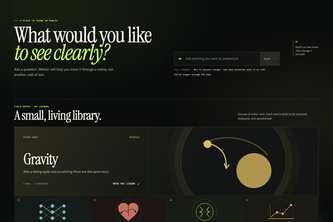
The description states that Metnor is an interactive learning runtime designed for learners who understand the words but not how concepts work. It ships as a polished, offline-first web app with five narrated interactive lessons covering topics like gravity, transformer architecture, human anatomy, photosynthesis, and supply and demand.
It uses a portable Scene contract that defines objects, relationships, narration, timeline events, interactions, and simulation variables. This data is rendered using a generic React/SVG runtime, which avoids building one-off UI code for each subject.
The system supports:
- Play/pause controls
- Contextual object inspection
- Replay functionality
- Real-time manipulation of simulation variables
It also includes optional integration with OpenAI APIs (GPT-5.6) to generate structured lesson plans or answer learner questions, though it falls back to local lessons when credentials are unavailable.
Inference: The product is described as a prototype runtime for interactive educational content, not a finished commercial offering.
Positioning & Claim Evolution
The author states that Metnor answers the gap between text-based explanations and understanding by providing "living scenes" where learners can explore ideas dynamically. It is positioned to help users build usable mental models rather than just making explanations prettier.
Key claims:
- The goal is not to make explanations prettier but to help learners build a usable mental model.
- If a six-year-old cannot follow the explanation, it’s not clear enough yet.
- The ambition is to allow any learner prompt to become a structured, interactive experience rather than a static answer.
Inference: The positioning is focused on interactive learning for complex concepts, with an emphasis on accessibility and usability. It implies a shift from traditional text-based tools toward dynamic, exploratory experiences.
Target Customer & ICP
The description does not explicitly name target customers or define an Ideal Customer Profile (ICP). However, it suggests the product is aimed at:
- Learners trying to understand complex, relational, and dynamic concepts.
- Educators or curriculum designers who want to create interactive content.
- Developers or educators working in STEM education, especially those using AI tools.
The author notes that lessons are designed around a standard: if a six-year-old cannot follow the explanation, it’s not clear enough yet — implying a broad audience including younger learners.
Inference: The ICP likely includes educators, curriculum developers, and learners seeking deeper conceptual understanding in STEM fields. No evidence of specific customer segments or personas is provided.
Business Model & Pricing Evidence
There is no evidence of pricing, monetization strategy, or business model in the description. The product is described as a working prototype with offline-first functionality and pre-built lessons. It does not mention:
- Subscription tiers
- Licensing models
- B2B vs B2C targeting
- Revenue streams
- Customer acquisition costs
The author mentions optional server-side integrations with OpenAI APIs but does not describe how these might be monetized.
Inference: No business model or pricing evidence is present. The product appears to be a prototype, not yet commercialized.
Technical & Delivery Signals
Metnor uses:
- Codex and GPT-5.6 for building the product and planning lessons.
- A portable Scene contract that contains all necessary data for rendering.
- A generic React/SVG renderer to interpret scene data without custom UI per lesson.
- Offline-first web app architecture, working without an account, API key, or network-dependent demo data.
The system supports:
- Validation of scene data
- Runtime store + timeline handling
- Narration and simulation controls
- Keyboard-accessible interfaces
It also includes a primitive registry, playback, selection, narration, and simulation systems.
Inference: The technical architecture is described as modular and reusable, suggesting scalability potential. However, no evidence of production deployment or performance metrics exists.
Traction & Maturity Signals
The description states that Metnor is already a working interactive lesson library with five lessons. It was submitted to the OpenAI 2026 hackathon, indicating early-stage development and validation.
There is no mention of:
- Users or customer adoption
- Revenue or funding
- Product usage metrics
- Market traction or growth
The author says it’s a prototype but not yet a commercial product.
Inference: The project shows early maturity with a working prototype and clear vision. However, there is no evidence of traction or user engagement.
Competitive Context
The description does not reference competitors or the broader market landscape. It focuses on what Metnor does rather than how it compares to existing tools in educational technology or interactive learning platforms.
No mention of:
- Existing platforms for visualizing complex concepts
- Competitors in AI-powered education
- Similar tools in developer tooling or simulation-based learning
Inference: No competitive context is provided. The author does not position Metnor against other solutions, nor does the description indicate awareness of the competitive environment.
Open Questions & Risks
- Prototype only: No evidence of commercial viability or user adoption.
- No revenue or monetization strategy: The product is described as a prototype with no indication of how it will generate value.
- Dependency on AI tools (Codex, GPT-5.6): Reliance on proprietary models may pose long-term risks if access changes or becomes costly.
- Limited scope: Only five lessons are currently available; the vision for expansion is described but not demonstrated.
- No clear path to scale: While the architecture supports reuse, there’s no evidence of plans for authoring tools, collaboration features, or broader distribution.
Inference: Risks include lack of traction, unclear monetization, and dependency on AI infrastructure. The project remains in early development with no proven business model.
Questions the description leaves open
- What is the intended user base for Metnor beyond the prototype?
- How do you plan to transition from a prototype to a scalable product or platform?
- Are there any plans to monetize or offer paid features?
- Have you tested the system with real learners or educators?
- What are your thoughts on integrating with existing LMS platforms or educational institutions?
- How would you handle content creation at scale beyond the current five lessons?
- What is the long-term vision for authoring tools and community contributions?
Overall Assessment
Not evidenced: There is no evidence of revenue, funding, or traction to support an investment or partnership decision. The project is described as a prototype submitted to a hackathon with no indication of commercial readiness.
The author claims the product aims to help learners build mental models through interactive scenes and uses AI tools like Codex and GPT-5.6. However, the description lacks:
- Customer data
- Financials
- Market positioning
- Go-to-market strategy
Confidence level: Low — based on self-reported evidence only.
Assessment: Metnor is an early-stage prototype with a promising concept and technical architecture. It has not yet demonstrated commercial viability or traction. Further diligence would require evidence of user engagement, monetization plans, and market validation.
User Stories BotA demo video on every pull request
Get a demo video on every new feature
GitHub App that watches your pull requests and records a narrated, captioned demo.
Save time on demo prep and make informed decisions faster with a video walkthrough of every new feature.
Source
Submitted to the OpenAI 2026 hackathon on Devpost. Project home on Devpost. Back to the full gallery on Devpost.
This competitive analysis was produced by top-founders.com (opens in a new tab)
Generated by a language model from this project's public Devpost page — its tagline, the author's own write-up and any built-with tags listed there — as captured in August 2026. Short quotations are the author's words. It is an opinion on the idea as a business, not on the people behind it, and it reflects the description as published then. If the project has moved on, request a correction below. The analysis is not independent research and contains no verified traction, revenue or customer data.
An independent guide by KFG International LLC — not affiliated with, endorsed by, or connected to Devpost or OpenAI.