

Archive position — measured, not model output
0 likes on Devpost
2,263 of the 7,850 archived projects have more likes, and 5,587 share exactly 0 — so this project's #5,283 place in the like-ranked listing is a tie-break inside that group, not a ranking.
Projects (log scale)
Likes on Devpost. ▲ marks this project's group.
Show the figures
| Likes | Projects | Share of archive |
|---|---|---|
| 0 | 5,587 | 71.2% |
| 1 | 1,758 | 22.4% |
| 2 | 284 | 3.6% |
| 3–4 | 132 | 1.7% |
| 5–9 | 75 | 1.0% |
| 10+ | 14 | 0.2% |
 User Stories BotA demo video on every pull request
Get a demo video on every new feature
GitHub App that watches your pull requests and records a narrated, captioned demo.
Save time on demo prep and make informed decisions faster with a video walkthrough of every new feature.
Executive Summary
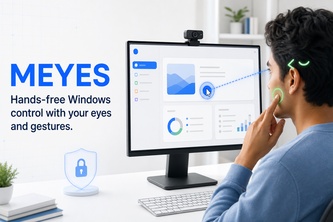
The description states that Meyes is a webcam-based eye and facial gesture control application for Windows, built as a prototype by one developer. The author claims it enables hands-free computer interaction using gaze, winks, temple touches, and optional cheek gestures — with local processing and no data upload. It was submitted to the OpenAI 2026 hackathon.
What changed: This is a self-reported prototype project, not a commercial product or service. No evidence of prior development, funding, or customer adoption exists.
Single most important open question: Is this a working prototype or an idea that has not yet been implemented?
What The Product Actually Is
The description states that Meyes is an application for Windows that allows users to control their computer using eye movements and facial gestures via an ordinary webcam. It includes features such as:
- Gaze-driven cursor movement
- Wink detection for mouse clicks
- Temple-touch gestures for scrolling
- Optional cheek bindings
- Customizable gesture profiles and sensitivity settings
The author says it uses Python 3.11, PySide6 for the interface, OpenCV for webcam capture, and MediaPipe Face Landmarker and Hand Landmarker for facial and hand landmarks.
Inference: The product is described as a software prototype that runs locally on Windows machines.
Positioning & Claim Evolution
The author states that Meyes was inspired by professional gamers' eye-tracking technology but aims to make hands-free computer control accessible using only an ordinary webcam. It is positioned as an assistive productivity tool, not a medical device.
Claim: The product is intended for people with motor disabilities or those who find traditional input difficult.
Inference: The positioning evolved from a general curiosity about eye-tracking to a specific aim at accessibility and alternative input methods.
Target Customer & ICP
The description states that Meyes is designed for people with motor disabilities or anyone who finds using a mouse and keyboard difficult. It is described as an assistive productivity prototype.
Inference: The target customer segment is individuals with physical limitations affecting their ability to use traditional computer input methods.
Business Model & Pricing Evidence
There is no evidence of pricing, monetization strategy, or business model in the description.
Not evidenced
Technical & Delivery Signals
The author states that Meyes was built using:
- Python 3.11
- PySide6 for Windows interface
- OpenCV for webcam capture
- MediaPipe Face Landmarker and Hand Landmarker for landmarks
- Local processing with no data upload
It uses a Smooth Pursuit calibration process to map eye features into screen coordinates.
Inference: The technical stack suggests a lightweight, local application built for Windows. The use of open-source tools indicates a prototype or proof-of-concept nature.
Traction & Maturity Signals
The description states that this is a prototype submitted to the OpenAI 2026 hackathon. It was built by one person (dresta putra) and has no evidence of revenue, customers, or adoption beyond its submission.
Not evidenced
Competitive Context
There is no mention of competitors in the description. The author does not reference existing products or technologies that perform similar functions.
Not evidenced
Open Questions & Risks
- Prototype vs. Product: The project is described as a hackathon submission and prototype, with no evidence of commercial viability or product development beyond this stage.
- Single Developer: The entire project was built by one person, raising questions about scalability, maintenance, and future development.
- No Traction or Revenue: No evidence of users, customers, or monetization exists.
- Unverified Claims: The description is self-reported and unverified; no third-party validation or testing data is provided.
Questions the description leaves open
- What is the current state of the prototype? Is it functional?
- Has there been any user testing or feedback from individuals with motor disabilities?
- Are there plans to develop beyond the hackathon prototype?
- What are the technical limitations of using only a webcam for gesture recognition?
- How does Meyes handle edge cases like lighting changes, head movement, or occlusion?
Overall Assessment
The description states that this is a prototype submitted to a hackathon and not a commercial product. There is no evidence of traction, revenue, customers, or even a clear go-to-market strategy.
Assessment: Not ready for investment or partnership consideration at this stage. This appears to be an early-stage idea or proof-of-concept with no demonstrated market need or business model.
User Stories BotA demo video on every pull request
Get a demo video on every new feature
GitHub App that watches your pull requests and records a narrated, captioned demo.
Save time on demo prep and make informed decisions faster with a video walkthrough of every new feature.
Source
Submitted to the OpenAI 2026 hackathon on Devpost. Project home on Devpost. Back to the full gallery on Devpost.
This competitive analysis was produced by top-founders.com (opens in a new tab)
Generated by a language model from this project's public Devpost page — its tagline, the author's own write-up and any built-with tags listed there — as captured in August 2026. Short quotations are the author's words. It is an opinion on the idea as a business, not on the people behind it, and it reflects the description as published then. If the project has moved on, request a correction below. The analysis is not independent research and contains no verified traction, revenue or customer data.
An independent guide by KFG International LLC — not affiliated with, endorsed by, or connected to Devpost or OpenAI.