

Archive position — measured, not model output
0 likes on Devpost
2,263 of the 7,850 archived projects have more likes, and 5,587 share exactly 0 — so this project's #5,284 place in the like-ranked listing is a tie-break inside that group, not a ranking.
Projects (log scale)
Likes on Devpost. ▲ marks this project's group.
Show the figures
| Likes | Projects | Share of archive |
|---|---|---|
| 0 | 5,587 | 71.2% |
| 1 | 1,758 | 22.4% |
| 2 | 284 | 3.6% |
| 3–4 | 132 | 1.7% |
| 5–9 | 75 | 1.0% |
| 10+ | 14 | 0.2% |
 User Stories BotA demo video on every pull request
Get a demo video on every new feature
GitHub App that watches your pull requests and records a narrated, captioned demo.
Save time on demo prep and make informed decisions faster with a video walkthrough of every new feature.
Executive Summary
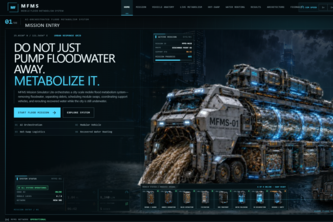
The description states that MFMS — Mobile Flood Metabolism System — is an AI-orchestrated flood response simulator built as a prototype for the OpenAI 2026 hackathon. The author describes it as an interactive operational concept prototype, not a validated engineering model or real deployment. It simulates mission orchestration using a deterministic rule engine and does not integrate live GPT models at runtime. The system is conceptual and visualized through a React-based frontend with simulated decision flows and module exchanges.
The most important open question is whether the project has any commercial traction, revenue, or customer adoption beyond its prototype form — which is not evidenced.
What The Product Actually Is
The description states that MFMS Mission Simulator Lite is an interactive operational concept prototype for AI-orchestrated urban flood response. It simulates:
- Mission configuration under disaster conditions (water depth, contamination type, priority target, network condition)
- AI orchestration of route selection, module configuration, and support vehicle deployment
- Module saturation prediction and hot-swap logistics
- Recovered water routing to various destinations
It is built with React, Vite, TypeScript, Tailwind CSS, Framer Motion, and a deterministic simulation engine. It does not use live GPT models at runtime.
Positioning & Claim Evolution
The description states that MFMS began with the question: “What if a city could process floodwater while the disaster is still happening?” The central idea is to “metabolize” floodwater rather than simply pump it away. This positions the product as an AI-driven urban infrastructure concept for real-time floodwater treatment and logistics coordination.
The claim evolution shows a shift from conceptual thinking (processing water during disaster) to a prototype demonstration of AI orchestration, modular systems, and mission flow logic.
Target Customer & ICP
Not evidenced. The description does not identify specific customer segments or personas beyond the general idea of urban flood response. No evidence of target users, buyer roles, or decision-makers is provided.
Business Model & Pricing Evidence
Not evidenced. There is no mention of pricing, monetization strategy, or business model in the description. The project is described as a prototype for a hackathon and not as a commercial offering.
Technical & Delivery Signals
The description states that the prototype was built with:
- React, Vite, TypeScript, Tailwind CSS, React Router
- Framer Motion for animations
- A deterministic simulation engine (not live GPT)
- Shared mission state across multiple pages
- Visual components including Mission Command, Vehicle Anatomy, Live Metabolism, Hot-Swap Logistics, Recovered Water Routing, Mission Results, and System Architecture
It was deployed via GitHub and Vercel. The system uses a rule-based logic engine rather than real-time AI inference.
Traction & Maturity Signals
Not evidenced. There is no evidence of revenue, customers, user adoption, or product-market fit beyond the prototype stage. The description explicitly states that it is not validated engineering or a real deployment.
Competitive Context
Not evidenced. No mention of competitors, market players, or competitive positioning is provided in the description.
Open Questions & Risks
- The system is described as a prototype with no validation or real-world testing.
- It does not use live AI models at runtime; only deterministic rules are simulated.
- The project is not claimed to be a certified system, engineering model, or government deployment.
- No evidence of traction, revenue, or customer engagement exists.
Questions the description leaves open
- What is the intended path from prototype to commercial product?
- Are there any partnerships or pilot programs with cities or emergency response agencies?
- How does the team plan to validate the simulation logic against real-world flood conditions?
- Is there a roadmap for integrating live data feeds (e.g., GIS, weather, water sensors)?
- What are the technical limitations of the deterministic engine versus a real-time AI model?
Overall Assessment
Not evidenced. There is no evidence of commercial traction, funding, or investment interest beyond the prototype submission to a hackathon. The description does not indicate any current or planned business development, partnerships, or monetization strategy.
User Stories BotA demo video on every pull request
Get a demo video on every new feature
GitHub App that watches your pull requests and records a narrated, captioned demo.
Save time on demo prep and make informed decisions faster with a video walkthrough of every new feature.
Source
Submitted to the OpenAI 2026 hackathon on Devpost. Project home on Devpost. Back to the full gallery on Devpost.
This competitive analysis was produced by top-founders.com (opens in a new tab)
Generated by a language model from this project's public Devpost page — its tagline, the author's own write-up and any built-with tags listed there — as captured in August 2026. Short quotations are the author's words. It is an opinion on the idea as a business, not on the people behind it, and it reflects the description as published then. If the project has moved on, request a correction below. The analysis is not independent research and contains no verified traction, revenue or customer data.
An independent guide by KFG International LLC — not affiliated with, endorsed by, or connected to Devpost or OpenAI.