

Archive position — measured, not model output
0 likes on Devpost
2,263 of the 7,850 archived projects have more likes, and 5,587 share exactly 0 — so this project's #7,246 place in the like-ranked listing is a tie-break inside that group, not a ranking.
Projects (log scale)
Likes on Devpost. ▲ marks this project's group.
Show the figures
| Likes | Projects | Share of archive |
|---|---|---|
| 0 | 5,587 | 71.2% |
| 1 | 1,758 | 22.4% |
| 2 | 284 | 3.6% |
| 3–4 | 132 | 1.7% |
| 5–9 | 75 | 1.0% |
| 10+ | 14 | 0.2% |
 User Stories BotA demo video on every pull request
Get a demo video on every new feature
GitHub App that watches your pull requests and records a narrated, captioned demo.
Save time on demo prep and make informed decisions faster with a video walkthrough of every new feature.
Executive Summary
What the company appears to be
The RP is a developer-first workflow tool that claims to bridge planning conversations into structured backlog items and retro summaries, syncing with existing boards like Azure Boards and Jira. It uses LLMs (specifically GPT-5.6) for processing meeting transcripts and generating structured work items and retrospectives.
What changed
The project is a hackathon submission that describes a prototype tool built using FastAPI, React, Python, and various LLMs including Codex and GPT-5.6. It was submitted to the OpenAI 2026 hackathon on Devpost.
Single most important open question — commercial due-diligence read
Is there evidence of traction or product-market fit beyond a hackathon prototype? The description does not indicate any revenue, customers, or adoption data — only self-reported claims and a technical write-up.
What The Product Actually Is
The description states that The RP is a workflow tool designed to:
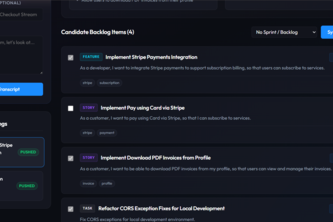
- Convert planning conversations (meeting transcripts) into structured backlog items.
- Sync those items to existing boards such as Azure Boards or Jira.
- Run simple, repeatable retrospectives using a “stress script” and AI-generated summaries with action items.
It includes two main flows:
- Meeting to Backlog: Transcripts are processed to extract decisions, risks, and candidate backlog items that can be edited and synced to boards.
- Sprint to Retro: Sprint metrics and team feedback (via a stress script) are combined into retro summaries with suggested actions.
The system is described as sitting next to existing tools and not replacing them, aiming for minimal process overhead.
Evidence
- The author states that the tool uses LLMs like GPT-5.6 to summarize discussions and extract structured items.
- It integrates with Azure Boards and Jira via REST APIs.
- It supports a “lightweight” developer-first approach.
- It is built using FastAPI, React, Python, SQLite, and various LLMs.
Inference The tool appears to be a prototype or proof-of-concept rather than a production-ready product. The architecture and stack suggest it's designed for rapid iteration and demo purposes.
Positioning & Claim Evolution
The author positions The RP as a solution to a common problem in dev teams: the disconnect between planning conversations and actual work items on boards, and the lack of useful retrospectives.
Claims made by the author
- Teams have great tools for coding but clumsy tools for turning conversations into actionable work.
- Planning meetings often end up as long notes or half-remembered summaries.
- Retros become a formality instead of a feedback loop.
- The RP aims to keep planning, execution, and reflection in sync without adding heavy process.
Evolution of the claim
- The idea evolved from identifying a gap between conversation and structured work.
- It was framed as a lightweight, developer-first tool that sits alongside existing tools.
- It emphasizes automation of mundane tasks while preserving team control over decisions.
Evidence
- The author describes the inspiration behind the project as solving a real problem in dev workflows.
- The goal is to make planning, execution, and retrospectives more aligned through automation.
Inference The positioning suggests an intent to build a tool that improves developer productivity by reducing admin and aligning teams on work items and outcomes. However, no evidence of actual usage or impact beyond the hackathon exists.
Target Customer & ICP
The description states that The RP is aimed at developer-first teams, particularly those using tools like Azure Boards or Jira for planning and execution.
Claims made by the author
- It targets modern dev teams who already use boards but struggle with converting conversations into structured work.
- It’s designed for lightweight, repeatable workflows.
- It supports a “developer-first” approach.
Evidence
- The tool integrates with Azure Boards and Jira.
- It is built using technologies familiar to developers (FastAPI, React, Python).
- The author mentions that it helps teams keep planning, execution, and reflection in sync — implying a focus on agile development teams.
Inference The ICP likely includes small to mid-sized software teams working in agile environments, especially those already invested in Jira or Azure DevOps. However, no explicit segmentation or customer data is provided.
Business Model & Pricing Evidence
There is no evidence of any business model or pricing structure in the description.
Evidence
- The author does not mention revenue streams, licensing models, or pricing tiers.
- No information is given about monetization, subscriptions, or usage-based billing.
Inference The project is a hackathon submission and lacks commercial viability details. It’s unclear whether this will ever become a paid product or how it would be monetized.
Technical & Delivery Signals
The author provides a detailed technical breakdown of the architecture and stack used:
Stack
- Backend: Python with FastAPI
- Frontend: React with TypeScript
- Database: SQLite with SQLAlchemy
- LLMs: GPT-5.6, Codex (used for coding assistance)
- Integrations: REST API integrations with Azure Boards and Jira
Features implemented
- Transcript ingestion and analysis pipeline
- Backlog item creation and editing
- Syncing to boards
- Sprint metrics and retro analytics
- Stress script input and aggregation
Evidence
- The author describes how the system works end-to-end, including data flow and integration points.
- It uses JSON validation and schema-based outputs for reliability.
Inference The tool is built with a simple but functional architecture suitable for a prototype. It shows awareness of LLM limitations and uses guardrails like JSON schemas to improve output quality.
Traction & Maturity Signals
There is no evidence of traction or maturity beyond the hackathon submission.
Evidence
- The project was submitted to the OpenAI 2026 hackathon.
- No mention of users, customers, revenue, or adoption metrics.
- No data on usage frequency, retention, or product performance in real-world settings.
Inference This is a prototype or proof-of-concept. There are no signs of product-market fit or commercial traction.
Competitive Context
The description does not provide any information about competitors or the competitive landscape.
Evidence
- No mention of existing tools or platforms that do similar things.
- No comparison to other planning, backlog management, or retrospective tools.
Inference It’s unclear whether The RP competes with tools like Jira, Azure Boards, Notion, or others in this space. The author does not reference any competitive positioning or differentiation strategy.
Open Questions & Risks
Several key risks and open questions emerge from the self-reported description:
- No traction or commercial viability: It is a hackathon project with no evidence of real-world usage.
- Unproven LLM reliability: While it uses LLMs, there’s no indication of how well they perform in practice or whether they are robust enough for production use.
- Limited integration depth: The tool integrates via REST APIs but lacks details on error handling, scalability, or support for complex workflows.
- No pricing or monetization model: No indication of how the product would be sold or monetized.
- Single-person team: The project is built by one person (David Maila), which raises questions about scalability and long-term maintenance.
Inference The tool may not be ready for commercial deployment, and its success depends heavily on whether it can evolve beyond a hackathon prototype.
Questions the description leaves open
- What is the actual user feedback or testing done with real teams?
- How does the system handle ambiguity in meeting transcripts? Are there fallbacks or manual overrides?
- Has the team considered how to scale integrations across different board tools (e.g., Confluence, Trello)?
- Is there a plan for monetization or long-term product strategy beyond this prototype?
- What are the limitations of GPT-5.6 in handling real-world meeting data and generating accurate backlog items?
- How does the tool ensure consistency across multiple steps in the analysis pipeline?
Overall Assessment
Not evidenced
The description provides no information about:
- Revenue or customer base
- Product-market fit or traction
- Financials or funding history
- Team experience or track record
- Strategic partnerships or market positioning
This is a hackathon project with no commercial evidence. The author states that it was submitted to the OpenAI 2026 hackathon and does not include any data on adoption, usage, or business development.
Confidence Level Low The entire analysis rests on self-reported claims without external validation. There is no indication of product maturity, traction, or commercial viability beyond a prototype.
User Stories BotA demo video on every pull request
Get a demo video on every new feature
GitHub App that watches your pull requests and records a narrated, captioned demo.
Save time on demo prep and make informed decisions faster with a video walkthrough of every new feature.
Source
Submitted to the OpenAI 2026 hackathon on Devpost. Project home on Devpost. Back to the full gallery on Devpost.
This competitive analysis was produced by top-founders.com (opens in a new tab)
Generated by a language model from this project's public Devpost page — its tagline, the author's own write-up and any built-with tags listed there — as captured in August 2026. Short quotations are the author's words. It is an opinion on the idea as a business, not on the people behind it, and it reflects the description as published then. If the project has moved on, request a correction below. The analysis is not independent research and contains no verified traction, revenue or customer data.
An independent guide by KFG International LLC — not affiliated with, endorsed by, or connected to Devpost or OpenAI.