

Archive position — measured, not model output
0 likes on Devpost
2,263 of the 7,850 archived projects have more likes, and 5,587 share exactly 0 — so this project's #7,248 place in the like-ranked listing is a tie-break inside that group, not a ranking.
Projects (log scale)
Likes on Devpost. ▲ marks this project's group.
Show the figures
| Likes | Projects | Share of archive |
|---|---|---|
| 0 | 5,587 | 71.2% |
| 1 | 1,758 | 22.4% |
| 2 | 284 | 3.6% |
| 3–4 | 132 | 1.7% |
| 5–9 | 75 | 1.0% |
| 10+ | 14 | 0.2% |
 User Stories BotA demo video on every pull request
Get a demo video on every new feature
GitHub App that watches your pull requests and records a narrated, captioned demo.
Save time on demo prep and make informed decisions faster with a video walkthrough of every new feature.
Executive Summary
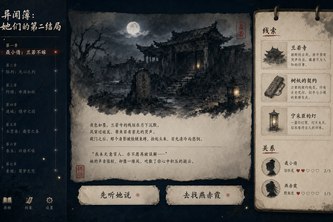
The Second Ending: Nie Xiaoqian is a self-reported interactive mystery game built as a hackathon project using React, Vite, Cloudflare, and GPT-5.6. The description states it is a Chinese narrative experience where players investigate clues and make choices that influence the story's outcome. It uses AI to analyze player theories but does not allow AI to override character agency or alter the ending.
The project appears to be an experimental, single-person creative endeavor focused on narrative design and AI integration in interactive media. The author claims to have used GPT-5.6 for structured analysis of player evidence, with deterministic fallbacks when AI is unavailable.
The most important open question
What is the actual scope of the AI's role in the game? The description states that GPT-5.6 analyzes player theories but cannot invent clues or alter endings — yet it remains unclear how much of the narrative structure and logic is actually driven by AI versus human design.
What The Product Actually Is
The description states:
- It is a Chinese interactive mystery for mobile and desktop browsers.
- It has three acts, with ten clues, consequential choices, and four possible endings.
- Players collect clues, make decisions, and reach one of four endings.
- At the end of Act II, players select clues and write theories that are analyzed by GPT-5.6.
- The game uses React + Vite, with data-driven story nodes, local browser saves, a clue notebook, branching state, and four ending rules.
- A Cloudflare Worker sends selected clue texts and player theories to OpenAI/GPT-5.6-luna through OpenRouter.
- Structured responses are validated before use; if the model is unavailable, a deterministic local review keeps the chapter playable.
The product is described as a web-based interactive narrative, not a commercial SaaS or marketplace.
Positioning & Claim Evolution
The description states:
- The game reimagines a public-domain Chinese tale from Strange Tales from a Chinese Studio through a female-centered lens.
- Xiaoqian is portrayed as a witness to her own coercion, not a victim or player-selected route.
- It emphasizes agency, trust, and entanglement as narrative elements that affect outcomes.
- The game uses AI to support player reasoning, but not to control the story's direction.
- The author frames it as an experiment in AI integration without authorial control.
The positioning is self-described as a narrative-driven interactive experience with a strong thematic focus on female agency and narrative autonomy. It positions itself as a creative tool for storytelling, not a commercial product or platform.
Target Customer & ICP
The description states:
- The game is an interactive mystery for mobile and desktop browsers.
- It is built for players interested in Chinese folklore, narrative choice, and interactive media.
- The author mentions that the game explores themes of coercion, freedom, and agency, suggesting a target audience interested in deep narrative experiences.
There is no evidence of a defined customer segment beyond general interest in interactive storytelling or Chinese literature. No data on demographics, usage patterns, or monetization strategies are provided.
Business Model & Pricing Evidence
The description states:
- The project was submitted to the OpenAI 2026 hackathon.
- It is a self-contained web app, not a commercial product.
- No pricing model, revenue streams, or monetization strategy are mentioned.
- The game is described as a public build that can be played online.
There is no evidence of any business model or pricing structure. The project appears to be a creative prototype, not a commercial offering.
Technical & Delivery Signals
The description states:
- Built with React + Vite.
- Uses Cloudflare Worker for sending data to GPT-5.6-luna.
- AI is used to analyze player theories, but responses are validated before use.
- If the model is unavailable, a deterministic local fallback ensures gameplay continues.
- The system includes data-driven story nodes, local browser saves, and branching state logic.
The technical architecture suggests a lightweight, browser-based interactive experience with AI integration for narrative support. It shows an awareness of AI limitations and deterministic fallbacks, which may indicate thoughtful design.
Traction & Maturity Signals
The description states:
- The project was submitted to the OpenAI 2026 hackathon.
- It is a public build available for players to try online.
- No evidence of user engagement, retention, or usage metrics is provided.
- The project is described as a single-person effort, with no mention of team size beyond one.
There is no evidence of traction, adoption, or user feedback. It appears to be an early-stage prototype or proof-of-concept.
Competitive Context
The description states:
- It is a Chinese interactive mystery reimagining a public-domain tale.
- The game uses AI for narrative support, not as a replacement for human storytelling.
- No direct competitors are named or described.
There is no evidence of a competitive landscape or market positioning beyond the author’s own claims.
Open Questions & Risks
The description states:
- It is a single-person project with no team size beyond one person.
- The AI is used in a limited, constrained way, but it's unclear how much of the narrative logic is AI-driven.
- No evidence of monetization or scalability.
Key risks include:
- Lack of team or organizational support for long-term development or commercialization.
- Unclear AI integration scope — whether the AI is used in core gameplay or just as a tool.
- No evidence of user engagement, feedback, or traction, which makes it hard to assess viability.
Questions the description leaves open
- What is the exact role of GPT-5.6 in shaping the narrative? Is it used for generating content, analyzing player input, or just validating choices?
- How many people are involved in development beyond the single founder?
- Are there any plans to monetize this experience or scale it beyond a prototype?
- What is the intended user base and how would you measure success?
- How does the deterministic fallback work in practice, and what happens if the AI fails consistently?
Overall Assessment
The description states:
- It is a hackathon submission, not a commercial product.
- No evidence of revenue, customers, or traction exists.
- The project is described as a creative experiment with a strong thematic focus.
This is a conceptual prototype with no demonstrated commercial viability or market traction. It may be an interesting creative endeavor but lacks the elements typically considered for investment or partnership — such as user engagement, scalability, or monetization strategy.
Assessment Not evidenced as a viable commercial opportunity. The project is best described as a narrative experiment, not a product ready for investment or partnership.
User Stories BotA demo video on every pull request
Get a demo video on every new feature
GitHub App that watches your pull requests and records a narrated, captioned demo.
Save time on demo prep and make informed decisions faster with a video walkthrough of every new feature.
Source
Submitted to the OpenAI 2026 hackathon on Devpost. Project home on Devpost. Back to the full gallery on Devpost.
This competitive analysis was produced by top-founders.com (opens in a new tab)
Generated by a language model from this project's public Devpost page — its tagline, the author's own write-up and any built-with tags listed there — as captured in August 2026. Short quotations are the author's words. It is an opinion on the idea as a business, not on the people behind it, and it reflects the description as published then. If the project has moved on, request a correction below. The analysis is not independent research and contains no verified traction, revenue or customer data.
An independent guide by KFG International LLC — not affiliated with, endorsed by, or connected to Devpost or OpenAI.