

Archive position — measured, not model output
0 likes on Devpost
2,263 of the 7,850 archived projects have more likes, and 5,587 share exactly 0 — so this project's #3,315 place in the like-ranked listing is a tie-break inside that group, not a ranking.
Projects (log scale)
Likes on Devpost. ▲ marks this project's group.
Show the figures
| Likes | Projects | Share of archive |
|---|---|---|
| 0 | 5,587 | 71.2% |
| 1 | 1,758 | 22.4% |
| 2 | 284 | 3.6% |
| 3–4 | 132 | 1.7% |
| 5–9 | 75 | 1.0% |
| 10+ | 14 | 0.2% |
 User Stories BotA demo video on every pull request
Get a demo video on every new feature
GitHub App that watches your pull requests and records a narrated, captioned demo.
Save time on demo prep and make informed decisions faster with a video walkthrough of every new feature.
Executive Summary
What the company appears to be
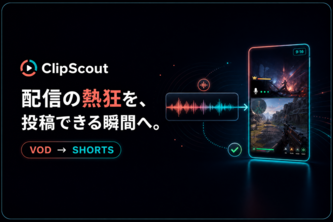
ClipScout is a self-reported tool for livestream creators that processes Twitch, YouTube, and Kick VODs into ranked, editable highlights using audio peaks, chat surges, and GPT-5.6. It allows creators to preview and edit clips in 16:9 or 9:16 formats before exporting as MP4.
What changed
The project was submitted as part of the OpenAI 2026 hackathon. It is described as a proof-of-concept with a built-in judge demo, deterministic signal processing, and AI-assisted editorial curation.
Single most important open question
Is there any evidence of traction, revenue, or customer adoption beyond the author’s self-reported description?
Note
This analysis is based solely on the self-reported project description provided by the caller. No independent verification, archived data, or third-party sources are available. All claims are treated as stated by the author and not proven.
What The Product Actually Is
The description states that ClipScout:
- Converts long Twitch, YouTube, and Kick VODs into ranked, editable highlights
- Uses audio peaks, chat surges, and GPT-5.6 for discovery
- Offers three modes: audio peaks, comment surges, hybrid
- Displays evidence behind each candidate highlight instead of black-box recommendations
- Generates editorial titles, explanations, hooks, and categories using GPT-5.6
- Allows creators to preview and edit clips in 16:9 or 9:16 formats
- Supports pan/zoom in gameplay region and free resizing of streamer region
- Exports final MP4s for platforms like YouTube Shorts, TikTok, Twitch
Inference The product is a video editing tool that leverages AI and signal processing to automate highlight creation from livestream footage.
Positioning & Claim Evolution
The description states:
- ClipScout addresses the problem of buried moments in livestreams
- It positions itself as a tool that makes discovery fast while keeping editorial control with creators
- It claims to avoid black-box recommendations and instead show evidence behind each moment
- The tool is described as a “complete judge demo” requiring no account or VOD access
Inference ClipScout positions itself as an AI-enhanced, creator-controlled highlight editor for livestream content. It evolved from a hackathon project into a potential subscription service.
Target Customer & ICP
The description states:
- The target is livestream creators
- It supports Twitch, YouTube, and Kick VODs
- It is designed to become a creator subscription service with usage-based video processing
Inference The primary customer segment is content creators who stream on Twitch, YouTube, or Kick. The tool is positioned for those who want to repurpose their VODs into short-form clips.
Business Model & Pricing Evidence
The description states:
- ClipScout is designed to become a creator subscription service
- It will have a limited free tier and usage-based video processing
- It plans to add processing credits, saved layouts, brand presets, and direct publishing integrations
Inference The business model is likely usage-based with a freemium structure. No pricing or revenue data are provided.
Technical & Delivery Signals
The description states:
- Built with React, TypeScript, FastAPI, yt-dlp, FFmpeg, GPT-5.6
- Uses Codex for engineering and product design during the OpenAI Build Week
- Media ingestion, audio analysis, and video rendering handled by a FastAPI worker
- Frontend hosted on OpenAI Sites, media worker on Google Cloud Run
- API credentials are server-side and not exposed in the browser
- GPT-5.6 returns structured results including semantic highlight score, editorial title, explanation, hook, and moment category
- Supports deterministic pipeline with fallback to AI if unavailable
Inference The tool is built using modern stack components, with a clear separation of frontend, backend, and AI layers. It includes server-side security and deterministic fallbacks.
Traction & Maturity Signals
The description states:
- A complete judge demo is included
- The project was submitted to the OpenAI 2026 hackathon
- No mention of revenue, customers, or adoption beyond the author’s own account
Inference There is no evidence of traction, revenue, or customer base. The tool is described as a prototype.
Competitive Context
The description does not provide any information about competitors or market positioning beyond self-reporting.
Not evidenced
Open Questions & Risks
- No evidence of revenue, customers, or adoption
- GPT-5.6 is described as gpt-5.6-sol — a non-standard model name
- The tool is presented as a hackathon submission with no indication of commercial viability or product-market fit
- No mention of platform restrictions or licensing issues for VOD processing
- The team size is listed as 1, suggesting limited development capacity
Inference The project lacks commercial traction and may be in early-stage prototype form.
Questions the description leaves open
- What is the current stage of development beyond the hackathon submission?
- Are there any existing users or pilot customers?
- How does ClipScout handle content rights and platform restrictions for VODs?
- Is there a plan to monetize the tool beyond usage-based credits?
- What are the technical limitations of processing VODs from different platforms?
- How is the AI model (gpt-5.6-sol) validated or tested in real-world use cases?
Overall Assessment
The description states that ClipScout is a hackathon submission and is designed to become a creator subscription service.
Not evidenced
There is no evidence of traction, revenue, or customer adoption. The tool appears to be a prototype with no commercial validation. The business model is speculative and not demonstrated.
Confidence Low — based on self-reported description only.
User Stories BotA demo video on every pull request
Get a demo video on every new feature
GitHub App that watches your pull requests and records a narrated, captioned demo.
Save time on demo prep and make informed decisions faster with a video walkthrough of every new feature.
Source
Submitted to the OpenAI 2026 hackathon on Devpost. Project home on Devpost. Back to the full gallery on Devpost.
This competitive analysis was produced by top-founders.com (opens in a new tab)
Generated by a language model from this project's public Devpost page — its tagline, the author's own write-up and any built-with tags listed there — as captured in August 2026. Short quotations are the author's words. It is an opinion on the idea as a business, not on the people behind it, and it reflects the description as published then. If the project has moved on, request a correction below. The analysis is not independent research and contains no verified traction, revenue or customer data.
An independent guide by KFG International LLC — not affiliated with, endorsed by, or connected to Devpost or OpenAI.