

Archive position — measured, not model output
0 likes on Devpost
2,263 of the 7,850 archived projects have more likes, and 5,587 share exactly 0 — so this project's #7,234 place in the like-ranked listing is a tie-break inside that group, not a ranking.
Projects (log scale)
Likes on Devpost. ▲ marks this project's group.
Show the figures
| Likes | Projects | Share of archive |
|---|---|---|
| 0 | 5,587 | 71.2% |
| 1 | 1,758 | 22.4% |
| 2 | 284 | 3.6% |
| 3–4 | 132 | 1.7% |
| 5–9 | 75 | 1.0% |
| 10+ | 14 | 0.2% |
 User Stories BotA demo video on every pull request
Get a demo video on every new feature
GitHub App that watches your pull requests and records a narrated, captioned demo.
Save time on demo prep and make informed decisions faster with a video walkthrough of every new feature.
Executive Summary
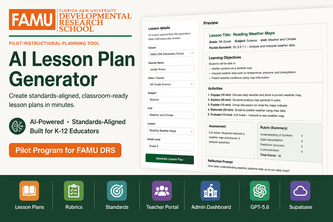
The description states that "The Lesson Plan Generator" is an AI-powered platform for K-12 teachers, intended to create standards-aligned lessons and provide administrators with a centralized dashboard. The project was submitted to the OpenAI 2026 hackathon by a single founder, bfdtally White. No evidence of revenue, customers, or product usage exists in the description. The author declares use of ChatGPT, Codex, GitHub, Render, and Supabase for development.
What Changed
This is a self-reported project submitted to a hackathon; there is no indication of prior development or commercial activity.
Most Important Open Question
Is this a prototype or a product in development? The description does not clarify whether the platform is functional or merely conceptual.
What The Product Actually Is
The description states that "The Lesson Plan Generator" is an AI-powered lesson planning platform for K-12 teachers. It claims to create standards-aligned lessons and offers administrators a centralized dashboard to manage and support instruction.
Evidence
- The project name, tagline, and author's own write-up describe the product as an AI-powered lesson planning tool.
- The author states that it is built with ChatGPT, Codex, GitHub, Render, and Supabase.
Inference
- The platform appears to be a web-based application, likely using AI for content generation and possibly integrating with educational standards or curricula.
Positioning & Claim Evolution
The description states the product is an "AI-powered lesson planning platform for K-12 teachers that creates standards-aligned lessons and gives administrators a centralized dashboard to manage and support instruction."
Evidence
- The tagline positions the tool as serving both teachers and administrators.
- It emphasizes AI capabilities, alignment with educational standards, and centralized management.
Inference
- The positioning suggests a dual-use model: teacher-facing lesson creation and admin-facing oversight.
- No indication of how it differentiates from existing tools or whether it has evolved from an earlier version.
Target Customer & ICP
The description states that the platform is for K-12 teachers and administrators.
Evidence
- The tagline identifies K-12 teachers as primary users.
- It also mentions administrators who manage instruction.
Inference
- The target customer segment appears to be educators and school leaders in K-12 settings.
- No evidence of细分客户、用户画像或具体使用场景。
Business Model & Pricing Evidence
The description does not provide any information on pricing, monetization, or business model.
Evidence
- No mention of subscription tiers, licensing models, or revenue streams.
- No indication of whether the platform is free, paid, or subsidized.
Inference
- The project appears to be in early development; no commercial model has been described.
Technical & Delivery Signals
The description states that the product was built with ChatGPT, Codex, GitHub, Render, and Supabase.
Evidence
- The author lists these tools as part of the tech stack.
- The project is hosted on Devpost, suggesting a prototype or demo.
Inference
- The use of AI tools like ChatGPT and Codex suggests an AI-driven approach to lesson generation.
- The tech stack implies a web-based platform with backend support from Supabase and deployment via Render.
Traction & Maturity Signals
The description does not provide evidence of traction, customers, or product maturity.
Evidence
- The project was submitted to a hackathon.
- It is described as a single-person effort (team size: 1).
Inference
- No evidence of user adoption, revenue, or product iteration.
- The lack of further details suggests this is an early-stage idea or prototype.
Competitive Context
The description does not provide any information on competitors or market positioning.
Evidence
- No mention of existing platforms or tools in the K-12 education space.
- No indication of how this product compares to others.
Inference
- The competitive landscape is unknown; no evidence of prior market analysis or differentiation.
Open Questions & Risks
The description does not provide sufficient information to assess risks, but several open questions are present:
Evidence
- No revenue, customers, or usage data.
- Only one team member listed.
- Submitted to a hackathon — implies early-stage development.
- No mention of product functionality or user feedback.
Inference
- The lack of traction and commercialization suggests high risk.
- The single-founder model may limit scalability or execution capability.
- No evidence of product-market fit or real-world testing.
Questions the description leaves open
- What is the current state of the product? Is it functional, a prototype, or conceptual?
- How does the AI-generated content align with educational standards?
- Have you tested the platform with actual teachers or administrators?
- What are your plans for monetization and scaling?
- Are there any existing partnerships or pilot programs in place?
Overall Assessment
The description states that this is a project submitted to the OpenAI 2026 hackathon by one founder, bfdtally White.
Evidence
- No evidence of traction, revenue, or product adoption.
- The project appears to be early-stage and unproven.
Inference
- This is not a viable investment or partnership opportunity at this stage.
- The lack of commercial evidence and user feedback makes it difficult to assess viability.
Confidence Level Low. The description provides no evidence of product-market fit, revenue, or customer traction.
User Stories BotA demo video on every pull request
Get a demo video on every new feature
GitHub App that watches your pull requests and records a narrated, captioned demo.
Save time on demo prep and make informed decisions faster with a video walkthrough of every new feature.
Source
Submitted to the OpenAI 2026 hackathon on Devpost. Project home on Devpost. Back to the full gallery on Devpost.
This competitive analysis was produced by top-founders.com (opens in a new tab)
Generated by a language model from this project's public Devpost page — its tagline and any built-with tags listed there, since the author published no write-up — as captured in August 2026. Short quotations are the author's words. It is an opinion on the idea as a business, not on the people behind it, and it reflects the description as published then. If the project has moved on, request a correction below. The analysis is not independent research and contains no verified traction, revenue or customer data.
An independent guide by KFG International LLC — not affiliated with, endorsed by, or connected to Devpost or OpenAI.