

Archive position — measured, not model output
1 like on Devpost
505 of the 7,850 archived projects have more likes, and 1,758 share exactly 1 — so this project's #1,347 place in the like-ranked listing is a tie-break inside that group, not a ranking.
Projects (log scale)
Likes on Devpost. ▲ marks this project's group.
Show the figures
| Likes | Projects | Share of archive |
|---|---|---|
| 0 | 5,587 | 71.2% |
| 1 | 1,758 | 22.4% |
| 2 | 284 | 3.6% |
| 3–4 | 132 | 1.7% |
| 5–9 | 75 | 1.0% |
| 10+ | 14 | 0.2% |
 User Stories BotA demo video on every pull request
Get a demo video on every new feature
GitHub App that watches your pull requests and records a narrated, captioned demo.
Save time on demo prep and make informed decisions faster with a video walkthrough of every new feature.
Executive Summary
What the company appears to be
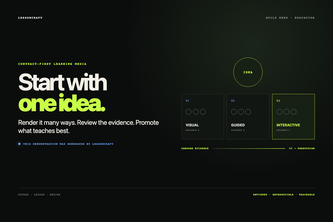
Lessoncraft is a self-reported tool that converts educational ideas into reviewable, browser-rendered video experiences using AI and automation. It allows users to define courses, lessons, and visual support (HTML, SVG, Canvas, WebGL), then renders those into HD videos via a browser-based engine. The system uses AI for narration synthesis and caption generation, with an emphasis on deterministic rendering and reproducibility.
What changed
The author describes building this tool during a hackathon to solve personal pain points in video creation for training platforms—specifically avoiding camera recording, editing, or expensive AI tools. It evolved from an experimental idea into a prototype that supports browser-based video production with minimal user involvement.
Single most important open question
Is there any evidence of actual usage, adoption, or revenue beyond the author's own demonstration and internal testing?
What The Product Actually Is
The description states that Lessoncraft turns one educational idea into many reviewable video experiences. It operates at three levels:
- Course: defines audience, narration language, and visual identity.
- Lesson: defines video content.
- Engine: renders lesson visuals in a browser and exports them as HD videos.
It uses Node.js for its production engine and Playwright to capture frames from the browser. FFmpeg encodes those frames into video-only masters; OpenAI is used for narration synthesis, though this can be replaced. The system supports HTML, SVG, Canvas, WebGL, or other browser-compatible technologies for visual rendering.
The author notes that each lesson exposes a small browser contract:
```js
window.__LESSON_READY__ = true;
window.__LESSON_PLAYER__.renderAt(timeMilliseconds, frameIndex);
```
This enables Playwright to request specific timestamps and frame indices from the browser, which are then encoded into video. Audio is mastered separately into WAV format, captions are generated in WebVTT, and audio/video are muxed together.
Codex and GPT-5.6 were used for architectural reasoning and implementation.
Inference: The tool appears to be a prototype or early-stage product designed for internal use or demonstration rather than commercial deployment.
Positioning & Claim Evolution
The tagline says: “Lessoncraft turns one educational idea into many reviewable video experiences, helping educators find better ways to teach while making content faster and much much more affordable to produce.”
This positions Lessoncraft as a tool that streamlines video creation for educators by reducing production costs and time. It claims to help users generate multiple versions of the same lesson efficiently.
The author’s write-up shows an evolution from trying to make videos manually, using AI tools (which were expensive), to building a system that automates the process using browser rendering and AI narration.
Claim: The product aims to democratize video creation for education by lowering barriers through automation and AI.
Inference: There is no evidence of market positioning beyond personal experimentation or hackathon use. No competitors, pricing, or target segment are mentioned.
Target Customer & ICP
The description states that Lessoncraft helps educators find better ways to teach and makes content faster and more affordable to produce. It also mentions that the system supports multiple languages and can adjust timing for different vocal rhythms.
However, there is no explicit mention of:
- Specific customer personas
- Educational institutions or platforms it targets
- Whether it's aimed at individual teachers or corporate training teams
Inference: Based on the author’s personal motivation (training platform), it seems likely that educators or instructional designers are the primary audience. But this remains unconfirmed.
Business Model & Pricing Evidence
There is no evidence in the description of:
- Revenue streams
- Pricing models
- Monetization strategy
- Subscription plans or licensing terms
The author describes building a tool for personal use and hackathon demonstration, not for sale or commercial deployment.
Inference: No business model has been established or communicated beyond the author’s own usage.
Technical & Delivery Signals
The system uses:
- Node.js engine with command-line workflow
- Chromium-based browser rendering via Playwright
- FFmpeg for video encoding
- OpenAI speech adapter for narration (replaceable)
- Codex and GPT-5.6 for architecture design
- WebVTT for captions
- Deterministic rendering using timestamps and frame indices
It supports HTML, SVG, Canvas, WebGL, or other browser-compatible technologies.
Key technical features include:
- Course isolation to avoid accidental defaults
- Browser rendering that is independent of visual technology used in lessons
- Narration decoupling from rendering pipeline
- Bit-for-bit verification between pre- and post-muxing media
Inference: The tool shows strong engineering effort around reproducibility, modularity, and deterministic behavior. However, no evidence exists regarding scalability, performance metrics, or real-world usage.
Traction & Maturity Signals
The description includes:
- A Build Week demonstration video
- Demos created with Lessoncraft
- Internal testing and iteration
- Use of AI for architecture design (Codex, GPT-5.6)
But there is no evidence of:
- Customers or users
- Revenue or monetization
- Adoption metrics
- Product-market fit validation
- Market traction beyond the author’s own use
Inference: This appears to be a prototype or proof-of-concept with limited external validation.
Competitive Context
There is no mention in the description of:
- Competitors in the educational video creation space
- Similar tools or platforms
- Market analysis or differentiation strategy
The author does not reference existing solutions like Lumen5, Pictory, or any other AI-powered video creation tools.
Inference: No competitive landscape has been described. The tool may be unique or niche, but this cannot be confirmed from the provided information.
Open Questions & Risks
- No traction or revenue: The entire description is self-reported and lacks evidence of real-world adoption.
- Unverified claims: All assertions about usefulness, efficiency, or cost savings are based on author experience alone.
- Limited scope: The tool appears to be a hackathon prototype with no indication of commercial viability or scalability.
- Unclear business model: No monetization strategy is evident.
- Dependency on AI instability: The author notes that AI outputs aren’t idempotent, which introduces risk in reproducibility and consistency.
Questions the description leaves open
- What specific problems are you solving for educators or instructional designers?
- Have you tested Lessoncraft with actual users or institutions?
- How do you plan to scale beyond the current prototype?
- Is there a monetization model in mind, and how does it align with your target customer’s willingness to pay?
- What are the technical limitations of the browser-based rendering approach at scale?
- Can you demonstrate real-world usage or feedback from early adopters?
Overall Assessment
Not evidenced.
There is no evidence of:
- Revenue
- Customers
- Traction
- Market validation
- Financials
- Team expansion beyond one person
- Product-market fit
The description is entirely self-reported and unverified. It describes a prototype or hackathon project with strong technical execution but no indication of commercial readiness or market demand.
Confidence level: Low. This is a very early-stage idea, possibly a proof-of-concept, not a viable product or business yet.
User Stories BotA demo video on every pull request
Get a demo video on every new feature
GitHub App that watches your pull requests and records a narrated, captioned demo.
Save time on demo prep and make informed decisions faster with a video walkthrough of every new feature.
Source
Submitted to the OpenAI 2026 hackathon on Devpost. Project home on Devpost. Back to the full gallery on Devpost.
This competitive analysis was produced by top-founders.com (opens in a new tab)
Generated by a language model from this project's public Devpost page — its tagline, the author's own write-up and any built-with tags listed there — as captured in August 2026. Short quotations are the author's words. It is an opinion on the idea as a business, not on the people behind it, and it reflects the description as published then. If the project has moved on, request a correction below. The analysis is not independent research and contains no verified traction, revenue or customer data.
An independent guide by KFG International LLC — not affiliated with, endorsed by, or connected to Devpost or OpenAI.