

Archive position — measured, not model output
1 like on Devpost
505 of the 7,850 archived projects have more likes, and 1,758 share exactly 1 — so this project's #1,349 place in the like-ranked listing is a tie-break inside that group, not a ranking.
Projects (log scale)
Likes on Devpost. ▲ marks this project's group.
Show the figures
| Likes | Projects | Share of archive |
|---|---|---|
| 0 | 5,587 | 71.2% |
| 1 | 1,758 | 22.4% |
| 2 | 284 | 3.6% |
| 3–4 | 132 | 1.7% |
| 5–9 | 75 | 1.0% |
| 10+ | 14 | 0.2% |
 User Stories BotA demo video on every pull request
Get a demo video on every new feature
GitHub App that watches your pull requests and records a narrated, captioned demo.
Save time on demo prep and make informed decisions faster with a video walkthrough of every new feature.
Executive Summary
What the company appears to be
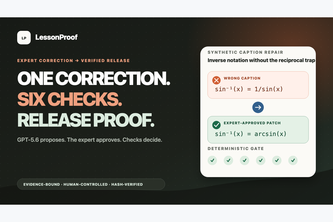
LessonProof is a self-reported tool that uses GPT-5.6 to propose edits for content before release, with human approval and automated code checks. It was built as a Build Week project by one developer (Demid Valiullin) in response to a personal mistake in Russian-language math video production.
What changed
The author describes transforming an ad-hoc correction process into a structured workflow involving AI-assisted editing, human review, and automated validation. The tool is presented as a way to verify changes before publication using GPT-5.6 for suggestions and code checks for compliance.
Single most important open question
Is there any evidence of external adoption or traction beyond the author’s own use case? The description does not indicate whether others are using LessonProof, nor does it provide data on usage volume, revenue, or customer feedback.
What The Product Actually Is
The description states that LessonProof:
- Checks one correction before a release goes public.
- Allows a reviewer to write what needs to change and add evidence.
- Uses GPT-5.6 to turn this note into a proposed edit.
- Shows the quote, source, and exact before/after text.
- Requires human approval of the exact change.
- Applies the change via code and runs six checks.
- Records verified releases with a new proof hash.
- Checks current release hash and two dependency records.
- Prevents reuse of old proposals if files change.
- Includes undo functionality with similar checks.
The system is described as being built using:
- React, Vite, TypeScript
- Node.js service for OpenAI key management
- OpenAI GPT-5.6 Sol via Responses API
- Zod for parsing responses
- Codex for most implementation (project structure, code, tests)
Inference The tool appears to be a prototype or proof-of-concept built in about six hours by one person, with significant manual direction from the author.
Positioning & Claim Evolution
The description states:
- The product was inspired by a mistake made during video production.
- It evolved from a personal workflow into a standalone project.
- The tagline is: “GPT-5.6 proposes the fix. A human approves it. Code checks the release.”
- The author mentions wanting to connect LessonProof back to subtitles, documents, or course packages.
Inference The positioning seems to be around AI-assisted content verification and correction workflows, particularly for educational or media production contexts. It is not yet positioned as a commercial product or platform with a defined market.
Target Customer & ICP
The description states:
- The author’s own use case involves Russian-language math videos on Telegram.
- The public demo uses an English example involving sin⁻¹(x) and arcsine.
- The author wants to extend the tool to “subtitles first, then perhaps documents or course packages.”
Inference The target customer appears to be content creators (especially educators), but there is no evidence of a defined ICP beyond the author’s personal experience. No specific personas, segments, or markets are described.
Business Model & Pricing Evidence
Not evidenced.
The description does not mention:
- Revenue streams
- Pricing models
- Monetization strategy
- Customer acquisition plans
- Any commercial intent or pricing structure
Technical & Delivery Signals
The description states:
- Built with React, Vite, TypeScript.
- Node.js backend for OpenAI key handling.
- Uses OpenAI GPT-5.6 Sol via Responses API.
- Zod parses model responses.
- Validator checks against current release.
- Includes session and request limits.
- Public demo works without login or API key.
- Has 42 tests (including interface, release engine, API, etc.)
- Interface uses a “Proof Ledger” design.
- Demo video shows one caption fixed, two dependency proofs recomputed, six of six checks passed.
Inference The technical stack is standard for modern web apps. The tool includes basic security and validation features (session boundaries, hash checking). It is presented as a working prototype with some edge-case handling.
Traction & Maturity Signals
Not evidenced.
The description does not contain:
- Customer data
- Usage metrics
- Revenue figures
- Adoption beyond the author’s own use case
- Product roadmap or future development plans
- Any evidence of traction, growth, or user feedback
Competitive Context
Not evidenced.
The description does not mention:
- Competitors
- Market positioning
- Differentiation from existing tools
- Industry trends or gaps in the market
Open Questions & Risks
Risk 1
The tool is described as a personal Build Week project with no evidence of external adoption. This raises questions about scalability, commercial viability, and real-world demand.
Risk 2
The author states that GPT-5.6 only prepares the proposal but cannot approve or publish it — this implies limited autonomy in the process, which may not scale well for complex workflows.
Risk 3
There is no indication of how the tool would integrate into existing systems or whether it supports multiple users or teams.
Risk 4
The project was submitted to a hackathon and is described as “first public software project” — this suggests early-stage development with limited maturity.
Questions the description leaves open
- What external feedback or use cases have you gathered beyond your own?
- How does the tool handle multi-user collaboration or team workflows?
- Are there any plans to monetize or commercialize the product?
- What are the technical limitations of relying on GPT-5.6 for content correction?
- Have you considered how this would scale for larger, more complex content systems?
- Is there a plan to support other types of content beyond subtitles?
Overall Assessment
Not evidenced.
The description does not provide:
- Financials
- Market opportunity
- Team traction or experience
- Strategic fit or alignment with investor goals
- Any indication of commercial readiness or potential for growth
Conclusion
This is a self-reported, unverified prototype built by one individual. There is no evidence of traction, revenue, or customer adoption. The tool may be an interesting concept but lacks the commercial due-diligence signals necessary to assess its viability as an investment or partnership opportunity.
User Stories BotA demo video on every pull request
Get a demo video on every new feature
GitHub App that watches your pull requests and records a narrated, captioned demo.
Save time on demo prep and make informed decisions faster with a video walkthrough of every new feature.
Source
Submitted to the OpenAI 2026 hackathon on Devpost. Project home on Devpost. Back to the full gallery on Devpost.
This competitive analysis was produced by top-founders.com (opens in a new tab)
Generated by a language model from this project's public Devpost page — its tagline, the author's own write-up and any built-with tags listed there — as captured in August 2026. Short quotations are the author's words. It is an opinion on the idea as a business, not on the people behind it, and it reflects the description as published then. If the project has moved on, request a correction below. The analysis is not independent research and contains no verified traction, revenue or customer data.
An independent guide by KFG International LLC — not affiliated with, endorsed by, or connected to Devpost or OpenAI.