

Archive position — measured, not model output
1 like on Devpost
505 of the 7,850 archived projects have more likes, and 1,758 share exactly 1 — so this project's #1,350 place in the like-ranked listing is a tie-break inside that group, not a ranking.
Projects (log scale)
Likes on Devpost. ▲ marks this project's group.
Show the figures
| Likes | Projects | Share of archive |
|---|---|---|
| 0 | 5,587 | 71.2% |
| 1 | 1,758 | 22.4% |
| 2 | 284 | 3.6% |
| 3–4 | 132 | 1.7% |
| 5–9 | 75 | 1.0% |
| 10+ | 14 | 0.2% |
 User Stories BotA demo video on every pull request
Get a demo video on every new feature
GitHub App that watches your pull requests and records a narrated, captioned demo.
Save time on demo prep and make informed decisions faster with a video walkthrough of every new feature.
Executive Summary
What the company appears to be
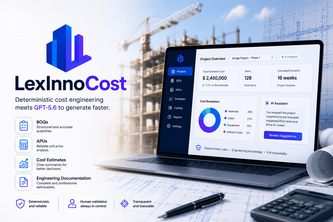
LexInnoCost is a self-reported construction cost engineering platform that integrates deterministic engineering rules with GPT-5.6 to generate faster, transparent, and reviewable Bills of Quantities (BOQs), Analysis of Unit Prices (APUs), and cost estimates. It positions itself as an AI-native tool designed to collaborate within structured engineering workflows rather than replace human judgment.
What changed
The project was initiated during a hackathon (OpenAI Build Week 2026) and is described as a prototype that has already begun evolving into a longer-term product vision. The author states they are building toward a platform that supports real-world construction projects, with plans for document ingestion, richer AI copilots, and expanded engineering knowledge modules.
Single most important open question
Is there evidence of traction or early adoption from construction professionals beyond the author’s own development efforts?
What The Product Actually Is
The description states that LexInnoCost is a platform designed to accelerate preparation of:
- Bills of Quantities (BOQs)
- Analysis of Unit Prices (APUs)
- Cost estimates
- Supporting engineering documentation
It uses a hybrid architecture where deterministic cost rules and a Domain Knowledge Base (DKB) form the foundation, while GPT-5.6 interprets requirements, structures information, and generates proposals—without replacing human review or deterministic calculations.
The system is described as not treating AI as the entire system but as one component within a broader engineering workflow.
Evidence The author's own write-up describes this architecture in detail.
Inference This suggests a tool aimed at improving efficiency in construction cost estimation through structured AI integration, rather than general-purpose AI tools or chatbots.
Positioning & Claim Evolution
The project is self-described as a hybrid deterministic-AI system for construction cost engineering. It emphasizes:
- Transparency and traceability
- Human accountability
- Collaboration with engineers instead of replacement
- Structured workflows that integrate AI into existing processes
It claims to move beyond simple text generation by embedding AI within a structured domain-specific process, aiming to become a specialized engineering agent.
The author notes that the initial idea came from frustration with manual estimation workflows and AI tools that lack integration or trustworthiness in professional settings.
Evidence The author’s own narrative explains how the product evolved from an idea rooted in real-world pain points.
Inference This positioning reflects a shift from generic AI tools toward domain-specific, trustworthy automation—though no evidence of market validation is provided.
Target Customer & ICP
The description states that LexInnoCost targets construction professionals, particularly those involved in cost estimation and engineering documentation such as civil engineers. The platform aims to support real-world projects where AI can assist with repetitive tasks while maintaining human oversight.
It also mentions a long-term vision of broader support for construction professionals, suggesting an intent to expand beyond just engineers or estimators.
Evidence The inspiration comes from a civil engineer’s experience; the product is intended for use in actual construction workflows.
Inference The ICP likely includes mid-to-senior-level construction engineers or project managers who prepare BOQs/APUs and require accuracy, transparency, and accountability.
Business Model & Pricing Evidence
There is no evidence of pricing models, monetization strategies, or business model details in the provided description. The author does not mention any revenue streams, subscription tiers, or customer acquisition methods.
Evidence Not evidenced.
Inference Since this is a hackathon submission and no commercial activity is reported, it's unclear whether any business model has been developed or tested.
Technical & Delivery Signals
The platform is built using:
- GPT-5.6
- Go (backend)
- React (frontend)
- PostgreSQL (database)
- Redis
It uses a hybrid architecture: deterministic cost engine + DKB + GPT-5.6.
The author mentions using Codex during development, treating it as an engineering partner rather than just a code generator.
They also emphasize iterative development, documentation of milestones, and Git history to maintain transparency and reproducibility.
Evidence The author lists technologies used and describes the architecture and development process.
Inference This indicates some technical sophistication and attention to software quality, though no production deployment or scalability data is shared.
Traction & Maturity Signals
There is no evidence of traction, customers, revenue, or adoption beyond the author’s own development efforts. The project is described as a hackathon submission that has since evolved into a longer-term product vision.
The author states that Build Week was only the beginning and outlines a roadmap for future features, but no current usage metrics, user feedback, or pilot programs are mentioned.
Evidence Not evidenced.
Inference The lack of traction signals suggests this is still in early development, possibly pre-product-market fit.
Competitive Context
The description does not mention competitors or direct market comparisons. It implies that existing tools do not adequately address the need for structured, trustworthy AI integration in construction cost estimation.
However, no evidence is given about:
- Who currently serves this niche
- Whether similar platforms exist
- How LexInnoCost differentiates from them
Evidence Not evidenced.
Inference The competitive landscape remains unknown, but the positioning suggests a gap in current offerings for AI-native engineering tools in construction.
Open Questions & Risks
- No traction or commercial validation: The project is described as a hackathon prototype with no evidence of real-world usage or revenue.
- Unverified claims about GPT-5.6: The author references "GPT-5.6", which may not be publicly available or accurately represented.
- Single-person team: With only one member listed, there is limited capacity for execution and scaling.
- Unclear path to monetization: No business model or pricing strategy is described.
- Lack of external validation: The entire description is self-reported with no third-party verification.
Evidence These are inferred from the lack of data in the description.
Questions the description leaves open
- What specific deterministic rules and engineering knowledge are encoded in the Domain Knowledge Base (DKB)?
- How does the system handle ambiguous or incomplete project data?
- Has the platform been tested with real construction professionals or engineers?
- What is the current status of the roadmap items (document ingestion, messaging integrations, etc.)?
- Are there any early adopters or pilots in progress?
- How do you plan to scale beyond a single developer?
- What are your plans for monetization and customer acquisition?
Overall Assessment
Not evidenced.
There is no evidence of revenue, customers, traction, or financial performance to support an investment or partnership decision.
The project appears to be in early-stage development, driven by a single founder with a strong technical background but lacking any commercial validation or market proof.
Given the self-reported nature of all information and absence of measurable outcomes, this is a high-risk, speculative opportunity with no clear commercial due-diligence basis for investment or partnership.
User Stories BotA demo video on every pull request
Get a demo video on every new feature
GitHub App that watches your pull requests and records a narrated, captioned demo.
Save time on demo prep and make informed decisions faster with a video walkthrough of every new feature.
Source
Submitted to the OpenAI 2026 hackathon on Devpost. Project home on Devpost. Back to the full gallery on Devpost.
This competitive analysis was produced by top-founders.com (opens in a new tab)
Generated by a language model from this project's public Devpost page — its tagline, the author's own write-up and any built-with tags listed there — as captured in August 2026. Short quotations are the author's words. It is an opinion on the idea as a business, not on the people behind it, and it reflects the description as published then. If the project has moved on, request a correction below. The analysis is not independent research and contains no verified traction, revenue or customer data.
An independent guide by KFG International LLC — not affiliated with, endorsed by, or connected to Devpost or OpenAI.