

Archive position — measured, not model output
1 like on Devpost
505 of the 7,850 archived projects have more likes, and 1,758 share exactly 1 — so this project's #1,348 place in the like-ranked listing is a tie-break inside that group, not a ranking.
Projects (log scale)
Likes on Devpost. ▲ marks this project's group.
Show the figures
| Likes | Projects | Share of archive |
|---|---|---|
| 0 | 5,587 | 71.2% |
| 1 | 1,758 | 22.4% |
| 2 | 284 | 3.6% |
| 3–4 | 132 | 1.7% |
| 5–9 | 75 | 1.0% |
| 10+ | 14 | 0.2% |
 User Stories BotA demo video on every pull request
Get a demo video on every new feature
GitHub App that watches your pull requests and records a narrated, captioned demo.
Save time on demo prep and make informed decisions faster with a video walkthrough of every new feature.
Executive Summary
What the company appears to be
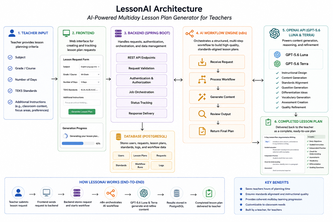
LessonPlan AI is a self-reported, teacher-built application that uses structured TEKS curriculum data and a multistep AI workflow to generate complete five-day instructional plans for Texas educators. It is described as not merely a GPT wrapper but an integrated system with backend services, curriculum pipelines, and orchestration layers powered by OpenAI.
What changed
The author states they began building this tool after years of personal use of AI for lesson planning, identifying inconsistency in outputs from single prompts. They transitioned from manual refinement of prompts to a structured, multistep AI workflow designed to produce aligned, coherent weekly lesson plans.
Single most important open question — the commercial due-diligence read
Is there evidence of real-world usage or traction by teachers? The description is entirely self-reported and lacks any data on adoption, revenue, customer base, or product-market fit beyond the author’s own experience.
What The Product Actually Is
The description states that LessonPlan AI is:
- A multistep AI system for TEKS-aligned lesson planning
- Designed to produce complete five-day instructional plans—not single lessons or weekly outlines
- Built with a Spring Boot backend, PostgreSQL storage, and OpenAI APIs
- Powered by an n8n orchestration layer and integrated curriculum data pipelines
- Not simply a GPT wrapper but a full application with structured workflows
Inference: The system appears to be a teacher-facing web application that leverages AI to automate parts of lesson planning while maintaining alignment with Texas standards.
Not evidenced: No details on UI/UX, user interface design, or how the tool is accessed beyond the mention of a “teacher-facing website.”
Positioning & Claim Evolution
The description states:
- The product aims to give teachers back their time by automating lesson planning
- It differentiates itself from other AI tools that produce only isolated lessons or weekly skeletons
- It focuses on producing fully developed, TEKS-aligned five-day plans with learning objectives, assessments, vocabulary, and materials
- It positions itself as a solution for the burden of lesson planning in middle and high school teaching
Inference: The positioning evolved from personal tool to scalable product, driven by the author's experience as both educator and developer.
Not evidenced: No claims about market size, target segments beyond Texas teachers, or competitive pricing.
Target Customer & ICP
The description states:
- Primary users are Texas teachers, particularly those in middle and high school
- Teachers who teach multiple subjects or courses face increased planning burdens
- The tool targets educators who need to align instruction with TEKS standards
Inference: The ICP is likely a subset of K–12 educators in Texas who require structured lesson plans across multiple disciplines.
Not evidenced: No segmentation data, no evidence of customer personas, or user interviews.
Business Model & Pricing Evidence
The description states:
- No explicit pricing model is mentioned
- The system includes persistent teacher accounts and lesson-plan ownership
- It has backend services for authentication, storage, and tracking
- There is no indication of monetization strategy or revenue streams
Inference: The business model remains unclear; it may be B2B SaaS, freemium, or a one-time tool.
Not evidenced: No pricing tiers, subscriptions, licensing, or monetization mechanisms are described.
Technical & Delivery Signals
The description states:
- Built with Java, Spring Boot, PostgreSQL, Docker, n8n
- Uses OpenAI APIs for generation and evaluation
- Includes curriculum data pipelines and vocabulary enrichment
- Has authentication, lesson-plan tracking, and saved plan management
- Developed iteratively using GPT-5.6 and Codex
Inference: The technical stack suggests a modern, scalable backend with AI integration and data processing capabilities.
Not evidenced: No information on scalability, infrastructure, or deployment details beyond local Docker setup.
Traction & Maturity Signals
The description states:
- The author has been working on the tool for nearly two years
- It was built during a hackathon (OpenAI 2026)
- It includes a working prototype with full functionality including curriculum data pipelines and AI orchestration
- No mention of users, customers, or real-world usage
Inference: The product is mature enough to be submitted as a hackathon project but lacks any evidence of traction.
Not evidenced: No metrics on user engagement, retention, revenue, or customer feedback.
Competitive Context
The description states:
- Existing AI lesson-planning tools often produce only single lessons or weekly outlines
- These tools are useful for brainstorming but not sufficient for full lesson preparation
- LessonPlan AI aims to fill the gap by producing complete, aligned five-day plans
Inference: The competitive landscape includes generic AI assistants and basic lesson-planning tools, with a niche opportunity in TEKS-aligned, multi-day planning.
Not evidenced: No analysis of competitors, pricing, or market positioning beyond self-description.
Open Questions & Risks
The description states:
- The author is a solo developer (team size = 1)
- The tool was built during a hackathon and lacks real-world testing
- There is no evidence of product-market fit or user validation
- No revenue, customers, or traction data are provided
Inference: Key risks include lack of scalability, limited market validation, and potential technical debt from rapid prototyping.
Not evidenced: No risk assessment, financials, or failure scenarios discussed.
Questions the description leaves open
- What specific TEKS standards does the tool support, and how are they integrated into the AI workflow?
- How is curriculum data normalized and validated across different subjects and grade levels?
- Has the tool been tested with actual teachers in real classrooms?
- Are there any plans for monetization or customer acquisition beyond the author’s own use case?
- What are the limitations of the current multistep AI workflow, and how might it scale?
Overall Assessment
The description states:
- The tool is a self-reported prototype built by one person
- It includes backend architecture, curriculum pipelines, and AI orchestration
- No evidence of revenue, customers, or traction exists
Inference: This is an early-stage idea with strong technical execution but no demonstrated commercial viability.
Not evidenced: No valuation, funding history, or partnership opportunities are mentioned. The project lacks any signs of traction or market validation.
User Stories BotA demo video on every pull request
Get a demo video on every new feature
GitHub App that watches your pull requests and records a narrated, captioned demo.
Save time on demo prep and make informed decisions faster with a video walkthrough of every new feature.
Source
Submitted to the OpenAI 2026 hackathon on Devpost. Project home on Devpost. Back to the full gallery on Devpost.
This competitive analysis was produced by top-founders.com (opens in a new tab)
Generated by a language model from this project's public Devpost page — its tagline, the author's own write-up and any built-with tags listed there — as captured in August 2026. Short quotations are the author's words. It is an opinion on the idea as a business, not on the people behind it, and it reflects the description as published then. If the project has moved on, request a correction below. The analysis is not independent research and contains no verified traction, revenue or customer data.
An independent guide by KFG International LLC — not affiliated with, endorsed by, or connected to Devpost or OpenAI.