

Archive position — measured, not model output
0 likes on Devpost
2,263 of the 7,850 archived projects have more likes, and 5,587 share exactly 0 — so this project's #5,274 place in the like-ranked listing is a tie-break inside that group, not a ranking.
Projects (log scale)
Likes on Devpost. ▲ marks this project's group.
Show the figures
| Likes | Projects | Share of archive |
|---|---|---|
| 0 | 5,587 | 71.2% |
| 1 | 1,758 | 22.4% |
| 2 | 284 | 3.6% |
| 3–4 | 132 | 1.7% |
| 5–9 | 75 | 1.0% |
| 10+ | 14 | 0.2% |
 User Stories BotA demo video on every pull request
Get a demo video on every new feature
GitHub App that watches your pull requests and records a narrated, captioned demo.
Save time on demo prep and make informed decisions faster with a video walkthrough of every new feature.
Executive Summary
What the company appears to be
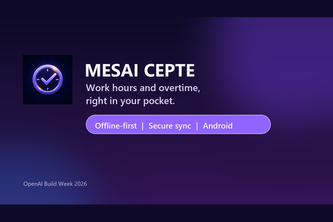
Mesai Cepte is a self-reported Android mobile application designed for tracking work hours, overtime, and earnings. The app supports multilingual use (Turkish and English), operates in a local-first mode with cross-device sync via Supabase, and includes features such as shift logging, break tracking, holiday/night shift recognition, and compensation snapshots.
What changed
The project is presented as a hackathon submission from the OpenAI 2026 Build Week, built using tools like GPT-5.6 (via Codex), React, Capacitor, Supabase, and others. It includes claims of incremental cloud sync, secure authentication, and offline functionality.
Single most important open question
Is there any evidence that this product has been adopted by users beyond the author’s own use case or testing?
What The Product Actually Is
The description states that Mesai Cepte is a multilingual Android work-hours, overtime, and earnings tracker, with support for Turkish and English. It allows users to:
- Record regular shifts or overtime
- Reuse shift templates
- Track breaks
- Mark night/weekend/holiday work
- Preserve compensation snapshots
- Add deductions and medical reports
- Review daily, weekly, and monthly summaries
It is described as local-first, meaning core tracking works offline. Syncing across devices happens through Supabase with Google sign-in.
The UI is built using React, TypeScript, Vite, Tailwind CSS, and shadcn/ui, packaged for Android via Capacitor. Data storage uses PostgreSQL via Supabase, protected by Row Level Security (RLS). Authentication is handled via Google OAuth with PKCE, and subscription entitlements are managed through RevenueCat.
Not evidenced:
- Whether the app has been released or made available to users beyond the developer.
- Whether any of these features have been tested in real-world usage.
- Any user feedback or adoption metrics.
Positioning & Claim Evolution
The author positions Mesai Cepte as a tool that simplifies work-hour logging, particularly for individuals managing complex schedules or health conditions. The stated goal is to make everyday life easier through simplicity — not just a feature but a design principle.
Key claims:
- The app turns scattered records into one clear mobile workflow.
- It supports local-first operation with secure cross-device sync.
- It helps employees verify time and understand how various factors affect earnings.
- It was built using AI assistance (Codex + GPT-5.6) during OpenAI Build Week.
Inferences:
- The app may be aimed at workers who need to track irregular or complex schedules.
- The use of AI tools suggests an emphasis on rapid development and code quality, though not necessarily product-market fit.
Not evidenced:
- No evidence of market positioning beyond the author’s personal experience.
- No indication of target audience segmentation or competitive differentiation.
- No mention of pricing strategy or monetization model beyond rewarded access and subscriptions.
Target Customer & ICP
The description implies a self-employed or hourly worker who needs to track irregular shifts, overtime, and earnings. The app is positioned for people managing multiple chronic health conditions, suggesting a niche audience focused on time management and ease of use.
Inferences:
- Likely users are those with non-standard work hours (e.g., night shifts, weekends).
- Users may also be concerned about accuracy in payroll reporting or need to document medical-related deductions.
- The app targets individuals rather than businesses or HR departments.
Not evidenced:
- No evidence of customer personas or segmentation.
- No data on whether the app is intended for employees in specific industries (e.g., healthcare, logistics).
- No indication of B2B vs. B2C focus.
Business Model & Pricing Evidence
The description mentions:
- Subscription entitlements managed via RevenueCat
- Rewarded 24-hour access via AdMob
- Premium features likely tied to subscription plans
Inferences:
- The app appears to be monetized through a freemium model with paid upgrades.
- AdMob integration suggests in-app advertising as a revenue stream.
Not evidenced:
- No pricing tiers or details about subscriptions.
- No evidence of revenue generation or user conversion rates.
- No mention of enterprise or team-based features.
Technical & Delivery Signals
The app is built using:
- Mobile framework: Android (via Capacitor)
- UI stack: React, TypeScript, Vite, Tailwind CSS, shadcn/ui
- Backend: Supabase Auth + PostgreSQL with RLS
- Authentication: Google OAuth with PKCE
- Sync mechanism: Local-first with incremental cloud reconciliation
- Testing: Vitest and Testing Library
Notable technical claims:
- Incremental, user-scoped cloud sync with offline mutation queues
- Secure handling of device PINs and biometric preferences (local-only)
- RLS-protected per-user data
- Historical compensation snapshots
- Rewarded access via AdMob and RevenueCat identity linkage
Inferences:
- The app handles complex edge cases like authentication changes, offline behavior, and multi-device sync.
- It uses modern development practices including CI/CD-ready builds.
Not evidenced:
- No evidence of production deployment or user testing.
- No information on scalability or performance under load.
- No mention of security audits or compliance measures.
Traction & Maturity Signals
The project is described as a hackathon submission (OpenAI 2026 Build Week). It includes:
- A tested, signed Android App Bundle ready for Google Play
- Functional implementation of core features like sync, auth, and offline support
Inferences:
- The app is at least functional and potentially deployable.
- It was developed quickly using AI-assisted engineering.
Not evidenced:
- No evidence of user adoption or retention.
- No revenue data or customer acquisition metrics.
- No indication of product-market fit or long-term viability.
- No mention of beta testing or feedback loops.
Competitive Context
The description does not reference competitors directly. However, the app’s features suggest it competes with:
- Time-tracking apps (e.g., Toggl, Clockify)
- Payroll tools (e.g., Gusto, BambooHR)
- Mobile productivity tools for workers in gig or irregular schedules
Inferences:
- The local-first approach and multilingual support may differentiate it from generic time trackers.
- Its focus on earnings verification and medical reports could appeal to niche audiences.
Not evidenced:
- No competitive analysis or market positioning.
- No evidence of existing competitors or market share.
- No indication of pricing or feature differentiation from similar tools.
Open Questions & Risks
- No traction or user data: The app is presented as a hackathon project with no evidence of real-world usage.
- Unproven monetization model: While subscriptions and ads are mentioned, there’s no proof of revenue generation or conversion.
- Single-founder development: With only one team member (AHMET HAZAR), scalability and long-term maintenance are uncertain.
- AI dependency: Heavy reliance on GPT-5.6 for development raises questions about whether the codebase can be maintained without AI assistance.
- Limited scope: The app is focused on Android, with no mention of iOS or web support.
Not evidenced:
- No evidence of legal or regulatory compliance (e.g., payroll laws in Turkey or other regions).
- No indication of data privacy practices beyond local storage and Supabase RLS.
Questions the description leaves open
- What is the actual user base, if any? How many people are using this app?
- Has the app been released on Google Play or is it still in development/testing?
- Are there plans to expand beyond Android (iOS, web)?
- How do you plan to monetize beyond subscriptions and rewarded access?
- What is your strategy for customer feedback and product iteration?
- Can you provide evidence of how the app solves a real pain point for users?
- Are there any legal or compliance considerations related to payroll tracking in the countries where it might be used?
Overall Assessment
Confidence: Low
The project is presented as a hackathon submission, not a commercial product with traction or revenue. The author describes a functional prototype with technical sophistication, but there is no evidence of:
- User adoption
- Revenue generation
- Market validation
- Long-term business strategy
While the app shows promise in terms of technical execution and niche targeting, it lacks the commercial due-diligence signals required for investment or partnership consideration.
Assessment: Not ready for investment or strategic partnership at this stage. Requires further evidence of traction, monetization, and user validation before any serious evaluation.
User Stories BotA demo video on every pull request
Get a demo video on every new feature
GitHub App that watches your pull requests and records a narrated, captioned demo.
Save time on demo prep and make informed decisions faster with a video walkthrough of every new feature.
Source
Submitted to the OpenAI 2026 hackathon on Devpost. Project home on Devpost. Back to the full gallery on Devpost.
This competitive analysis was produced by top-founders.com (opens in a new tab)
Generated by a language model from this project's public Devpost page — its tagline, the author's own write-up and any built-with tags listed there — as captured in August 2026. Short quotations are the author's words. It is an opinion on the idea as a business, not on the people behind it, and it reflects the description as published then. If the project has moved on, request a correction below. The analysis is not independent research and contains no verified traction, revenue or customer data.
An independent guide by KFG International LLC — not affiliated with, endorsed by, or connected to Devpost or OpenAI.