

Archive position — measured, not model output
0 likes on Devpost
2,263 of the 7,850 archived projects have more likes, and 5,587 share exactly 0 — so this project's #7,235 place in the like-ranked listing is a tie-break inside that group, not a ranking.
Projects (log scale)
Likes on Devpost. ▲ marks this project's group.
Show the figures
| Likes | Projects | Share of archive |
|---|---|---|
| 0 | 5,587 | 71.2% |
| 1 | 1,758 | 22.4% |
| 2 | 284 | 3.6% |
| 3–4 | 132 | 1.7% |
| 5–9 | 75 | 1.0% |
| 10+ | 14 | 0.2% |
 User Stories BotA demo video on every pull request
Get a demo video on every new feature
GitHub App that watches your pull requests and records a narrated, captioned demo.
Save time on demo prep and make informed decisions faster with a video walkthrough of every new feature.
Executive Summary
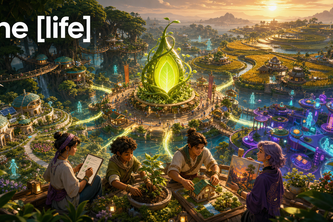
The LIFE is a self-reported 3D virtual world prototype built as a personal project by one developer (상범 손) for the OpenAI 2026 hackathon. The author describes it as an experience where users create real-life goals, complete them, and earn "LIFE" to build a personal 3D world. It includes features like goal tracking, 3D building tools, social spaces, content creation, and AI-assisted planning.
The project is described as a vertical slice of a larger metaverse concept, implemented using React, Next.js, Three.js, and Cloudflare Workers. It includes multiple authored worlds, a 3D build mode, and integration with LiveKit for communication and YouTube API for media discovery.
No revenue, customers, or traction data are provided. The project is presented as a prototype with no commercial operations or monetization in place.
The single most important open question
Is there evidence of any real-world usage, user feedback, or product-market fit beyond the author's own development and submission to a hackathon?
What The Product Actually Is
The description states that The LIFE is a 3D virtual world experience where users:
- Create real-life goals
- Turn them into achievable steps
- Complete the goals and earn "LIFE"
- Use that LIFE to build personal worlds
- Engage in social spaces, content creation, learning, and communication
It includes:
- A planner with calendar integration (read-only)
- AI-assisted goal transformation using GPT-5.6
- Multiple 3D worlds with distinct purposes (Knowledge Grove, Maker Isles, Content Maker Studio, Community House, Proof Arena)
- A 3D build mode for placing and manipulating objects in personal worlds
- Integration with LiveKit for communication
- Server-authoritative LIFE ledger to manage rewards and balances
The experience is described as a desktop web application built using React, Next.js, Three.js, and Cloudflare Workers.
Evidence The author's own write-up and technology tags.
Confidence Low — this is self-reported functionality without independent verification or evidence of actual use.
Positioning & Claim Evolution
The author states that The LIFE attempts to connect productivity apps (which end with checked boxes) and games (which focus on rewards) by allowing real-life actions to grow a virtual world.
It positions itself as:
- A way to make progress visible through 3D representation
- An alternative to gamification based on scores or competition
- A tool for personal growth, learning, and community building
The project evolved from a broad metaverse idea into a "coherent vertical slice" that judges can understand and experience within minutes.
Evidence The author's own description of the inspiration, evolution, and goals.
Confidence Low — this is a self-described positioning, not validated in the market or by users.
Target Customer & ICP
The author describes the target as:
- People who want to track real-life progress
- Individuals interested in building personal worlds through meaningful action
- Learners and creators seeking motivation and visibility for their efforts
- Users who prefer non-competitive, growth-based engagement
No specific customer segments or personas are identified. The ICP is described as "anyone" who wants to grow a world from real-life actions.
Evidence The author's own description of the experience and its intended audience.
Confidence Low — no evidence of actual user research or segmentation.
Business Model & Pricing Evidence
The description states that:
- LIFE is used to build worlds, create content, and connect with others
- A simulated marketplace demonstrates how LIFE could eventually connect personal growth with virtual items, land, and real-world rewards
- No real payment, purchase, or delivery occurs in the current prototype
There is no evidence of any pricing model, monetization strategy, or revenue streams beyond the prototype.
Evidence The author's own description.
Confidence Very low — no commercial data or business model details provided.
Technical & Delivery Signals
The project is built using:
- Frontend: React, Next.js, Three.js, WebGL
- Backend: Cloudflare D1 (database), R2 (storage), Workers (server logic)
- AI: GPT-5.6 for goal transformation and personalization
- Communication: LiveKit for audio/video/chat
- Integrations: Google Calendar (read-only), YouTube Data API
The author reports:
- Implementation of a server-authoritative LIFE ledger
- 3D build mode with undo/redo, placement limits, and validation
- Multiple authored worlds with distinct visual identities
- Browser-based creative tools for content creation
Evidence The author's own technical write-up.
Confidence Medium — the technical details are self-reported but describe a functional prototype.
Traction & Maturity Signals
The project is described as:
- A hackathon submission (OpenAI 2026)
- A vertical slice of a larger concept
- Built by one developer (상범 손)
- Not yet commercialized or monetized
There is no evidence of:
- Users, customers, or adoption
- Revenue or ARR
- Product-market fit
- Any traction beyond the prototype
Evidence The author's own description.
Confidence Very low — no traction data provided.
Competitive Context
The author does not name competitors or describe the competitive landscape. The project is described as a unique approach to combining productivity, gamification, and virtual worlds.
No evidence of:
- Direct competitors
- Market positioning relative to existing tools (e.g., Notion, Habitica, VR platforms)
- Industry trends or market size
Evidence The author's own description.
Confidence Very low — no competitive analysis provided.
Open Questions & Risks
Key risks and open questions include:
- Single-person development: No team or support structure
- Prototype-only status: No commercial product or user base
- Unverified claims: All features are self-reported, with no independent validation
- No monetization strategy: No evidence of how the project will generate revenue
- AI dependency: Reliance on GPT-5.6 and Codex for core functionality raises questions about scalability and control
- Technical complexity: 3D world-building and real-time communication are high-risk technical challenges
Evidence The author's own description, combined with lack of external data.
Confidence Medium — these are inferred risks from the self-reported nature of the project.
Questions the description leaves open
- What is the actual user feedback or testing done beyond the prototype?
- How does the team plan to scale beyond a single developer?
- What are the specific plans for monetization and revenue generation?
- How will the AI integration be managed at scale, and what happens if APIs fail?
- Are there any partnerships or early adopters in the pipeline?
- What is the long-term vision for the product beyond this prototype?
Evidence Not evidenced — these are questions to probe the author's claims.
Confidence Low — these are speculative but necessary due to lack of evidence.
Overall Assessment
The project is described as a prototype built by one developer, submitted to a hackathon. It includes no revenue, customers, or commercial traction. The author describes it as a vertical slice of a larger concept, not a product in the market.
There is no evidence of any commercial viability, user adoption, or business model beyond the prototype.
Assessment Not evidenced — this is a self-reported idea with no demonstrated traction or commercial readiness.
Confidence Very low — the project is described as a personal experiment, not a scalable business.
User Stories BotA demo video on every pull request
Get a demo video on every new feature
GitHub App that watches your pull requests and records a narrated, captioned demo.
Save time on demo prep and make informed decisions faster with a video walkthrough of every new feature.
Source
Submitted to the OpenAI 2026 hackathon on Devpost. Project home on Devpost. Back to the full gallery on Devpost.
This competitive analysis was produced by top-founders.com (opens in a new tab)
Generated by a language model from this project's public Devpost page — its tagline, the author's own write-up and any built-with tags listed there — as captured in August 2026. Short quotations are the author's words. It is an opinion on the idea as a business, not on the people behind it, and it reflects the description as published then. If the project has moved on, request a correction below. The analysis is not independent research and contains no verified traction, revenue or customer data.
An independent guide by KFG International LLC — not affiliated with, endorsed by, or connected to Devpost or OpenAI.