

Archive position — measured, not model output
1 like on Devpost
505 of the 7,850 archived projects have more likes, and 1,758 share exactly 1 — so this project's #2,069 place in the like-ranked listing is a tie-break inside that group, not a ranking.
Projects (log scale)
Likes on Devpost. ▲ marks this project's group.
Show the figures
| Likes | Projects | Share of archive |
|---|---|---|
| 0 | 5,587 | 71.2% |
| 1 | 1,758 | 22.4% |
| 2 | 284 | 3.6% |
| 3–4 | 132 | 1.7% |
| 5–9 | 75 | 1.0% |
| 10+ | 14 | 0.2% |
 User Stories BotA demo video on every pull request
Get a demo video on every new feature
GitHub App that watches your pull requests and records a narrated, captioned demo.
Save time on demo prep and make informed decisions faster with a video walkthrough of every new feature.
Executive Summary
What the company appears to be
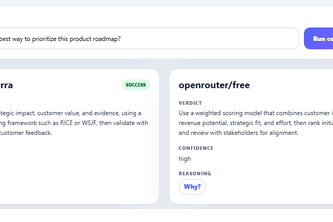
The Dot is a self-reported AI comparison tool that allows users to ask one question and receive answers from two different AI models simultaneously. It then generates an Insight Card summarizing where the models agree, disagree, and what to ask next.
What changed
The author reports building this in one day using OpenAI Codex, with no prior experience with the tool. The core idea evolved from a simple dual-AI response system into a structured output format that includes Assessment, Confidence, Reasoning, and an Insight Card analyzing model disagreement.
Single most important open question
Is there any evidence of traction, revenue, or customer adoption beyond the author's own development experience?
What The Product Actually Is
The description states that The Dot is a tool where:
- A user inputs one question.
- It sends the same question to two AI models at once (GPT-5.6 from OpenAI and a free model via OpenRouter).
- Each model returns:
- An Assessment
- A Confidence level
- Full Reasoning (hidden behind a "Why?" button)
- An Insight Card is generated by GPT-5.6 that:
- Identifies Agreement between models
- Details Conflict — specifically naming the assumption causing disagreement
- Lists Missing Information needed to resolve confusion
- Suggests a Next Best Question
This is described as a self-contained web application built in one day using OpenAI Codex.
Evidence
- Author's own write-up
- Technology stack: api, codex, css, gpt-5.6, html, javascript, node.js, openai, openrouter
Inference The product is a proof-of-concept prototype built for a hackathon; it does not appear to have any commercial or production deployment.
Positioning & Claim Evolution
The author states:
- The inspiration was to move beyond single-AI tools that give one answer and force the user to trust it.
- The goal was to show where disagreement occurs, so users can make informed decisions.
- The tool is not about determining which AI is right but about showing where further thinking or inquiry is needed.
Evidence
- Self-reported write-up
- Claim: “It's not about which AI is right. It's about showing where you still need to think before deciding.”
Inference The positioning appears to be centered on transparency, decision support, and reducing reliance on single-AI outputs — a niche in the AI space focused on interpretability and user agency.
Target Customer & ICP
Not evidenced.
Evidence needed
No mention of specific customer personas, use cases, or target industries. The author only describes personal motivation for building it.
Business Model & Pricing Evidence
Not evidenced.
Evidence needed
No indication of monetization strategy, pricing tiers, or revenue model. The tool is described as a hackathon submission with no commercial intent.
Technical & Delivery Signals
The description states:
- Built in one day using OpenAI Codex.
- Uses GPT-5.6 from OpenAI and a free model via OpenRouter.
- Server and UI built in Codex Cloud.
- Output format standardized as Assessment, Confidence, Reasoning.
- Insight Card logic implemented by instructing Codex to name the real assumption behind disagreement.
- Challenges included API key persistence, model availability, and temperature settings.
Evidence
- Author's own write-up
- Technology tags: api, codex, css, gpt-5.6, html, javascript, node.js, openai, openrouter
Inference The tool is a minimal prototype built for demonstration purposes, likely not scalable or production-ready.
Traction & Maturity Signals
Not evidenced.
Evidence needed
No data on user engagement, retention, revenue, or adoption. The project was submitted to a hackathon and has no known users beyond the author.
Competitive Context
Not evidenced.
Evidence needed
No mention of existing tools in this space, nor any competitive analysis. The author does not reference similar products or market positioning.
Open Questions & Risks
- Prototype only: Built for a hackathon; no evidence of commercial viability or scalability.
- Unstable AI models: Free-tier models are reported to be unreliable and change frequently.
- No customer data: No evidence of real-world usage, feedback, or adoption.
- Single founder: The team size is listed as 1, suggesting limited development capacity.
- Self-reported only: All claims are unverified; no third-party validation.
Inference This is a concept demonstration with no commercial traction. It may not be suitable for investment or partnership unless further validated.
Questions the description leaves open
- What was the actual user feedback during the hackathon?
- Are there any plans to build beyond this prototype, and if so, what are they?
- How would you monetize this tool if it were to scale?
- Have you considered how to handle model availability or API stability at scale?
- Is there any interest from potential users or partners in the current form?
Overall Assessment
Not evidenced.
Evidence needed
No data on valuation, funding rounds, revenue, or customer base. The project is described as a hackathon submission with no commercial traction or evidence of market demand.
Inference At this stage, there is insufficient evidence to support an investment or partnership decision. It appears to be a proof-of-concept prototype with no demonstrated product-market fit or commercial viability.
User Stories BotA demo video on every pull request
Get a demo video on every new feature
GitHub App that watches your pull requests and records a narrated, captioned demo.
Save time on demo prep and make informed decisions faster with a video walkthrough of every new feature.
Source
Submitted to the OpenAI 2026 hackathon on Devpost. Project home on Devpost. Back to the full gallery on Devpost.
This competitive analysis was produced by top-founders.com (opens in a new tab)
Generated by a language model from this project's public Devpost page — its tagline, the author's own write-up and any built-with tags listed there — as captured in August 2026. Short quotations are the author's words. It is an opinion on the idea as a business, not on the people behind it, and it reflects the description as published then. If the project has moved on, request a correction below. The analysis is not independent research and contains no verified traction, revenue or customer data.
An independent guide by KFG International LLC — not affiliated with, endorsed by, or connected to Devpost or OpenAI.