

Archive position — measured, not model output
0 likes on Devpost
2,263 of the 7,850 archived projects have more likes, and 5,587 share exactly 0 — so this project's #4,032 place in the like-ranked listing is a tie-break inside that group, not a ranking.
Projects (log scale)
Likes on Devpost. ▲ marks this project's group.
Show the figures
| Likes | Projects | Share of archive |
|---|---|---|
| 0 | 5,587 | 71.2% |
| 1 | 1,758 | 22.4% |
| 2 | 284 | 3.6% |
| 3–4 | 132 | 1.7% |
| 5–9 | 75 | 1.0% |
| 10+ | 14 | 0.2% |
 User Stories BotA demo video on every pull request
Get a demo video on every new feature
GitHub App that watches your pull requests and records a narrated, captioned demo.
Save time on demo prep and make informed decisions faster with a video walkthrough of every new feature.
Executive Summary
What the company appears to be
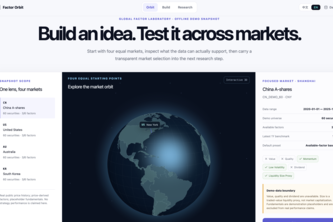
Factor Orbit is a self-reported quantitative research tool for building and testing factor strategies across four markets (China, US, Australia, South Korea). It presents itself as an evidence-first platform where users can construct transparent strategies with reproducible backtests. The product is described as a research demonstration, not investment advice.
What changed
The project was built in the context of an OpenAI 2026 hackathon and uses AI coding tools (Codex powered by GPT-5.6) for development. It includes a 3D globe visualization, strategy builder with configurable parameters, backtesting engine, and research storage features.
The single most important open question
Is there any evidence of traction, revenue, or customer adoption beyond the author's own demonstration? The description states no such evidence exists, but this remains unverified.
What The Product Actually Is
- The description states that Factor Orbit is a "research demonstration" focused on building and testing factor strategies.
- It allows users to explore four markets through an interactive 3D globe.
- Users can build factor strategies using Momentum, Low Volatility, and Liquidity Size Proxy.
- It includes functionality for configuring portfolio size, rebalancing frequency, weighting method, position limits, and transaction costs.
- The system runs reproducible backtests and displays performance metrics like Sharpe ratio, information ratio, drawdown, turnover, and yearly performance.
- It stores research cases with configurations, assessments, and supporting evidence.
- It is described as not providing Value, Quality, and Dividend factors due to lack of cross-market point-in-time fundamental data.
Not evidenced No actual product deployment or live usage is described beyond the author's own demonstration. The system is presented as a demo only.
Positioning & Claim Evolution
- The description states that Factor Orbit aims to offer an "evidence-first quantitative research workspace" where every strategy is transparent and assumptions are visible.
- It claims to avoid fabricating data by making unsupported factors visibly unavailable.
- The project positions itself as different from other quantitative investing tools that "show attractive charts without making it clear how a strategy was constructed, what data was used, or whether the result can be reproduced."
- The author describes this as a "research demonstration and not investment advice."
Inference The positioning suggests a focus on transparency and reproducibility in quantitative finance research. However, there is no evidence of market positioning beyond the author's own claims.
Target Customer & ICP
- The description states that Factor Orbit targets users interested in building and testing factor strategies across four specific markets (China, US, Australia, South Korea).
- It implies use by researchers or practitioners in quantitative finance who value transparency and reproducibility.
- The system is designed to be used with synthetic securities for reproducible offline backtests.
Not evidenced No information about actual customers, target personas, or customer segments beyond the author's own usage scenario.
Business Model & Pricing Evidence
- The description states that Factor Orbit is a "research demonstration and not investment advice."
- There is no mention of pricing, monetization, or business model.
- It is described as a public demo using deterministic synthetic securities.
Not evidenced No evidence of any revenue streams, pricing models, or commercialization plans.
Technical & Delivery Signals
- The project uses a shared web and API architecture:
- Frontend: Next.js, React, TypeScript
- Backend: FastAPI, Python
- Data storage: DuckDB, Parquet
- Visualization: Three.js, react-globe.gl
- It employs automated tests, integrity checks, and a sanitized public export process.
- The entire project was reportedly built with Codex powered by GPT-5.6.
- It uses shared contracts for market data, strategy requests, backtest results, and research evidence.
Inference The technical stack suggests a modern SaaS-like architecture with AI-assisted development. However, these are self-reported implementation details without verification of delivery quality or scalability.
Traction & Maturity Signals
- The project is described as a "research demonstration" submitted to the OpenAI 2026 hackathon.
- It includes no mention of users, customers, revenue, or adoption metrics.
- The author notes that almost the entire project was completed with Codex, including architecture and testing.
Not evidenced No evidence of traction, user engagement, or product maturity beyond the author's own development effort.
Competitive Context
- The description states that quantitative investing tools often show attractive charts without clarity on strategy construction or reproducibility.
- Factor Orbit is positioned as an alternative that emphasizes transparency and evidence-based research.
- It does not appear to directly compete with existing platforms like Bloomberg, Morningstar, or QuantConnect, but rather positions itself in a niche focused on reproducible research.
Not evidenced No information about competitors, market share, or competitive positioning beyond the author's own claims.
Open Questions & Risks
- The project is described as a "research demonstration" and not investment advice.
- It does not provide Value, Quality, and Dividend factors due to lack of cross-market point-in-time fundamental data.
- There is no evidence of any real-world usage or customer feedback.
- The entire system was built by one person (Oliver Sun) using AI tools.
- The author notes that the total usage of Codex was higher than expected.
Inference The lack of real-world adoption, revenue, or customer base raises questions about commercial viability. Also, reliance on a single developer and AI coding tools may indicate limited scalability or maturity.
Questions the description leaves open
- What is the intended path to monetization or commercialization?
- Are there any plans for expanding beyond the four markets currently supported?
- How does Factor Orbit plan to handle real-world data integration and compliance issues?
- Has the author considered how to scale beyond a single-person development effort?
- Is there any interest from financial institutions or researchers in using this tool?
Overall Assessment
- The project is described as a research demonstration submitted to a hackathon.
- There is no evidence of traction, revenue, customers, or commercial viability.
- It is built by one individual and uses AI coding tools for development.
- No pricing model or business plan is evident.
Not evidenced No basis for investment or partnership consideration based on the provided information. The project remains in a pre-commercial phase with no verified user base or financial metrics.
User Stories BotA demo video on every pull request
Get a demo video on every new feature
GitHub App that watches your pull requests and records a narrated, captioned demo.
Save time on demo prep and make informed decisions faster with a video walkthrough of every new feature.
Source
Submitted to the OpenAI 2026 hackathon on Devpost. Project home on Devpost. Back to the full gallery on Devpost.
This competitive analysis was produced by top-founders.com (opens in a new tab)
Generated by a language model from this project's public Devpost page — its tagline, the author's own write-up and any built-with tags listed there — as captured in August 2026. Short quotations are the author's words. It is an opinion on the idea as a business, not on the people behind it, and it reflects the description as published then. If the project has moved on, request a correction below. The analysis is not independent research and contains no verified traction, revenue or customer data.
An independent guide by KFG International LLC — not affiliated with, endorsed by, or connected to Devpost or OpenAI.