

Archive position — measured, not model output
0 likes on Devpost
2,263 of the 7,850 archived projects have more likes, and 5,587 share exactly 0 — so this project's #7,193 place in the like-ranked listing is a tie-break inside that group, not a ranking.
Projects (log scale)
Likes on Devpost. ▲ marks this project's group.
Show the figures
| Likes | Projects | Share of archive |
|---|---|---|
| 0 | 5,587 | 71.2% |
| 1 | 1,758 | 22.4% |
| 2 | 284 | 3.6% |
| 3–4 | 132 | 1.7% |
| 5–9 | 75 | 1.0% |
| 10+ | 14 | 0.2% |
 User Stories BotA demo video on every pull request
Get a demo video on every new feature
GitHub App that watches your pull requests and records a narrated, captioned demo.
Save time on demo prep and make informed decisions faster with a video walkthrough of every new feature.
Executive Summary
What the company appears to be
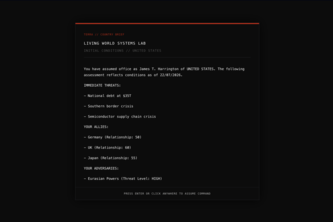
Terra is a self-reported educational geopolitical systems-thinking simulator built as a full-stack web application. The description states it is designed for students to forecast policy tradeoffs, govern through consequences, and compare outcomes of their decisions in an interconnected world.
What changed
The project was submitted to the OpenAI 2026 hackathon. It is described as a prototype or proof-of-concept with no evidence of prior traction, revenue, or customer adoption.
Single most important open question
Is there any evidence that Terra has been used in classrooms or by learners beyond its developer team?
What The Product Actually Is
The description states that Terra is an educational geopolitical systems-thinking simulator. It is described as a full-stack Next.js application built with React, TypeScript, Zustand, Leaflet, and a custom world-state simulation engine.
It includes:
- Curated learning missions.
- A Scenario Builder for creating playable crisis chains.
- Current-world signals with source links.
- A TERRA Guide explaining political constraints.
- Consequence Replay and Counterfactual Lab views.
- An onboarding flow and command-center experience.
The product is described as a simulation where learners make decisions under uncertainty, see consequences across multiple systems (e.g., treasury, stability, public approval), and compare their choices with alternatives.
Evidence
- The author states: “TERRA: Living World is an educational geopolitical systems-thinking simulator.”
- The author describes features such as Scenario Builder, Consequence Replay, Counterfactual Lab, and TERRA Guide.
- The author mentions the use of AI (GPT-5.6, Codex) for development but not for core simulation logic.
Inference The product is built to teach systems thinking through interactive decision-making in a geopolitical context.
Positioning & Claim Evolution
The description states that Terra aims to shift political education from "a list of institutions, elections, treaties, and historic events" to one where students "feel" the consequences of their decisions. It positions itself as an educational tool that turns geopolitics into a "living simulation."
It claims to:
- Enable learners to forecast effects on stability, economy, public trust, and global tension.
- Make second-order effects visible through replay and comparison tools.
- Provide a structured learning debrief after each decision.
Evidence
- The author states: “Politics is often taught as a list of institutions... But the real skill is systems thinking.”
- The author says: “TERRA turns geopolitics into a living simulation where every decision leaves a visible trace across an interconnected world.”
Inference The positioning is that Terra is a pedagogical innovation in political education, not a commercial product or platform for general use.
Target Customer & ICP
The description states that Terra is designed for students. It is described as an educational tool for learners to understand geopolitical systems and policy tradeoffs.
Evidence
- The author says: “TERRA turns geopolitics into a living simulation where every decision leaves a visible trace across an interconnected world.”
- The author mentions “Curated learning missions” and “structured learning debrief.”
Inference The primary customer is likely students in educational settings, possibly high school or university-level learners.
Business Model & Pricing Evidence
Not evidenced. The description does not mention any pricing model, monetization strategy, or business model.
Evidence
- No mention of revenue streams, subscriptions, licensing, or sales.
Inference The project is described as a hackathon submission and has no evidence of commercialization or pricing.
Technical & Delivery Signals
The product is built with:
- Next.js (full-stack)
- React
- TypeScript
- Zustand (state management)
- Leaflet.js (mapping)
- Custom simulation engine
- AI tools like GPT-5.6 and Codex for development
It includes:
- Server-side optional model layer.
- Deterministic local fallbacks.
- Source-linked world signals.
- Resilient design that remains functional without live AI.
Evidence
- The author states: “We built TERRA as a full-stack Next.js application using React, TypeScript, Zustand, Leaflet...”
- The author says: “The optional model layer is server-side, while deterministic local fallbacks ensure the educational experience remains playable even when an external model provider is unavailable.”
Inference The technical architecture supports both AI-enhanced and offline functionality, with a focus on resilience and educational delivery.
Traction & Maturity Signals
Not evidenced. The description does not mention any users, customers, or adoption metrics.
Evidence
- The author states: “Team size: 0”.
- No mention of revenue, ARR, headcount, or usage data.
- No evidence of product-market fit or user feedback.
Inference The project is in an early stage (hackathon submission) with no demonstrated traction or maturity.
Competitive Context
Not evidenced. The description does not mention competitors or a competitive landscape.
Evidence
- No mention of existing tools, platforms, or educational simulators in the geopolitical or systems-thinking space.
Inference No competitive context is provided; it is unclear whether Terra is addressing an existing market gap or creating a new one.
Open Questions & Risks
- Lack of traction or commercialization: The project is described as a hackathon submission with no evidence of product-market fit, revenue, or users.
- Unproven pedagogical impact: While the author claims to teach systems thinking, there is no evidence of learning outcomes or effectiveness.
- No team size or structure: The description states “Team size: 0,” raising questions about execution capability.
- AI dependency without clarity on deployment: Although AI tools were used in development, it's unclear how AI will be deployed for learners or whether it’s a core feature.
- Unverified claims: All claims are self-reported and unverified.
Evidence
- “Team size: 0”
- No mention of users, adoption, or feedback
- No evidence of revenue or business model
Questions the description leaves open
- What is the actual educational impact of Terra? Have you tested it with students?
- How will the simulation scale to classroom use or teacher monitoring?
- Is there a plan for monetization or long-term sustainability beyond the hackathon?
- How do you ensure that learners distinguish between real-world signals and fictional consequences?
- What are the technical limitations of the current simulation engine, and how will they be addressed?
Overall Assessment
Not evidenced. The description does not provide any information about funding, valuation, or investment interest.
Evidence
- No mention of funding rounds, investors, or valuations.
- No indication of partnership opportunities or commercial interest.
Inference This is a hackathon project with no evidence of commercial readiness or investor interest. It may be an early-stage idea or prototype with potential for further development but lacks any traction or business signals to support investment or partnership consideration.
User Stories BotA demo video on every pull request
Get a demo video on every new feature
GitHub App that watches your pull requests and records a narrated, captioned demo.
Save time on demo prep and make informed decisions faster with a video walkthrough of every new feature.
Source
Submitted to the OpenAI 2026 hackathon on Devpost. Project home on Devpost. Back to the full gallery on Devpost.
This competitive analysis was produced by top-founders.com (opens in a new tab)
Generated by a language model from this project's public Devpost page — its tagline, the author's own write-up and any built-with tags listed there — as captured in August 2026. Short quotations are the author's words. It is an opinion on the idea as a business, not on the people behind it, and it reflects the description as published then. If the project has moved on, request a correction below. The analysis is not independent research and contains no verified traction, revenue or customer data.
An independent guide by KFG International LLC — not affiliated with, endorsed by, or connected to Devpost or OpenAI.