

Archive position — measured, not model output
0 likes on Devpost
2,263 of the 7,850 archived projects have more likes, and 5,587 share exactly 0 — so this project's #3,269 place in the like-ranked listing is a tie-break inside that group, not a ranking.
Projects (log scale)
Likes on Devpost. ▲ marks this project's group.
Show the figures
| Likes | Projects | Share of archive |
|---|---|---|
| 0 | 5,587 | 71.2% |
| 1 | 1,758 | 22.4% |
| 2 | 284 | 3.6% |
| 3–4 | 132 | 1.7% |
| 5–9 | 75 | 1.0% |
| 10+ | 14 | 0.2% |
 User Stories BotA demo video on every pull request
Get a demo video on every new feature
GitHub App that watches your pull requests and records a narrated, captioned demo.
Save time on demo prep and make informed decisions faster with a video walkthrough of every new feature.
Executive Summary
What the company appears to be
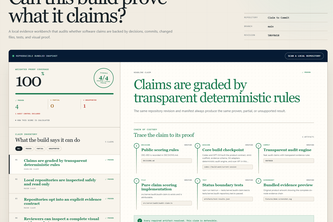
Claim to Commit is a self-reported local repository evidence workbench designed to connect software claims (e.g., features claimed in AI-assisted development) to inspectable chains of proof, using Git and deterministic rules.
What changed
The project was submitted as part of the OpenAI 2026 hackathon. It is described as a complete, self-auditing product that resolves evidence from human decisions through commits, tests, and visual artifacts in a local Git repository.
Single most important open question
Is there any evidence that this tool has been used beyond the demo or hackathon context, and does it have any traction or adoption among developers or engineering teams?
What The Product Actually Is
The description states:
- Claim to Commit is a local repository evidence workbench.
- It turns software claims into inspectable chains of proof, connecting:
- Human decision → Codex session → commit → changed files → passing test → visual proof.
- It uses an evidence manifest to opt repositories in.
- It applies transparent deterministic rules to grade each claim as proven, partial, or unsupported.
- It includes an Audit Mode that exposes missing evidence and explains what would make a claim defensible.
- The tool is built with familiar tools: Node.js, TypeScript, React, Vite, Express, SQLite, Vitest, Git CLI.
- It runs locally and requires no account or paid service; one command (
npm run demo) starts it.
Inference The product appears to be a proof-of-concept or prototype for validating AI-generated software claims using Git-based evidence chains. It is not described as a commercial offering or production-ready tool.
Positioning & Claim Evolution
The description states:
- The inspiration came from the need to verify AI-generated software features in engineering reviews and hackathon judging.
- It was built to address the gap between activity logs (transcripts, diffs) and product-level chains of custody.
- The tool is positioned as a local, trustworthy, and transparent way to connect human decisions and AI work to concrete repository evidence.
Inference The positioning evolved from a hackathon project aimed at solving a specific problem in AI-assisted development — verifying claims made during AI coding sessions — into a framework that could be extended for broader use cases like auditability or compliance in software delivery.
Target Customer & ICP
The description states:
- The target audience includes engineering leads, reviewers, and hackathon judges.
- It is designed to help those who need to inspect claims made during AI-assisted development.
- It supports a reviewer-focused interface, suggesting that the primary users are not developers building with it but those evaluating their work.
Inference The ICP likely includes engineering teams, product managers, and technical reviewers working in environments where AI tools are used for software development. However, no explicit segmentation or customer personas are provided.
Business Model & Pricing Evidence
The description states:
- The tool is local-only, requires no account or paid service, and runs with one command.
- It is described as a self-contained demo and not a commercial product.
Inference There is no evidence of any pricing model, monetization strategy, or business model beyond the self-reported demo. The tool is presented as a prototype for hackathon use.
Technical & Delivery Signals
The description states:
- Built using Codex (GPT-5.6) and tools like Node.js, TypeScript, React, Express, SQLite, Vitest, Git CLI.
- The stack uses familiar, runnable vertical slices.
- It includes:
- A TypeScript evidence schema
- Safe read-only Git adapters
- Deterministic scoring engine
- SQLite scan history
- Express API and React workbench
- Automated tests (43 passing)
- Production build and typecheck
- The tool is designed to be run locally with a single command (
npm run demo). - It supports self-auditing, including scanning its own commit history.
Inference The technical stack is standard for modern web development, and the project shows some maturity in terms of structure and testing. However, no evidence suggests it has been deployed or scaled beyond a demo environment.
Traction & Maturity Signals
The description states:
- The tool includes 43 passing tests, a successful typecheck and production build.
- It has seed evidence, exact judge test steps, and a narrated demo.
- Its own repository reports 100% evidence coverage across four shipped claims.
- It was submitted to the OpenAI 2026 hackathon.
Inference There is no evidence of real-world adoption or usage beyond the demo. The project is described as a self-contained prototype, not a product with customers or revenue.
Competitive Context
The description states:
- It was built for the OpenAI 2026 hackathon.
- It addresses a gap in AI-assisted software development where activity logs are insufficient for verification.
- It is positioned as a tool that connects human decisions and AI work to concrete repository evidence, which could be seen as complementary to tools like CI/CD systems, code review platforms, or audit tools.
Inference No direct competitors are named. The space of AI-assisted development verification is emerging, and this project appears to be one of the early explorations in that area.
Open Questions & Risks
The description states:
- It is a self-reported hackathon submission, not independently verified.
- It is local-only and lacks any mention of cloud or enterprise features.
- The tool is described as not a commercial product, with no evidence of monetization.
Inference
Key risks include:
- Lack of real-world usage or adoption.
- No evidence of scalability or integration into existing workflows.
- The tool’s focus on local execution may limit its utility in team environments.
- It is not clear if the project will evolve beyond a demo or prototype.
Questions the description leaves open
- Has this tool been used outside of the hackathon context?
- What are the plans for scaling or integrating it into existing development workflows?
- Are there any real-world use cases or feedback from engineering teams who have tried it?
- How does it handle edge cases like merge conflicts, multiple developers, or CI/CD pipelines?
- Is there a plan to support cloud-based deployment or enterprise features?
Overall Assessment
The description states:
- This is a hackathon submission, not a commercial product.
- It is described as a self-contained demo with no evidence of traction, revenue, or customers.
Inference At this stage, there is no basis for investment or partnership. The project is a proof-of-concept prototype, and the author has not provided any evidence of real-world adoption or commercial viability. It may be worth revisiting if it evolves into a product with measurable traction or use cases beyond the demo.
User Stories BotA demo video on every pull request
Get a demo video on every new feature
GitHub App that watches your pull requests and records a narrated, captioned demo.
Save time on demo prep and make informed decisions faster with a video walkthrough of every new feature.
Source
Submitted to the OpenAI 2026 hackathon on Devpost. Project home on Devpost. Back to the full gallery on Devpost.
This competitive analysis was produced by top-founders.com (opens in a new tab)
Generated by a language model from this project's public Devpost page — its tagline, the author's own write-up and any built-with tags listed there — as captured in August 2026. Short quotations are the author's words. It is an opinion on the idea as a business, not on the people behind it, and it reflects the description as published then. If the project has moved on, request a correction below. The analysis is not independent research and contains no verified traction, revenue or customer data.
An independent guide by KFG International LLC — not affiliated with, endorsed by, or connected to Devpost or OpenAI.