

Archive position — measured, not model output
0 likes on Devpost
2,263 of the 7,850 archived projects have more likes, and 5,587 share exactly 0 — so this project's #5,232 place in the like-ranked listing is a tie-break inside that group, not a ranking.
Projects (log scale)
Likes on Devpost. ▲ marks this project's group.
Show the figures
| Likes | Projects | Share of archive |
|---|---|---|
| 0 | 5,587 | 71.2% |
| 1 | 1,758 | 22.4% |
| 2 | 284 | 3.6% |
| 3–4 | 132 | 1.7% |
| 5–9 | 75 | 1.0% |
| 10+ | 14 | 0.2% |
 User Stories BotA demo video on every pull request
Get a demo video on every new feature
GitHub App that watches your pull requests and records a narrated, captioned demo.
Save time on demo prep and make informed decisions faster with a video walkthrough of every new feature.
Executive Summary
What the company appears to be
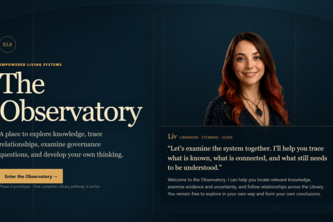
The project described by the author is a prototype for an interactive observatory of knowledge and systems, built around a guiding AI entity named Liv. The product is not a chatbot but a navigable environment where users can explore governance-related topics through structured pathways, visual maps, private study tools, and decision-making laboratories. It is positioned as a tool to support reasoning about complex issues without replacing user judgment or transferring responsibility.
What changed
The project evolved from an idea for a conversational assistant into a place-based system — an observatory with curated content, interactive navigation, and a role for Liv as a steward rather than a decision-maker. This shift was intentional, driven by the desire to avoid reducing the product to a text box.
Single most important open question
Is there evidence that the author’s vision of a scalable, usable, and impactful observatory can be realized beyond this prototype? The description does not indicate any traction, revenue, or customer data — only an unverified self-reported account of a weekend build.
What The Product Actually Is
The description states that the product is a prototype for an interactive observatory. It includes:
- A Library architecture spanning governance, technology, communities, and essential systems.
- A Connected Systems Map to visualize relationships between these domains.
- A Study Desk for private note-taking and reflection.
- A Nursery where early ideas are stored as “Seeds.”
- A Living Governance Decision Laboratory, which supports structured reasoning through multiple dimensions (e.g., purpose, people, evidence).
- A private browser-based interface, with no accounts or cloud storage.
It is not a chatbot. The author explicitly states that the product is a place, not a conversational assistant.
The prototype was built using GPT-5.6 and Codex, following a Product Constitution that defined purpose, boundaries, and experience goals.
Claim
The product is an observatory with a guiding AI entity named Liv.
Evidence Author's own description; no independent verification.
Positioning & Claim Evolution
The author states that the project was inspired by the need to make complex systems of governance accessible without requiring deep knowledge. The core idea evolved from building a chatbot to creating an interactive environment where users can explore, reflect, and reason — guided by Liv but not directed.
This evolution reflects a shift in positioning:
- From conversational AI assistant → to navigable knowledge environment
- From AI as decision-maker → to AI as guide and steward
Claim
The product is positioned as an observatory, not a chatbot.
Evidence Explicit statement in the write-up: “The breakthrough came when we recognised that the product needed to be a place.”
Target Customer & ICP
The description does not name specific customers or personas. However, it implies a target audience interested in:
- Complex governance questions
- Systems thinking
- Exploring relationships between technology, ecology, institutions, and society
- Reasoning through policy or institutional design without being told what to think
It also suggests that the product is intended for visitors who want to explore rather than simply consume information.
Claim
The target audience includes people interested in systems thinking and governance.
Evidence Author’s framing of the product as a way to “explore complex issues” and “trace relationships between systems.”
Business Model & Pricing Evidence
There is no evidence provided about pricing, monetization, or business model. The prototype is described as a public, open-access tool with no account requirements or paid features.
Claim
No pricing or business model information is given.
Evidence Not evidenced.
Technical & Delivery Signals
The prototype was built using:
- GPT-5.6 for concept development and documentation
- Codex for implementation
- A phased build process with reviews, testing, and integrity checks
- OpenAI Sites for deployment
It includes:
- A structured product constitution
- Phased builds with clean recovery points
- Automated checks (lint, integrity, accessibility)
- Browser-based storage without cloud or analytics
Claim
The prototype was built using AI tools and a structured engineering approach.
Evidence Author’s own description of the build process.
Traction & Maturity Signals
There is no evidence of traction, revenue, customers, or adoption beyond the prototype being publicly released. The project is described as a weekend hackathon effort with limited time and resources.
Claim
No traction or maturity data.
Evidence Not evidenced.
Competitive Context
The description does not mention competitors or existing products in this space. It focuses on the unique positioning of an observatory over a chatbot, but does not compare to other tools for systems thinking, governance exploration, or knowledge management.
Claim
No competitive context provided.
Evidence Not evidenced.
Open Questions & Risks
- Unproven scalability: The prototype is described as a single pathway in a larger system. There is no indication of how the full observatory would be developed or maintained.
- No monetization strategy: No evidence of how this product might generate revenue or sustain long-term development.
- Limited team size: Only one person built it, suggesting limited capacity for future expansion.
- Self-reported only: All claims are unverified and based on the author’s own account.
Inference The project may not be viable beyond its prototype stage without significant investment in content, engineering, and governance.
Evidence Author's description of time constraints and limited scope.
Questions the description leaves open
- What is the long-term vision for the observatory? How will it scale beyond a single pathway?
- What are the key challenges in maintaining and updating the content without compromising its integrity?
- How do you plan to sustain development beyond this prototype, especially given the limited team size?
- Are there any plans to monetize or commercialize the product?
- How do you intend to validate that the system supports meaningful reasoning rather than just presenting information?
Overall Assessment
This is a self-reported prototype of an ambitious idea — a navigable knowledge environment for exploring governance and systems thinking, guided by an AI entity named Liv.
There is no evidence of traction, revenue, or customer adoption. The project was built in a short timeframe with limited resources, and the author does not describe any path to scaling beyond this initial version.
Assessment Not ready for investment or partnership at this stage.
Confidence level Low — based entirely on self-reported evidence and no external validation.
User Stories BotA demo video on every pull request
Get a demo video on every new feature
GitHub App that watches your pull requests and records a narrated, captioned demo.
Save time on demo prep and make informed decisions faster with a video walkthrough of every new feature.
Source
Submitted to the OpenAI 2026 hackathon on Devpost. Project home on Devpost. Back to the full gallery on Devpost.
This competitive analysis was produced by top-founders.com (opens in a new tab)
Generated by a language model from this project's public Devpost page — its tagline, the author's own write-up and any built-with tags listed there — as captured in August 2026. Short quotations are the author's words. It is an opinion on the idea as a business, not on the people behind it, and it reflects the description as published then. If the project has moved on, request a correction below. The analysis is not independent research and contains no verified traction, revenue or customer data.
An independent guide by KFG International LLC — not affiliated with, endorsed by, or connected to Devpost or OpenAI.