

Archive position — measured, not model output
0 likes on Devpost
2,263 of the 7,850 archived projects have more likes, and 5,587 share exactly 0 — so this project's #3,271 place in the like-ranked listing is a tie-break inside that group, not a ranking.
Projects (log scale)
Likes on Devpost. ▲ marks this project's group.
Show the figures
| Likes | Projects | Share of archive |
|---|---|---|
| 0 | 5,587 | 71.2% |
| 1 | 1,758 | 22.4% |
| 2 | 284 | 3.6% |
| 3–4 | 132 | 1.7% |
| 5–9 | 75 | 1.0% |
| 10+ | 14 | 0.2% |
 User Stories BotA demo video on every pull request
Get a demo video on every new feature
GitHub App that watches your pull requests and records a narrated, captioned demo.
Save time on demo prep and make informed decisions faster with a video walkthrough of every new feature.
Executive Summary
What the company appears to be
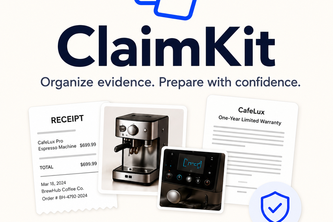
ClaimKit is a self-reported web application that organizes warranty evidence into a structured, review-ready claim packet using AI. It allows users to upload documents and images, processes them with GPT-5.6 for fact extraction, enables human review of extracted facts, and generates a final packet without submitting it to any third party.
What changed
The project is described as an MVP built for the OpenAI 2026 hackathon. It includes live processing via GPT-5.6, deterministic readiness checks, and a focus on provenance and user control over claim drafting. No revenue, customers or traction are evidenced.
Single most important open question
Is there any evidence of real-world usage, customer feedback, or product-market fit beyond the hackathon MVP?
What The Product Actually Is
The description states that ClaimKit is a mobile-first web application built with Next.js 16, React 19, and TypeScript, deployed on Vercel. It uses GPT-5.6 via OpenAI’s Responses API to process documents and images, extract facts, and draft warranty claims.
Key technical elements:
- Uses GPT-5.6 server-side through the OpenAI Responses API.
- Implements Zod structured outputs with
store: false. - Processes PDFs, PNGs, JPEGs, including receipt data, product photos, issue photos, and warranty terms.
- Supports image-based serial number reading via model vision capabilities.
- Enforces immutable source references (document page/image region).
- Operates without accounts or external integrations in the MVP.
- All uploaded bytes are processed in memory; no persistent storage.
The product is described as a self-contained tool for organizing evidence, not submitting claims or contacting manufacturers.
Inference: The product appears to be an AI-powered document organizer, not a legal or claims-processing platform. It is designed to help users compile and review facts before manually submitting a claim.
Positioning & Claim Evolution
The author states that the idea came from the difficulty of organizing warranty evidence, which is scattered across receipts, photos, labels, and warranties.
ClaimKit is positioned as:
- A tool for organizing evidence into a structured packet.
- Not a validator or predictor of claim outcomes.
- Not an automated claim submitter or legal advisor.
- Designed to reduce friction in the claim process, not replace human judgment.
The product does not claim to validate claims, authenticate documents, or guarantee approvals. It is framed as a review-ready evidence organizer.
Inference: The positioning reflects a shift from generic AI tools toward a niche use case—consumer warranty management—where trust and clarity of source are critical.
Target Customer & ICP
The description does not name specific customer segments or personas.
However, it implies:
- Consumers who file warranty claims.
- Users with disparate evidence (receipts, photos, warranties) that they need to organize.
- People looking for a structured way to prepare a claim packet, without relying on manual document assembly.
No explicit ICP is defined. The MVP is described as being built for the OpenAI hackathon, suggesting early-stage experimentation rather than a targeted market.
Inference: The target customer likely includes individuals who are frustrated by the complexity of filing warranty claims and want a tool to help them organize their materials.
Business Model & Pricing Evidence
There is no evidence of pricing, monetization strategy, or business model in the description.
The product:
- Is described as an MVP for a hackathon.
- Does not include any accounts, analytics, or retailer integrations.
- Has no external submission calls.
- Operates without persistent storage or user tracking.
Inference: No commercial model is evident. The product may be intended as a prototype or proof-of-concept, with no stated path to revenue.
Technical & Delivery Signals
Key technical signals:
- Built on Next.js 16, React 19, TypeScript.
- Uses GPT-5.6 via OpenAI Responses API.
- Implements Zod for structured outputs and strict model behavior.
- Enforces immutable source references, provenance tracking, and user confirmation gates.
- Includes deterministic readiness checks, not predictions.
- Supports browser-based session state, no persistent storage.
- Uses Playwright for testing.
- Includes 13 automated tests covering provenance, safety, file limits, and packet flow.
Inference: The technical architecture shows a focus on data integrity, user control, and deterministic behavior, which suggests a cautious approach to AI use in sensitive domains like claims.
Traction & Maturity Signals
The description states:
- This is an MVP for the OpenAI 2026 hackathon.
- No revenue, customers, or adoption data are provided.
- The product has been tested with a fictional sample, but no real-world usage is reported.
Inference: There is no evidence of traction, customer feedback, or product-market fit beyond the hackathon context. The project is in an early stage of development.
Competitive Context
The description does not mention any competitors or existing solutions in the warranty claim space.
It implies that current tools do not adequately support:
- Organizing scattered evidence.
- Providing clear provenance for facts.
- Human review and confirmation before finalization.
Inference: The competitive landscape is unclear, but there may be a gap in solutions that help consumers organize warranty claims without relying on manual processes or unverified AI outputs.
Open Questions & Risks
- No real-world usage or feedback: The product exists only as an MVP.
- No monetization strategy: No pricing, business model, or revenue path is evident.
- Limited scope: Does not submit claims, contact manufacturers, or provide legal advice.
- AI dependency without validation: While GPT-5.6 is used, the system does not validate outputs beyond user review.
- No team size or structure: The team is listed as 0 members, and no roles are defined.
Inference: The project lacks commercial viability or traction, and its future direction remains speculative.
Questions the description leaves open
- What is the intended path from MVP to a product that can be used by real consumers?
- How does the team plan to validate the accuracy of GPT-5.6 outputs in real-world scenarios?
- Are there any plans for user testing or feedback collection beyond the hackathon?
- What are the long-term goals for monetization and scaling?
- How will the product evolve if users begin submitting claims through third-party channels?
Overall Assessment
Not evidenced.
The project is described as an MVP for a hackathon, with no evidence of traction, revenue, or customer adoption. It is not clear whether it has any commercial viability or strategic value beyond its current prototype form.
Inference: Without further evidence of product-market fit, user engagement, or a clear path to monetization, this project does not appear ready for investment or partnership consideration at this time.
User Stories BotA demo video on every pull request
Get a demo video on every new feature
GitHub App that watches your pull requests and records a narrated, captioned demo.
Save time on demo prep and make informed decisions faster with a video walkthrough of every new feature.
Source
Submitted to the OpenAI 2026 hackathon on Devpost. Project home on Devpost. Back to the full gallery on Devpost.
This competitive analysis was produced by top-founders.com (opens in a new tab)
Generated by a language model from this project's public Devpost page — its tagline, the author's own write-up and any built-with tags listed there — as captured in August 2026. Short quotations are the author's words. It is an opinion on the idea as a business, not on the people behind it, and it reflects the description as published then. If the project has moved on, request a correction below. The analysis is not independent research and contains no verified traction, revenue or customer data.
An independent guide by KFG International LLC — not affiliated with, endorsed by, or connected to Devpost or OpenAI.