

Archive position — measured, not model output
0 likes on Devpost
2,263 of the 7,850 archived projects have more likes, and 5,587 share exactly 0 — so this project's #7,197 place in the like-ranked listing is a tie-break inside that group, not a ranking.
Projects (log scale)
Likes on Devpost. ▲ marks this project's group.
Show the figures
| Likes | Projects | Share of archive |
|---|---|---|
| 0 | 5,587 | 71.2% |
| 1 | 1,758 | 22.4% |
| 2 | 284 | 3.6% |
| 3–4 | 132 | 1.7% |
| 5–9 | 75 | 1.0% |
| 10+ | 14 | 0.2% |
 User Stories BotA demo video on every pull request
Get a demo video on every new feature
GitHub App that watches your pull requests and records a narrated, captioned demo.
Save time on demo prep and make informed decisions faster with a video walkthrough of every new feature.
Executive Summary
What the company appears to be
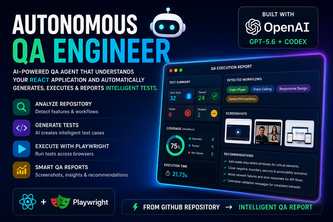
TestingAgent is an AI-powered QA tool for React applications that claims to automate test case generation and execution using natural language instructions. The author describes it as an "Autonomous QA Engineer" built with Python, Playwright, Streamlit, and LLMs like GPT-5.6 and Llama 3.2.
What changed
The project was submitted as a hackathon entry (OpenAI Build Week 2026), indicating early-stage development and prototype status. No evidence of commercial traction or product-market fit exists beyond the author's self-description.
Single most important open question
Is there any evidence that this tool has been used by developers outside of the hackathon context, or that it generates meaningful test coverage in real-world applications?
What The Product Actually Is
The description states that TestingAgent is an AI-powered QA agent for React JavaScript and TypeScript applications. It claims to:
- Analyze GitHub repositories or local React projects.
- Understand natural language QA instructions (e.g., “Test the login functionality”).
- Generate intelligent test cases and Playwright scripts.
- Execute automated tests with screenshots and HTML reporting.
- Work offline using a rule-based engine.
- Integrate Ollama with Llama 3.2 for enhanced understanding when available.
It also includes modules such as:
- Repository Analyzer
- Code Parser
- Instruction Engine
- Test Case Generator
- Playwright Generator
- Test Executor
- Screenshot Manager
- Report Generator
The author notes that it was built using Python, Streamlit, Playwright, Pytest, Ollama (Llama 3.2), SQLite, Git analysis techniques, and rule-based workflows.
Confidence Low — all described features are self-reported without evidence of functionality or usage.
Positioning & Claim Evolution
The author positions TestingAgent as an AI-powered QA agent that behaves like a senior QA engineer, aiming to reduce time spent on writing UI and functional tests by automating the process through natural language input.
Key claims:
- Reduces manual effort in QA automation.
- Makes intelligent testing accessible to every developer.
- Transforms traditional QA workflow into a simple three-step experience: Analyze → Select → Run.
- Works completely offline using a rule-based engine.
- Uses AI tools like GPT-5.6 and Codex during development.
There is no indication of prior positioning or evolution in the description — this appears to be a one-time self-description from a hackathon submission.
Confidence Low — claims are unverified, and there's no evidence of market positioning beyond the author’s own words.
Target Customer & ICP
The author states that TestingAgent targets developers who want to automate QA for React applications, especially those who find manual test creation time-consuming.
It is positioned for:
- Developers working with React projects.
- Teams looking to reduce QA overhead.
- Users seeking AI-assisted QA automation without relying on paid APIs or cloud services.
No explicit segmentation or customer personas are provided. The ICP seems to be individual developers and small teams building React apps, but no evidence supports adoption or demand from such groups.
Confidence Low — no data on actual users, customers, or target segments beyond stated intent.
Business Model & Pricing Evidence
There is no evidence in the description of any business model or pricing structure. The author does not mention monetization plans, subscription tiers, licensing models, or revenue streams.
The project is described as a hackathon submission and lacks any indication of commercial viability or product-market fit.
Confidence Not evidenced — no information on how this would be sold or funded.
Technical & Delivery Signals
Technical components mentioned:
- Built with Python, Streamlit, Playwright, Pytest, Ollama (Llama 3.2), SQLite
- Uses Git repository analysis techniques
- Rule-based testing workflows
- Offline execution capability
- Integration of LLMs like GPT-5.6 and Codex
The architecture is modular:
- Repository Analyzer
- Code Parser
- Instruction Engine
- Test Case Generator
- Playwright Generator
- Test Executor
- Screenshot Manager
- Report Generator
- QA Chat Assistant
- Rule-Based Engine
- Llama Integration Layer
It supports offline use with a fallback rule-based engine.
Confidence Medium — technical details are provided, but no validation of performance or scalability.
Traction & Maturity Signals
The project is described as a hackathon submission (OpenAI Build Week 2026) and has no evidence of:
- Revenue
- Customers
- Product adoption
- Market traction
- Post-hackathon development or iteration
It was built rapidly using AI tools like GPT-5.6 and Codex, suggesting early prototype status.
Confidence Very low — no signs of traction or maturity beyond initial concept.
Competitive Context
No mention of competitors in the description. However, based on the stated functionality (React QA automation with AI), potential categories include:
- Test automation platforms (e.g., Selenium, Playwright)
- AI-powered testing tools
- Developer tooling for QA workflows
There is no evidence that TestingAgent competes directly with existing solutions or has differentiated features beyond what’s described.
Confidence Not evidenced — no competitive analysis or positioning against existing tools.
Open Questions & Risks
Key risks and open questions:
- Unproven functionality: No evidence of real-world usage or effectiveness.
- Prototype status: Built as a hackathon project, not validated for production use.
- AI dependency: Relies heavily on LLMs (GPT-5.6, Codex) which may not be scalable or reliable in enterprise settings.
- Limited scope: Currently focused only on React apps; no evidence of broader support.
- No commercialization plan: No pricing, monetization, or go-to-market strategy.
- Self-reported maturity: All claims are from the author and lack independent verification.
Confidence High — these are clear structural issues based on the limited evidence provided.
Questions the description leaves open
- Has TestingAgent been tested in real-world React applications beyond the hackathon?
- What is the accuracy of its test case generation? Can it detect critical workflows reliably?
- How does it handle complex React features or edge cases not covered in the prototype?
- Are there any plans to expand support beyond React (e.g., Next.js, Angular)?
- What is the roadmap for monetization and product development post-hackathon?
- Has the team validated demand from developers who might use this tool?
- How does it compare to existing tools like Playwright or Selenium in terms of usability and effectiveness?
Overall Assessment
Assessment Not ready for investment or partnership.
TestingAgent is currently a hackathon prototype with no demonstrated traction, revenue, or customer validation. While the idea shows promise in addressing developer pain points around QA automation, there is no evidence of product-market fit, scalability, or commercial viability.
The author’s claims are ambitious but unverified, and the tool lacks any indication of real-world utility or adoption beyond its own description.
Confidence Very low — this is a speculative idea with no supporting data.
User Stories BotA demo video on every pull request
Get a demo video on every new feature
GitHub App that watches your pull requests and records a narrated, captioned demo.
Save time on demo prep and make informed decisions faster with a video walkthrough of every new feature.
Source
Submitted to the OpenAI 2026 hackathon on Devpost. Project home on Devpost. Back to the full gallery on Devpost.
This competitive analysis was produced by top-founders.com (opens in a new tab)
Generated by a language model from this project's public Devpost page — its tagline, the author's own write-up and any built-with tags listed there — as captured in August 2026. Short quotations are the author's words. It is an opinion on the idea as a business, not on the people behind it, and it reflects the description as published then. If the project has moved on, request a correction below. The analysis is not independent research and contains no verified traction, revenue or customer data.
An independent guide by KFG International LLC — not affiliated with, endorsed by, or connected to Devpost or OpenAI.