

Archive position — measured, not model output
0 likes on Devpost
2,263 of the 7,850 archived projects have more likes, and 5,587 share exactly 0 — so this project's #7,198 place in the like-ranked listing is a tie-break inside that group, not a ranking.
Projects (log scale)
Likes on Devpost. ▲ marks this project's group.
Show the figures
| Likes | Projects | Share of archive |
|---|---|---|
| 0 | 5,587 | 71.2% |
| 1 | 1,758 | 22.4% |
| 2 | 284 | 3.6% |
| 3–4 | 132 | 1.7% |
| 5–9 | 75 | 1.0% |
| 10+ | 14 | 0.2% |
 User Stories BotA demo video on every pull request
Get a demo video on every new feature
GitHub App that watches your pull requests and records a narrated, captioned demo.
Save time on demo prep and make informed decisions faster with a video walkthrough of every new feature.
Executive Summary
What the company appears to be
Testrig, as described by its author, is an open-source tool designed for reviewing AI model migrations. It enables teams to compare outputs from different AI models using a structured corpus of test cases, and provides deterministic checks alongside human review capabilities. The system supports both synthetic (immutable) and self-hosted (with real provider credentials) workflows.
What changed
This is a self-reported project submitted for the OpenAI 2026 hackathon. It does not indicate any prior commercial activity or product release beyond its demonstration at the event.
Single most important open question
Is there evidence of traction, adoption, or revenue generation from this tool? The description contains no data on users, customers, or monetization — only a self-reported technical implementation and use case.
Note: All findings are based solely on the author’s own description. No external verification is available. This is not a commercial due-diligence read of an existing company but rather an analysis of a self-reported project submitted to a hackathon.
What The Product Actually Is
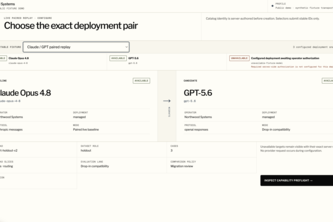
The description states that Testrig is an open-source tool for reviewing AI model migrations. It replays a representative corpus against a baseline and candidate model, pairs executions by stable case identity, applies deterministic checks, allows human review of differences, and exports fingerprint-bound evidence.
Key features include:
- Paired trace explorer interface
- Filtering outcomes, expanding cases, comparing durations
- Inspection of outputs, checks, inputs, reviews, and evidence
- Export of verification artifacts
- Deliberate two-step deletion flow
The tool supports both synthetic fixtures (used in public demo) and self-hosted paths with real provider credentials.
Claim: The product is described as a migration review tool for AI models.
Evidence: Author's own write-up.
Inference: This appears to be a developer-facing tool aimed at reducing risk during model swaps in AI applications.
Positioning & Claim Evolution
The author states that Testrig addresses the gap between comparing model prices and benchmark scores, and understanding migration risks such as structured outputs, tool calls, errors, latency, and ambiguous behavior. It aims to provide "fingerprint-bound evidence" of changes without claiming semantic equivalence or production approval.
It is positioned as a way to "replay one representative corpus" and make migration reviews inspectable and auditable.
Claim: Testrig positions itself as a tool for validating AI model migrations through structured testing.
Evidence: Author's own write-up.
Inference: The positioning suggests it targets developers or ML engineers who need to assess risks when switching models in production-like environments.
Target Customer & ICP
The description does not explicitly name target customers. However, the tool is described as useful for teams reviewing AI model migrations and for developers working with structured outputs and tool calls.
It supports both synthetic (demo) and self-hosted workflows, suggesting it could appeal to developers or engineering teams within organizations using AI models in their applications.
Claim: The intended users are likely engineers or ML practitioners involved in AI model migration.
Evidence: Author's own write-up.
Inference: Not directly stated; inferred from context of use case and technical architecture.
Business Model & Pricing Evidence
There is no mention of pricing, monetization, or business model in the description. The tool is described as open-source, and there are no references to paid features, subscriptions, or revenue streams.
Claim: No evidence of a defined business model or pricing structure.
Evidence: Author's own write-up.
Inference: Not evidenced — no indication of commercialization plans or monetization strategy.
Technical & Delivery Signals
The tool is built using:
- Rust, Axum, Tokio, Serde, SQLx, SQLite
- Next.js, React, TypeScript
- Playwright for QA
- Docker Compose for demo setup
It includes features like:
- Deterministic checks
- Canonicalization of inputs/outputs
- Fingerprint-bound exports
- Immutable configuration snapshots
- Strict request conformance and mock support
Security practices include:
- Secrets kept out of browser, logs, Git history
- No automatic retries on provider dispatch
- Null rather than zero for missing usage or price
- Untrusted model output handling
Claim: The tool is technically robust with strong security boundaries.
Evidence: Author's own write-up.
Inference: Based on the detailed technical architecture, this seems plausible but not verified.
Traction & Maturity Signals
There is no evidence of traction or adoption beyond its submission to a hackathon. No mention of users, customers, downloads, or usage metrics.
The project was built in a short timeframe (hackathon) and is described as a prototype with intentional limitations:
- Avoids LLM judges
- Does not offer automatic routing recommendations
- Does not claim broad compatibility
Claim: No evidence of traction or maturity beyond hackathon submission.
Evidence: Author's own write-up.
Inference: Not evidenced — no data on adoption, user base, or product evolution.
Competitive Context
The description does not reference competitors or existing tools in the AI model migration space. It focuses on its own unique features rather than situating itself within a competitive landscape.
Claim: No evidence of competitive positioning or awareness.
Evidence: Author's own write-up.
Inference: Not evidenced — no mention of similar products or market analysis.
Open Questions & Risks
- No commercial traction or revenue: The tool is described as a hackathon submission with no indication of real-world usage.
- Limited scope: Intentionally avoids LLM judges, automatic routing, and broad compatibility claims.
- Self-hosted only path: The self-hosted version requires manual setup and configuration.
- No pricing or monetization strategy: No evidence of how the tool would be monetized if developed further.
- Open-source nature: May limit commercial viability unless combined with a SaaS offering.
Claim: Risks include lack of traction, unclear monetization, and limited scope.
Evidence: Author's own write-up.
Inference: Based on absence of key commercial indicators.
Questions the description leaves open
- What is the intended path to market or product development beyond this hackathon prototype?
- Are there any early adopters or pilot users who have tested the tool in real-world scenarios?
- How do you plan to monetize or scale the open-source offering?
- What are the specific use cases where teams would benefit most from Testrig’s functionality?
- Has the team considered integrating with popular AI platforms (e.g., OpenAI, Anthropic)?
- Are there any plans to support additional model providers beyond those tested in the demo?
Note: These questions aim to uncover whether the project has evolved beyond a proof-of-concept and shows signs of commercial viability.
Overall Assessment
Not evidenced.
There is no evidence of revenue, customers, traction, or any commercial activity beyond the hackathon submission. The tool is described as open-source and built for internal use during a competition. No indication exists that it has moved past prototype stage or gained adoption.
Claim: No basis for investment or partnership decision.
Evidence: Author's own write-up.
Inference: Not evidenced — no data on performance, market fit, or commercial potential.
User Stories BotA demo video on every pull request
Get a demo video on every new feature
GitHub App that watches your pull requests and records a narrated, captioned demo.
Save time on demo prep and make informed decisions faster with a video walkthrough of every new feature.
Source
Submitted to the OpenAI 2026 hackathon on Devpost. Project home on Devpost. Back to the full gallery on Devpost.
This competitive analysis was produced by top-founders.com (opens in a new tab)
Generated by a language model from this project's public Devpost page — its tagline, the author's own write-up and any built-with tags listed there — as captured in August 2026. Short quotations are the author's words. It is an opinion on the idea as a business, not on the people behind it, and it reflects the description as published then. If the project has moved on, request a correction below. The analysis is not independent research and contains no verified traction, revenue or customer data.
An independent guide by KFG International LLC — not affiliated with, endorsed by, or connected to Devpost or OpenAI.