

Archive position — measured, not model output
0 likes on Devpost
2,263 of the 7,850 archived projects have more likes, and 5,587 share exactly 0 — so this project's #7,200 place in the like-ranked listing is a tie-break inside that group, not a ranking.
Projects (log scale)
Likes on Devpost. ▲ marks this project's group.
Show the figures
| Likes | Projects | Share of archive |
|---|---|---|
| 0 | 5,587 | 71.2% |
| 1 | 1,758 | 22.4% |
| 2 | 284 | 3.6% |
| 3–4 | 132 | 1.7% |
| 5–9 | 75 | 1.0% |
| 10+ | 14 | 0.2% |
 User Stories BotA demo video on every pull request
Get a demo video on every new feature
GitHub App that watches your pull requests and records a narrated, captioned demo.
Save time on demo prep and make informed decisions faster with a video walkthrough of every new feature.
Executive Summary
What the company appears to be
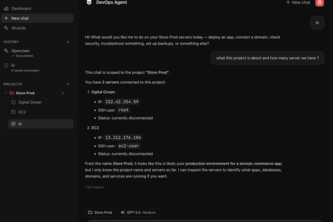
Tevada DevOps is a self-reported desktop application built for developers and "vibe coders" who want to manage their own servers via SSH/SFTP and deploy applications using AI assistance, without needing deep DevOps knowledge or relying on cloud-based SaaS platforms.
What changed
The project was submitted as part of the OpenAI 2026 hackathon. It is described as a working prototype with cross-platform support (macOS/Windows/Linux), but no commercial traction or revenue is evidenced.
Single most important open question
Is there any evidence that users are actively using this tool, or that it has moved beyond a proof-of-concept stage?
Note: This analysis is based entirely on the self-reported project description provided by the author. No independent verification, archived data, or third-party sources were used.
What The Product Actually Is
The description states that Tevada DevOps is:
- A desktop app built with Electron + React/TypeScript
- It includes an in-app SSH terminal (powered by xterm.js) and SFTP file browser
- An AI copilot panel integrated into server actions
- One-click deployment templates using Dokploy format
- GitHub sign-in via device-flow authentication
- MCP integration for Claude Code/Codex
- Designed to run on infrastructure the user owns, not as a SaaS product
Inference: The tool is positioned as an end-to-end desktop solution for managing and deploying applications on personal servers.
Claim: The author claims it's a desktop app with integrated AI assistance.
Evidence: Yes — from the project write-up and tech stack.
Positioning & Claim Evolution
The description states:
- Tevada DevOps aims to bring "vibe-coding" energy all the way to production
- It is described as a tool that keeps things simple, safe, and free to run
- The goal is to remove barriers between coding and deployment for non-DevOps users
- It emphasizes running on user-owned infrastructure, avoiding vendor lock-in or per-seat fees
Inference: The positioning evolves from a hackathon prototype into a vision of a lightweight, accessible DevOps tool for indie developers and hobbyists.
Claim: The author positions the product as a way to simplify deployment without SaaS complexity.
Evidence: Yes — in the inspiration and what it does sections.
Target Customer & ICP
The description states:
- Intended for "vibe coders" — people who can describe an app to an AI and watch it get built quickly
- Users who want to deploy their apps without wrestling with SSH or hosting bills
- Developers who don’t know DevOps but want to manage their own servers
- Builders who prefer not to pay per-seat SaaS fees
Inference: The ICP appears to be indie developers, hobbyists, and small teams who value ownership over infrastructure and simplicity in deployment.
Claim: The target customer is non-DevOps users who build apps on personal servers.
Evidence: Yes — from the inspiration and what it does sections.
Business Model & Pricing Evidence
The description states:
- Everything runs against infrastructure you own
- No per-seat SaaS fee
- No vendor lock-in
- The tool is free to run
- GitHub sign-in and one-click MCP install are included features
Inference: There is no evidence of a monetization model beyond the current desktop app. No pricing, subscriptions, or paid tiers are mentioned.
Claim: The business model avoids SaaS fees and vendor lock-in.
Evidence: Yes — from the “What it does” section.
Claim: No pricing information provided.
Evidence: Not evidenced.
Technical & Delivery Signals
The description states:
- Built with Electron + React/TypeScript
- Uses xterm.js for terminal, ssh2 for SSH/SFTP connections
- Integrates GitHub App with device-flow sign-in
- Includes a local MCP server for Claude Code/Codex integration
- Packaged using Electron Forge for macOS/Windows/Linux
- Native modules like ssh2 were challenging to package cross-platform
Inference: The technical stack suggests a desktop-first approach, with some complexity in native module handling.
Claim: The tool is built as a cross-platform desktop app.
Evidence: Yes — from the “How we built it” section.
Claim: Native packaging issues were encountered.
Evidence: Yes — from the “Challenges we ran into” section.
Traction & Maturity Signals
The description states:
- It is a working desktop app
- Has solved packaging problems for macOS/cross-platform use
- GitHub App integration works with smooth device-flow sign-in
- One-click MCP install is functional
- The project was submitted to the OpenAI 2026 hackathon
Inference: This is a prototype or MVP, not yet proven in production or at scale.
Claim: It’s a working desktop app.
Evidence: Yes — from “What it does” and “Accomplishments that we’re proud of”
Claim: No traction or adoption data provided.
Evidence: Not evidenced.
Competitive Context
The description does not mention any competitors directly. However, the author implies a niche for tools that:
- Allow deployment on personal servers
- Integrate AI assistance into DevOps workflows
- Are free and avoid vendor lock-in
Inference: The space likely overlaps with tools like Dokploy, GitHub Codespaces, or other self-hosted deployment platforms, but no direct comparison is made.
Claim: No competitive analysis provided.
Evidence: Not evidenced.
Open Questions & Risks
- The tool is described as a desktop app only — no web/cloud/mobile versions currently
- No evidence of user feedback, usage metrics, or real-world adoption
- The project was submitted to a hackathon — implies early-stage development
- Native module packaging issues suggest potential scalability or maintenance concerns
- No pricing or monetization strategy is evident
Inference: The tool may be in an early prototype phase with limited commercial viability.
Claim: No evidence of traction, revenue, or user base.
Evidence: Not evidenced.
Questions the description leaves open
- What is the current usage or feedback from users?
- Are there plans to expand beyond desktop (web, mobile)?
- How does the AI copilot handle security and command execution?
- Is there any plan for monetization or pricing models?
- What are the technical challenges in scaling this to more users or environments?
Note: These questions are based on the lack of evidence around traction, scalability, and business model.
Overall Assessment
The description indicates that Tevada DevOps is a hackathon submission with a working prototype. It is not evidenced to have any revenue, customers, or commercial traction.
Assessment: Not ready for investment or partnership at this stage. The product shows promise in solving a niche problem but lacks evidence of real-world usage or business viability.
Confidence Level: Low — based on self-reported information only, no third-party validation or data.
User Stories BotA demo video on every pull request
Get a demo video on every new feature
GitHub App that watches your pull requests and records a narrated, captioned demo.
Save time on demo prep and make informed decisions faster with a video walkthrough of every new feature.
Source
Submitted to the OpenAI 2026 hackathon on Devpost. Project home on Devpost. Back to the full gallery on Devpost.
This competitive analysis was produced by top-founders.com (opens in a new tab)
Generated by a language model from this project's public Devpost page — its tagline, the author's own write-up and any built-with tags listed there — as captured in August 2026. Short quotations are the author's words. It is an opinion on the idea as a business, not on the people behind it, and it reflects the description as published then. If the project has moved on, request a correction below. The analysis is not independent research and contains no verified traction, revenue or customer data.
An independent guide by KFG International LLC — not affiliated with, endorsed by, or connected to Devpost or OpenAI.