

Archive position — measured, not model output
0 likes on Devpost
2,263 of the 7,850 archived projects have more likes, and 5,587 share exactly 0 — so this project's #3,276 place in the like-ranked listing is a tie-break inside that group, not a ranking.
Projects (log scale)
Likes on Devpost. ▲ marks this project's group.
Show the figures
| Likes | Projects | Share of archive |
|---|---|---|
| 0 | 5,587 | 71.2% |
| 1 | 1,758 | 22.4% |
| 2 | 284 | 3.6% |
| 3–4 | 132 | 1.7% |
| 5–9 | 75 | 1.0% |
| 10+ | 14 | 0.2% |
 User Stories BotA demo video on every pull request
Get a demo video on every new feature
GitHub App that watches your pull requests and records a narrated, captioned demo.
Save time on demo prep and make informed decisions faster with a video walkthrough of every new feature.
Executive Summary
What the company appears to be
Clariia Action Inbox is a self-reported tool that connects ChatGPT to a user's personal workspace via the Model Context Protocol (MCP), enabling users to send content from ChatGPT into an inbox for review before it is filed or published. It is built by a solo founder, Donna O'Donoghue, who describes herself as an artist and business owner rather than a traditional developer.
What changed
The project was extended during Build Week, with improvements made to authentication (OAuth), routing, diagnostic logging, and workflow support for content types like recipes and images. The author states that the system now supports a production-level workflow from ChatGPT to Clariia.
Single most important open question
Is there evidence of real-world usage or adoption by solopreneurs or small-business owners beyond the founder’s own testing?
Note: This analysis is based entirely on the self-reported, unverified description provided by the author. No third-party verification, revenue data, customer list, or traction metrics are available.
What The Product Actually Is
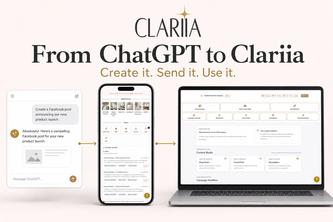
- The description states that Clariia Action Inbox connects securely to ChatGPT through the Model Context Protocol (MCP).
- Users can create content in ChatGPT and send it to their Clariia Action Inbox.
- Supported content includes tasks, notes, projects, blog drafts, social posts, newsletter drafts, recipes, and images.
- Content arrives as a pending card for review; nothing is automatically published or filed.
- The user decides whether to send the item to the appropriate Clariia workspace.
- The system uses Firebase, Firestore, OAuth, JavaScript, Node.js, and MCP.
Inference: Based on the description, this appears to be an integration tool that allows users to manage AI-generated content from ChatGPT in a structured way, with human approval before any action is taken. It does not appear to be a standalone SaaS product but rather a workflow enhancement for existing systems.
Positioning & Claim Evolution
- The author claims Clariia was created to help solopreneurs and small-business owners manage their work more easily.
- The tagline states: “Turn ChatGPT creations into organised, human-approved work.”
- The project evolved from an earlier version during Build Week, with improvements in authentication, routing, and workflow support.
- The author emphasizes that the tool helps avoid copying, pasting, and reorganizing AI-generated content manually.
Claim: Clariia is positioned as a solution for people who struggle with organizing ChatGPT output into usable business systems.
Inference: The positioning has evolved from a personal tool to one intended for broader use by non-technical users, though no evidence of external adoption exists.
Target Customer & ICP
- The author identifies solopreneurs and small-business owners as the primary audience.
- These users are described as struggling with consistency in social media and content creation.
- They may not be technically inclined but want to leverage AI tools like ChatGPT without losing control over their output.
Not evidenced: No specific customer personas, user segments, or market research data are provided. The target is inferred from the author's stated problem.
Business Model & Pricing Evidence
- There is no mention of pricing, subscriptions, monetization, or business model in the description.
- The project is described as a personal tool built during a hackathon and later extended for production use.
- No indication of whether it will be offered as a paid service, freemium, or open-source.
Not evidenced: No evidence of any commercial structure, pricing tiers, or monetization strategy.
Technical & Delivery Signals
- Built using ChatGPT, GPT-5.6, OpenAI Codex, Visual Studio Code, JavaScript, Node.js, Firebase, Firestore, OAuth, and MCP.
- The author used Codex to implement changes, write tests, and verify workflows.
- Improvements included better OAuth sign-in, reconnection logic, routing, logging, and support for new content types (recipes, images).
- Authentication is designed to avoid replacing the user’s session or exposing account ownership information.
Inference: The technical stack suggests a lightweight, serverless architecture using Firebase and AI-assisted development. The use of Codex implies an experimental or iterative approach to building software.
Traction & Maturity Signals
- The author states that Clariia works as a real production workflow from ChatGPT to Clariia.
- A demonstration was shown where a Facebook post created in ChatGPT was delivered to Clariia, reviewed, and saved into the Social Posts workspace.
- The system has been tested with multiple content types and destinations.
- No mention of actual users, usage statistics, or feedback from external testers.
Not evidenced: No evidence of real-world adoption, user base, or performance metrics beyond the founder’s own testing.
Competitive Context
- The description does not reference competitors or similar tools in the market.
- It focuses on integrating ChatGPT with personal workspaces, which could overlap with tools like Notion, Airtable, Zapier, or other AI workflow platforms.
- No indication of how Clariia differentiates itself from existing solutions.
Not evidenced: No competitive landscape analysis or differentiation strategy provided.
Open Questions & Risks
- The project is built by a single person (1-person team), which raises concerns about scalability and long-term maintenance.
- The author describes herself as a non-traditional developer, suggesting potential technical limitations or lack of deep engineering experience.
- No evidence of revenue, customers, or product-market fit beyond the founder’s own use case.
- The reliance on ChatGPT and Codex for development introduces uncertainty about reproducibility and future viability if those tools change.
- The tool is described as a workflow enhancement rather than a standalone product, which may limit its commercial appeal.
Inference: Risk of limited traction due to lack of external validation, scalability concerns from single-person operation, and potential technical fragility in AI-assisted development.
Questions the description leaves open
- What specific problems do solopreneurs or small-business owners face when trying to organize ChatGPT-generated content?
- How many users have you tested the system with beyond yourself?
- Have you validated your solution with actual customers in a real business environment?
- What are the long-term plans for monetization, if any?
- Can you explain how the authentication and routing systems handle edge cases or failures?
- How do you plan to scale beyond a single developer’s capacity?
Overall Assessment
- The project is in an early stage of development, built by one person with limited external validation.
- It addresses a plausible pain point for users of ChatGPT and AI tools, but lacks evidence of traction or commercial viability.
- There is no indication of revenue, customers, or product-market fit beyond the founder’s own experience.
- The use of AI-assisted development (Codex) introduces uncertainty about long-term maintainability and scalability.
Assessment: Not ready for investment or partnership at this time. Further evidence of real-world usage, customer feedback, and a clear path to monetization is needed before considering deeper due diligence.
User Stories BotA demo video on every pull request
Get a demo video on every new feature
GitHub App that watches your pull requests and records a narrated, captioned demo.
Save time on demo prep and make informed decisions faster with a video walkthrough of every new feature.
Source
Submitted to the OpenAI 2026 hackathon on Devpost. Project home on Devpost. Back to the full gallery on Devpost.
This competitive analysis was produced by top-founders.com (opens in a new tab)
Generated by a language model from this project's public Devpost page — its tagline, the author's own write-up and any built-with tags listed there — as captured in August 2026. Short quotations are the author's words. It is an opinion on the idea as a business, not on the people behind it, and it reflects the description as published then. If the project has moved on, request a correction below. The analysis is not independent research and contains no verified traction, revenue or customer data.
An independent guide by KFG International LLC — not affiliated with, endorsed by, or connected to Devpost or OpenAI.