

Archive position — measured, not model output
1 like on Devpost
505 of the 7,850 archived projects have more likes, and 1,758 share exactly 1 — so this project's #1,311 place in the like-ranked listing is a tie-break inside that group, not a ranking.
Projects (log scale)
Likes on Devpost. ▲ marks this project's group.
Show the figures
| Likes | Projects | Share of archive |
|---|---|---|
| 0 | 5,587 | 71.2% |
| 1 | 1,758 | 22.4% |
| 2 | 284 | 3.6% |
| 3–4 | 132 | 1.7% |
| 5–9 | 75 | 1.0% |
| 10+ | 14 | 0.2% |
 User Stories BotA demo video on every pull request
Get a demo video on every new feature
GitHub App that watches your pull requests and records a narrated, captioned demo.
Save time on demo prep and make informed decisions faster with a video walkthrough of every new feature.
Executive Summary
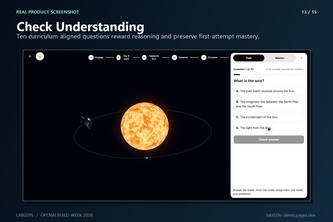
Lab029s is an AI-native science-lab platform built around a practical learning loop: curriculum → model → learner action → evidence → feedback → teacher insight. The project description states that it was developed during a hackathon and includes a vertical slice of a Grade 4 lesson on Earth's movements, implemented using React, Three.js, Node.js, FastAPI, LangGraph, and OpenAI APIs (specifically GPT-5.6 Sol in Codex). It emphasizes adaptive mentoring, evidence-based assessment, and teacher-ready reports.
The platform is described as having a plugin architecture for lessons, with the Earth's movements lesson being one vertical slice demonstrating how this system works. The AI is used primarily for reasoning and code assistance rather than runtime execution, and fallbacks are built in to ensure learning can proceed without AI availability.
Key commercial signals:
- Not evidenced: revenue, customers, or adoption
- Not evidenced: business model beyond self-description
- Not evidenced: pricing structure
- Not evidenced: team traction or prior funding
The single most important open question is whether the described plugin architecture and lesson design can scale to support multiple curriculum-aligned labs while maintaining scientific rigor and teacher utility.
What The Product Actually Is
The description states that Lab029s is an AI-guided 3D science-lab platform built around a practical loop: curriculum → model → learner action → evidence → feedback → teacher insight. It includes:
- A vertical slice of a Grade 4 lesson on Earth's movements
- Six-stage learning flow with interactive 3D scenes using Three.js
- Adaptive mentoring that responds to learner attempts and misconceptions
- Evidence-based assessment where learners must complete specific actions to progress
- Teacher-ready reports with visible evidence and rubrics
- Plugin architecture for lesson-specific curriculum, stages, misconceptions, rubric, Mentor behavior, and scene bindings
The platform uses React, TypeScript, Vite, Tailwind CSS for frontend; Three.js for 3D scenes; Node.js gateway; FastAPI/LangGraph service for lesson plugins; PostgreSQL and Prisma for data storage; deployed on Cloudflare Pages and Google Cloud Run.
Positioning & Claim Evolution
The description states that Lab029s is positioned as an AI-native platform that turns science curricula into interactive 3D labs with adaptive mentoring, evidence-based assessment, and teacher-ready reports. The authors note they started with a question about whether a child can explain sunrise after actually moving Earth instead of memorizing a paragraph.
The claim evolution shows:
- Initial focus on closing the gap between video explanation and learner discovery
- Emphasis on making the model part of the assessment rather than just showing answers
- Positioning as an AI-guided platform, not an AI replacement for learning
- Focus on practicality over cinematic presentation
Target Customer & ICP
The description states that the target customer is Grade 4 learners and their teachers. The lesson specifically targets Grade 4 Earth's movements curriculum. The platform is designed to be used in ordinary browsers with no special hardware requirements.
The ICP appears to be:
- K-12 science educators
- Grade 4 students learning about Earth's movements
- Schools or educational institutions seeking interactive science curricula
Business Model & Pricing Evidence
Not evidenced. The description does not contain any information about business model, pricing structure, revenue streams, or monetization strategy.
Technical & Delivery Signals
The platform uses:
- Frontend: React, TypeScript, Vite, Tailwind CSS
- 3D scenes: Three.js (imperative approach)
- Backend: Node.js gateway, FastAPI/LangGraph service
- Data storage: PostgreSQL with Prisma
- Deployment: Cloudflare Pages, Google Cloud Run
- AI tools: GPT-5.6 Sol in Codex for engineering and reasoning
The description notes:
- Separation of concerns between React (lesson state) and Three.js (scene controller)
- Deterministic local validation and hints as fallbacks
- Pixel ratio bounded, lazy-loaded assets, performance optimizations
- Use of LangGraph for lesson plugins
- Separate OpenAI runtime model from the Codex engineering partner
Traction & Maturity Signals
Not evidenced. The description does not contain any information about traction, revenue, customers, or adoption metrics.
Competitive Context
Not evidenced. The description does not contain any information about competitors, market positioning, or competitive landscape.
Open Questions & Risks
- The platform is described as built during a hackathon with no prior work beyond the shared platform shell
- No evidence of real user testing or feedback from Grade 4 learners and teachers
- The AI is used primarily for engineering assistance rather than runtime execution
- The plugin architecture is described but not demonstrated in practice
- No information about scalability to other curriculum areas
- No evidence of production deployment or long-term sustainability
Questions the description leaves open
- What specific curriculum standards does this platform address, and how many are planned?
- How will the platform scale beyond one lesson to multiple science disciplines?
- What is the plan for real user testing with Grade 4 students and teachers?
- How does the plugin architecture work in practice, and what are the maintenance costs?
- What are the technical challenges of deploying this in real classroom environments?
- How will the platform handle different learning paces and styles?
- What is the long-term vision for AI integration beyond engineering assistance?
Overall Assessment
Not evidenced. The description does not contain any information about funding, investment status, or partnership opportunities. The project appears to be a hackathon submission with no demonstrated traction or commercial viability beyond the single lesson implementation.
User Stories BotA demo video on every pull request
Get a demo video on every new feature
GitHub App that watches your pull requests and records a narrated, captioned demo.
Save time on demo prep and make informed decisions faster with a video walkthrough of every new feature.
Source
Submitted to the OpenAI 2026 hackathon on Devpost. Project home on Devpost. Back to the full gallery on Devpost.
This competitive analysis was produced by top-founders.com (opens in a new tab)
Generated by a language model from this project's public Devpost page — its tagline, the author's own write-up and any built-with tags listed there — as captured in August 2026. Short quotations are the author's words. It is an opinion on the idea as a business, not on the people behind it, and it reflects the description as published then. If the project has moved on, request a correction below. The analysis is not independent research and contains no verified traction, revenue or customer data.
An independent guide by KFG International LLC — not affiliated with, endorsed by, or connected to Devpost or OpenAI.