

Archive position — measured, not model output
0 likes on Devpost
2,263 of the 7,850 archived projects have more likes, and 5,587 share exactly 0 — so this project's #5,237 place in the like-ranked listing is a tie-break inside that group, not a ranking.
Projects (log scale)
Likes on Devpost. ▲ marks this project's group.
Show the figures
| Likes | Projects | Share of archive |
|---|---|---|
| 0 | 5,587 | 71.2% |
| 1 | 1,758 | 22.4% |
| 2 | 284 | 3.6% |
| 3–4 | 132 | 1.7% |
| 5–9 | 75 | 1.0% |
| 10+ | 14 | 0.2% |
 User Stories BotA demo video on every pull request
Get a demo video on every new feature
GitHub App that watches your pull requests and records a narrated, captioned demo.
Save time on demo prep and make informed decisions faster with a video walkthrough of every new feature.
Executive Summary
What the company appears to be
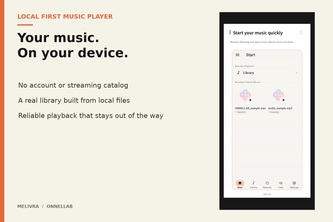
Melivra is a self-reported local music player for Android and iOS, built as a personal project by a single developer (ONNEL LAB). It claims to support offline playback of local music libraries with adaptive UI, accessibility features, and no accounts or streaming.
What changed
The author states that during the OpenAI 2026 hackathon Build Week, they focused on improving layout adaptability across devices, fixing playback lifecycle issues, enhancing library scanning, and strengthening accessibility. They also used Codex as an engineering partner to debug interface and playback problems.
The single most important open question
Is Melivra a viable product or just a prototype? The description does not provide evidence of revenue, customers, or adoption beyond the author's own account.
Analysis basis
This report is based entirely on the self-reported project description provided by the caller. It contains no external verification, archived data, or third-party corroboration. All claims are treated as stated by the author and not proven true.
What The Product Actually Is
The description states that Melivra is a local music player for Android and iOS. It scans music chosen by the listener and organizes it by song, album, artist, album artist, composer, genre, year, and folder. Files remain local.
Key features mentioned:
- Persistent queue
- Resume playback
- Bookmarks
- Favorites
- Ratings
- Playlists
- Playback speed
- A-B repeat
- EQ
- Volume normalization
- Gapless playback
- System controls (Android Media3, iOS AVFoundation)
- Widgets for both platforms
The app is built using Flutter and Dart. SQLite stores the local library index and listening state. The presentation layer asks application controllers for library and playback state instead of opening files directly.
Platform audio stays native:
- Android uses Media3 and system media session
- iOS uses AVFoundation and Control Center integration
The author notes that Codex was used to help finish parts difficult on real devices, including layouts that survive small screens and large text, library state consistency after scans, and predictable playback across Flutter and native engines.
Evidence Self-reported by the author. No independent verification or data about actual functionality beyond the description.
Positioning & Claim Evolution
The author states their inspiration was to create a player that treats local music as a real library and stays out of the way — contrasting with players that flatten collections into folders or surround them with accounts, recommendations, and online services.
Key positioning claims:
- Offline-first
- Turns huge local libraries into fast, accessible, adaptive listening experience
- Reliable playback
- Smart navigation
- No accounts or streaming
The author also emphasizes:
- Local music first
- No recommendation feed
- No account requirement
- No patch whose only purpose was to make a test pass
During Build Week, the focus shifted toward improving:
- Adaptive UI for different screen sizes and zoom levels
- Accessibility (TalkBack, VoiceOver)
- Playback lifecycle consistency
- Library scanning robustness
Evidence Self-reported claims about intent and positioning. No evidence of market traction or customer feedback.
Target Customer & ICP
The description does not explicitly state who the target customer is. However, it implies a user who:
- Keeps music files locally
- Values treating their collection as a real library
- Prefers offline access without accounts or streaming
- Uses Android and/or iOS devices
- May have large local libraries
There is no mention of specific personas, segments, or use cases beyond the author's personal motivation.
Evidence Inferred from the author’s stated intent. No explicit customer segmentation or ICP defined.
Business Model & Pricing Evidence
The description does not contain any information about pricing, monetization, or business model. The author describes Melivra as a local music player without accounts or streaming — implying no subscription or transactional model.
Evidence Not evidenced. No mention of revenue streams, pricing tiers, or commercial strategy.
Technical & Delivery Signals
The app is built with Flutter and Dart. SQLite stores the local library index and listening state. The presentation layer communicates with application controllers rather than opening files directly.
Platform audio remains native:
- Android uses Media3 and system media session
- iOS uses AVFoundation and Control Center integration
Key technical elements:
- Incremental scan-source persistence
- Normalized library grouping
- Queue, detail navigation, resume, and native playback lifecycle fixes
- Physical-device harness that records constraints, overflow, keyboard, navigation, and accessibility evidence
- Use of Codex for debugging interface and playback issues
The author mentions using Codex to trace symptoms to owning routes, controllers, database queries, or native callbacks; then changing those boundaries and checking nearby callers.
Evidence Self-reported technical details. No independent validation or performance data.
Traction & Maturity Signals
There is no evidence of traction, customers, or adoption beyond the author’s own account. The project was submitted to a hackathon (Devpost), and the author notes that the Build Week work touched 118 files across app, native platforms, tests, harnesses, and documentation.
The author states:
- The next step is to run final judging builds through physical-device matrix
- They want to keep improving large-library scan time and playback recovery
No mention of downloads, user base, retention, or usage metrics.
Evidence Not evidenced. No data on product adoption or performance in real-world conditions.
Competitive Context
The description does not provide any information about competitors or the competitive landscape. It only describes Melivra’s own features and design choices.
Evidence Not evidenced. No comparison to existing products or market positioning.
Open Questions & Risks
- Single-person development: The project is described as a solo effort, which raises questions about scalability, long-term maintenance, and team capacity.
- No revenue or monetization model: The lack of any business model or pricing information suggests the product may not be intended for commercial sale.
- Prototype nature: The project appears to be a hackathon submission with no evidence of production-ready features or market validation.
- Unverified claims: All descriptions are self-reported and unverified. There is no third-party confirmation of functionality, performance, or user experience.
- Limited scope: The focus on local music players without streaming or recommendation systems may limit its appeal in a broader market.
Inference These risks stem from the lack of evidence for commercial viability or product maturity.
Questions the description leaves open
- What is your long-term vision for Melivra beyond this hackathon project?
- Have you tested the app with real users, and what feedback have you received?
- Are there any plans to monetize or scale the product?
- How do you plan to handle device compatibility beyond the current testing matrix?
- What are your thoughts on expanding support for additional platforms or file formats?
- Can you describe how you would address potential scalability issues with large local libraries?
Note
These questions are based on the limited information provided in the self-reported description.
Overall Assessment
There is insufficient evidence to assess whether Melivra represents a viable investment or partnership opportunity. The project appears to be a prototype developed during a hackathon, with no demonstrated traction, revenue, or customer base.
The author’s claims about product features and design choices are self-reported and unverified. Without independent validation of functionality, performance, or market demand, it is not possible to evaluate the commercial potential of Melivra.
Confidence level Low — based on thin evidence and lack of verifiable data.
User Stories BotA demo video on every pull request
Get a demo video on every new feature
GitHub App that watches your pull requests and records a narrated, captioned demo.
Save time on demo prep and make informed decisions faster with a video walkthrough of every new feature.
Source
Submitted to the OpenAI 2026 hackathon on Devpost. Project home on Devpost. Back to the full gallery on Devpost.
This competitive analysis was produced by top-founders.com (opens in a new tab)
Generated by a language model from this project's public Devpost page — its tagline, the author's own write-up and any built-with tags listed there — as captured in August 2026. Short quotations are the author's words. It is an opinion on the idea as a business, not on the people behind it, and it reflects the description as published then. If the project has moved on, request a correction below. The analysis is not independent research and contains no verified traction, revenue or customer data.
An independent guide by KFG International LLC — not affiliated with, endorsed by, or connected to Devpost or OpenAI.