

Archive position — measured, not model output
1 like on Devpost
505 of the 7,850 archived projects have more likes, and 1,758 share exactly 1 — so this project's #1,312 place in the like-ranked listing is a tie-break inside that group, not a ranking.
Projects (log scale)
Likes on Devpost. ▲ marks this project's group.
Show the figures
| Likes | Projects | Share of archive |
|---|---|---|
| 0 | 5,587 | 71.2% |
| 1 | 1,758 | 22.4% |
| 2 | 284 | 3.6% |
| 3–4 | 132 | 1.7% |
| 5–9 | 75 | 1.0% |
| 10+ | 14 | 0.2% |
 User Stories BotA demo video on every pull request
Get a demo video on every new feature
GitHub App that watches your pull requests and records a narrated, captioned demo.
Save time on demo prep and make informed decisions faster with a video walkthrough of every new feature.
Executive Summary
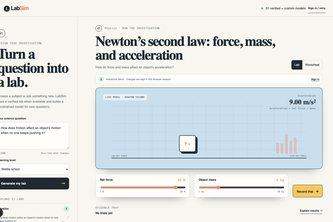
LabSim is a browser-based science investigation workspace described by its author as an educational tool for students to engage with interactive simulations or explore their own scientific questions. The product was built in two days using Codex and GPT-5.6-Sol, with no verified revenue, customers, or traction data. The author states that LabSim allows students to adjust variables, record trials, observe results, and complete guided worksheets — but does not describe how this is monetized or who pays for it.
The single most important open question is: What is the actual commercial model behind LabSim, and how will it scale beyond a single developer's prototype?
This analysis is based entirely on self-reported information from the author. There is no evidence of revenue, customer acquisition, pricing, partnerships, or any form of commercial traction.
What The Product Actually Is
The description states that LabSim is a browser-based science investigation workspace. It allows students to:
- Choose a trusted interactive simulation
- Describe their own question
- Record trials
- Complete a worksheet
It is built using Codex and GPT-5.6-Sol, with Next.js, PostgreSQL, and TypeScript.
Inference: The product appears to be an educational platform for science learning that integrates AI-generated simulations or exploratory tools within a browser environment.
Not evidenced: No details on how the product functions technically beyond its build stack; no screenshots, user flows, or interface descriptions are provided.
Positioning & Claim Evolution
The author claims LabSim was inspired by their work teaching children about large language models and AI, aiming to make learning more engaging and accessible. The project is positioned as an educational tool that uses AI to accelerate development and enable interactive science exploration.
Inference: The positioning suggests a focus on democratizing access to science education through AI-assisted experimentation and simulation.
Not evidenced: No evidence of prior versions, market research, or competitive positioning beyond the hackathon submission. No claims about specific learning outcomes or pedagogical frameworks are made.
Target Customer & ICP
The author states that LabSim is for students who can choose between a trusted simulation or explore their own question. The product supports guided evidence-based worksheets and trial recording.
Inference: The target customer appears to be K-12 or early college-level science students, possibly in educational settings.
Not evidenced: No information about age groups, grade levels, school districts, or institutional adoption is provided. No indication of whether the tool targets teachers, parents, or institutions directly.
Business Model & Pricing Evidence
The description does not state how LabSim will generate revenue or who pays for it. It mentions students using the platform but does not describe any pricing model, subscription structure, or monetization strategy.
Inference: The business model is unclear; it may be free-to-use, B2B (e.g., schools), or B2C (e.g., individual users). No evidence supports any of these assumptions.
Not evidenced: No mention of licensing, subscriptions, usage fees, grants, or institutional partnerships. No pricing data, payment flows, or monetization strategy are described.
Technical & Delivery Signals
LabSim was built in two days using Codex and GPT-5.6-Sol, with Next.js, PostgreSQL, and TypeScript. The author notes challenges deploying the app on Netlify.
Inference: The tool is a prototype built rapidly using AI-assisted development tools. It may be technically unstable or limited in scope due to its rapid development cycle.
Not evidenced: No information about scalability, security, data privacy, or long-term technical architecture. No mention of testing, QA, or production stability beyond initial deployment.
Traction & Maturity Signals
The author states that LabSim was built and deployed in two days, and that it is a fully functional product. It was submitted to the OpenAI 2026 hackathon.
Inference: The project is at an early prototype stage, likely not yet used by real students or institutions.
Not evidenced: No evidence of user feedback, usage metrics, customer interviews, or adoption rates. No mention of pilot programs, beta users, or institutional trials.
Competitive Context
No information is provided about existing competitors or market players in the educational simulation or science learning space.
Inference: LabSim may compete with platforms like PhET, Khan Academy, or other browser-based science tools, but this is speculative.
Not evidenced: No mention of direct or indirect competition, nor any differentiation strategy from existing offerings.
Open Questions & Risks
- Unproven commercial model: No evidence of how LabSim will be monetized.
- Prototype-only status: Built in two days; no indication of long-term viability or scalability.
- AI dependency: Reliance on Codex and GPT-5.6-Sol raises concerns about sustainability, cost, and control over development.
- No traction or adoption: No evidence of users, customers, or institutional interest beyond the author’s own use.
Not evidenced: No risk assessments, financial forecasts, or market validation data are provided.
Questions the description leaves open
- What is your plan for monetizing LabSim? Who pays for it?
- How do you intend to scale beyond a single developer's prototype?
- Have you tested LabSim with real students or teachers? What feedback have you received?
- What are the technical limitations of using Codex and GPT-5.6-Sol for product development?
- Are there any legal or ethical considerations around AI-generated content in educational tools?
- How do you plan to ensure data privacy and security for student users?
Overall Assessment
The description provides no evidence of commercial traction, revenue, or customer adoption. LabSim is described as a prototype built in two days by one developer, with no indication of market validation or scalability.
Inference: At this stage, LabSim is not ready for investment or partnership consideration without further development and proof of concept.
Not evidenced: No valuation, funding history, or strategic alignment data are available. The project lacks the commercial signals typically required to assess viability for investment or partnership.
User Stories BotA demo video on every pull request
Get a demo video on every new feature
GitHub App that watches your pull requests and records a narrated, captioned demo.
Save time on demo prep and make informed decisions faster with a video walkthrough of every new feature.
Source
Submitted to the OpenAI 2026 hackathon on Devpost. Project home on Devpost. Back to the full gallery on Devpost.
This competitive analysis was produced by top-founders.com (opens in a new tab)
Generated by a language model from this project's public Devpost page — its tagline, the author's own write-up and any built-with tags listed there — as captured in August 2026. Short quotations are the author's words. It is an opinion on the idea as a business, not on the people behind it, and it reflects the description as published then. If the project has moved on, request a correction below. The analysis is not independent research and contains no verified traction, revenue or customer data.
An independent guide by KFG International LLC — not affiliated with, endorsed by, or connected to Devpost or OpenAI.