

Archive position — measured, not model output
1 like on Devpost
505 of the 7,850 archived projects have more likes, and 1,758 share exactly 1 — so this project's #1,306 place in the like-ranked listing is a tie-break inside that group, not a ranking.
Projects (log scale)
Likes on Devpost. ▲ marks this project's group.
Show the figures
| Likes | Projects | Share of archive |
|---|---|---|
| 0 | 5,587 | 71.2% |
| 1 | 1,758 | 22.4% |
| 2 | 284 | 3.6% |
| 3–4 | 132 | 1.7% |
| 5–9 | 75 | 1.0% |
| 10+ | 14 | 0.2% |
 User Stories BotA demo video on every pull request
Get a demo video on every new feature
GitHub App that watches your pull requests and records a narrated, captioned demo.
Save time on demo prep and make informed decisions faster with a video walkthrough of every new feature.
Executive Summary
What the company appears to be
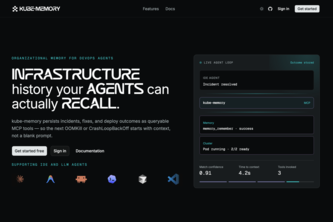
The description states that kube-memory is a platform designed to provide AI agents with persistent, searchable memory of an organization's infrastructure history. It aims to enable AI coding assistants and CI/CD pipelines to recall past incidents, fixes, deployment outcomes, and operational runbooks before making decisions. The system is described as MCP-native and integrates with various DevOps tools such as Kubernetes, GitHub, Slack, PagerDuty, and cloud providers.
What changed
The project was built for the OpenAI 2026 hackathon. It represents an early-stage prototype or proof-of-concept that integrates AI agents with operational knowledge systems in a DevOps context. The authors describe it as an attempt to move beyond simple tool exposure to LLMs and instead create a system where AI agents can accumulate operational experience over time.
The single most important open question
Is there any evidence of traction, revenue, or customer adoption beyond the hackathon submission? The description does not provide any data on usage, customers, or monetization, which is critical for assessing commercial viability.
What The Product Actually Is
- The description states that kube-memory is a MCP-native platform.
- It provides persistent, searchable memory of an organization's infrastructure history.
- It enables AI agents and CI/CD pipelines to recall similar incidents, previous fixes, deployment outcomes, and operational runbooks.
- It includes:
- An MCP-native server compatible with Cursor, VS Code, Claude Desktop, and other MCP clients.
- A semantic memory layer powered by Cognee.
- A workspace dashboard for integrations, API keys, and configuration.
- Connectors to Kubernetes, GitHub, Slack, PagerDuty, Prometheus, ArgoCD, AWS, Azure, GCP, Datadog, Splunk, Jira, and others.
- Risk prediction for planned deployments using historical incidents.
- REST APIs for CI pipelines and automation.
- The system is composed of:
- A secure multi-tenant backend handling authentication, RBAC, encrypted connector credentials, and API key management.
- A memory layer that converts incidents into structured operational episodes.
- A modern dashboard for configuration and integration.
Not evidenced: No information on actual product functionality beyond the hackathon prototype, or whether it has been deployed in production environments.
Positioning & Claim Evolution
- The description positions kube-memory as a platform that allows AI agents to learn from operational experience, rather than starting from scratch each time.
- It claims to offer organizational memory for DevOps agents.
- It describes itself as:
- Not just another AI wrapper around Kubernetes.
- A system that lets AI agents accumulate operational experience over time.
- An MCP-native developer experience.
- A tool that supports end-to-end deployment workflows involving Kubernetes, GitHub, Slack, and long-term memory.
Inference: The positioning suggests a move toward autonomous AI-driven DevOps operations, but this is not substantiated with evidence of real-world usage or adoption beyond the hackathon.
Target Customer & ICP
- The description implies that the primary users are DevOps teams working in environments where Kubernetes and related platforms are used.
- These teams likely include engineers who rely on AI coding assistants, CI/CD pipelines, and incident response workflows.
- The platform targets organizations seeking to reduce repetitive debugging and improve deployment reliability through AI-assisted reasoning over historical data.
Not evidenced: No explicit identification of specific customer segments, personas, or use cases beyond general DevOps contexts. No evidence of target accounts or buyer personas.
Business Model & Pricing Evidence
- The description does not mention any pricing model, subscription tiers, or monetization strategy.
- It states that the platform includes REST APIs for CI pipelines and automation, suggesting potential integration into enterprise workflows.
- There is no indication of whether the product will be sold as a SaaS offering, open-source, or part of an enterprise license.
Not evidenced: No evidence of business model, pricing structure, or revenue streams.
Technical & Delivery Signals
- The system is built using MCP (Model Control Protocol) and integrates with tools like Codex.
- It uses Cognee for semantic memory.
- It supports secure multi-tenancy, including:
- Authentication
- RBAC
- Encrypted connector credentials
- API key management
- The backend exposes both MCP tools and REST APIs.
- It includes a modern dashboard with features like:
- Integration configuration
- API key generation
- Workspace isolation
Inference: The technical architecture suggests a sophisticated, scalable system designed for enterprise use. However, this is based on the self-reported build process and not verified in production.
Traction & Maturity Signals
- The project was submitted to the OpenAI 2026 hackathon.
- It includes a production-ready dashboard with authentication, integrations, and API key management.
- The authors claim to have shipped a complete MCP-native developer experience.
- They describe a fully functional end-to-end deployment workflow that spans Kubernetes, GitHub, Slack, and long-term memory.
Not evidenced: No evidence of actual user adoption, customer feedback, or real-world performance metrics. No data on headcount, funding, or product maturity beyond the hackathon prototype.
Competitive Context
- The description does not provide any information about competitors.
- It implies that kube-memory is positioned to augment AI agents with organizational memory, which could overlap with:
- Knowledge management platforms
- Observability tools (e.g., Datadog, Splunk)
- DevOps automation platforms
- AI coding assistant integrations
Not evidenced: No competitive landscape analysis or differentiation from existing solutions.
Open Questions & Risks
- The project is described as a hackathon submission, indicating an early-stage prototype.
- There is no evidence of:
- Revenue
- Customers
- Product-market fit
- Scalability beyond the hackathon environment
- The platform relies heavily on MCP compatibility, which may limit adoption if not widely adopted.
- The use of Codex for development raises questions about dependency risks and scalability.
- The system requires integration with many external platforms, which introduces complexity and potential failure points.
Inference: Without traction or commercial validation, the risk of misalignment between product vision and market demand is high.
Questions the description leaves open
- What are the key assumptions underlying your positioning as an AI agent memory platform for DevOps?
- How do you plan to scale beyond the hackathon prototype?
- Have you validated your concept with any real-world users or organizations?
- What is your path to monetization, and how do you intend to price the solution?
- Are there any technical dependencies (e.g., Codex) that could pose risks to long-term viability?
- How do you plan to handle data privacy and security in multi-tenant environments?
- What are the biggest challenges in maintaining consistent memory representation over time?
Overall Assessment
- The description indicates a conceptual and technical foundation for a platform that could be valuable in AI-assisted DevOps workflows.
- However, there is no evidence of traction, revenue, or customer adoption beyond the hackathon submission.
- The project appears to be an early-stage prototype with strong technical execution but unclear commercial viability.
- Given the lack of verified data on users, market fit, or monetization strategy, this presents a high-risk opportunity with potential for growth if validated in real-world use cases.
Not evidenced: No financials, customer base, or strategic partnerships to support an investment or partnership decision.
User Stories BotA demo video on every pull request
Get a demo video on every new feature
GitHub App that watches your pull requests and records a narrated, captioned demo.
Save time on demo prep and make informed decisions faster with a video walkthrough of every new feature.
Source
Submitted to the OpenAI 2026 hackathon on Devpost. Project home on Devpost. Back to the full gallery on Devpost.
This competitive analysis was produced by top-founders.com (opens in a new tab)
Generated by a language model from this project's public Devpost page — its tagline, the author's own write-up and any built-with tags listed there — as captured in August 2026. Short quotations are the author's words. It is an opinion on the idea as a business, not on the people behind it, and it reflects the description as published then. If the project has moved on, request a correction below. The analysis is not independent research and contains no verified traction, revenue or customer data.
An independent guide by KFG International LLC — not affiliated with, endorsed by, or connected to Devpost or OpenAI.