

Archive position — measured, not model output
0 likes on Devpost
2,263 of the 7,850 archived projects have more likes, and 5,587 share exactly 0 — so this project's #7,194 place in the like-ranked listing is a tie-break inside that group, not a ranking.
Projects (log scale)
Likes on Devpost. ▲ marks this project's group.
Show the figures
| Likes | Projects | Share of archive |
|---|---|---|
| 0 | 5,587 | 71.2% |
| 1 | 1,758 | 22.4% |
| 2 | 284 | 3.6% |
| 3–4 | 132 | 1.7% |
| 5–9 | 75 | 1.0% |
| 10+ | 14 | 0.2% |
 User Stories BotA demo video on every pull request
Get a demo video on every new feature
GitHub App that watches your pull requests and records a narrated, captioned demo.
Save time on demo prep and make informed decisions faster with a video walkthrough of every new feature.
Executive Summary
What the company appears to be
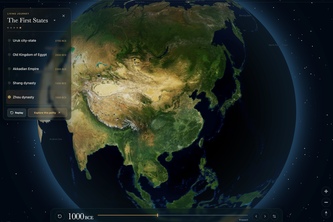
Terrava Earth, as described by its author, is a global historical atlas interface that explores power, place, and time across every polity in recorded history. It uses a local agent engine to continuously expand, refine, and publish the atlas. The product is built using AI coding tools like Codex and ChatGPT, with a technical stack including Next.js, FastAPI, Mapbox, PostgreSQL, and Rust.
What changed
This is a self-reported project submitted as part of an OpenAI 2026 hackathon. It represents an early-stage prototype or proof-of-concept, not yet a commercial product or service. The author states they are building it further ("BUILD! There is no way I'm letting this go") but does not indicate any revenue, customers, or traction beyond the hackathon submission.
Single most important open question
Is there sufficient evidence in the self-reported description to suggest that Terrava Earth has a viable path from prototype to product, and whether its core idea—using AI to build a continuously expanding historical atlas—is scalable or defensible?
What The Product Actually Is
The description states:
- Terrava Earth is a global interface for exploring power, place, and time across every polity in recorded history.
- It features a large globe-centric view, with timelines showing changing polities and views.
- It includes power, place, and time journeys, as well as selected polity details.
- A local agent engine is used to continuously expand, refine, and publish the atlas.
The author also describes how it was built:
- Primarily using Codex (99%), with support from ChatGPT.
- Built with a stack including Next.js, FastAPI, Mapbox, PostgreSQL, Rust, Python, TypeScript, React.
- The system is designed to be locally built and hosted, with the agent engine handling expansion.
Inference The product appears to be an interactive historical map tool that uses AI to generate and update content about political entities over time. It is not a traditional SaaS or marketplace but rather a data-driven, AI-enhanced visualization platform.
Positioning & Claim Evolution
The author states:
- The inspiration came from a fascination with history, especially the complexity of simultaneous historical events.
- The goal was to create an ambitious project for a hackathon, leveraging prior experience building map apps with AI coding tools.
- The idea evolved into a local build & host split, using Codex as the engine harness.
Inference The positioning seems to be that Terrava Earth is a historical exploration tool that combines mapping and AI to offer a unique way of understanding political change over time. It is not yet positioned as a commercial product but rather as an experimental, scalable idea with potential for future development.
Target Customer & ICP
The description does not provide specific information about:
- Who the end users are.
- What their needs or behaviors are.
- Whether there’s a defined ICP (Ideal Customer Profile).
Not evidenced.
Business Model & Pricing Evidence
There is no mention in the self-reported description of:
- How the product would be monetized.
- What pricing model might apply.
- Whether there are paid features or tiers.
Not evidenced.
Technical & Delivery Signals
The author states:
- The system uses Codex as the primary engine, with ChatGPT for support.
- It is built using a stack including Next.js, FastAPI, Mapbox, PostgreSQL, Rust, Python, TypeScript, React.
- The architecture supports a local build and host split.
- There is a focus on linting, preflight checks, and review skills to improve AI coding quality.
Inference The technical approach suggests that the product is built with modern web and backend technologies, and that it leverages AI for content generation. The local agent engine implies a decentralized or distributed model of data creation and updating.
Traction & Maturity Signals
The description states:
- This was a hackathon submission.
- The author has proved the idea works ("I proved the idea. This will work.").
- A prototype exists, though it is incomplete ("semi prototype").
- The author plans to continue building ("BUILD! There is no way I'm letting this go").
- The agent engine is described as "feeling a bit sloppy" but powerful once cleaned up.
Not evidenced
No evidence of:
- Revenue
- Customers
- Users
- Product adoption
- Market traction
Competitive Context
The description does not mention:
- Competitors in the historical data or mapping space.
- How Terrava Earth differentiates from existing tools.
- Whether similar products already exist.
Not evidenced.
Open Questions & Risks
- The project is not yet a product, but a prototype.
- It was built in a hackathon environment, with limited time and resources.
- The author notes that the agent engine is not fully developed ("feeling a bit sloppy").
- There is no evidence of:
- Revenue
- Customers
- Product-market fit
- Scalable or defensible business model
Inference The biggest risk is that the project may not evolve beyond a prototype without significant additional development, funding, and validation. The AI-driven content generation approach introduces uncertainty in terms of accuracy, scalability, and consistency.
Questions the description leaves open
- What are the key assumptions underlying the agent engine’s ability to continuously expand and refine the atlas?
- How will the data be validated for historical accuracy?
- What is the plan for monetization or commercial viability beyond the prototype phase?
- Are there any existing partnerships, datasets, or collaborations that support this project?
- What are the technical challenges in scaling the local build & host model to a global audience?
Overall Assessment
The description states:
- The author is committed to continuing development ("BUILD! There is no way I'm letting this go").
- The idea has been proven ("I proved the idea. This will work.").
- It uses AI coding tools, including Codex, which suggests a strong technical foundation.
Not evidenced
No evidence of:
- Revenue
- Customers
- Traction
- Market validation
- Business model
Assessment (inference)
Terrava Earth is an early-stage idea with potential for development into a product. However, it is currently a prototype, and the self-reported description does not provide sufficient evidence to assess its commercial viability or scalability. It may be worth investing time in further due diligence if there’s a plan to validate the concept with real users or data sources.
User Stories BotA demo video on every pull request
Get a demo video on every new feature
GitHub App that watches your pull requests and records a narrated, captioned demo.
Save time on demo prep and make informed decisions faster with a video walkthrough of every new feature.
Source
Submitted to the OpenAI 2026 hackathon on Devpost. Project home on Devpost. Back to the full gallery on Devpost.
This competitive analysis was produced by top-founders.com (opens in a new tab)
Generated by a language model from this project's public Devpost page — its tagline, the author's own write-up and any built-with tags listed there — as captured in August 2026. Short quotations are the author's words. It is an opinion on the idea as a business, not on the people behind it, and it reflects the description as published then. If the project has moved on, request a correction below. The analysis is not independent research and contains no verified traction, revenue or customer data.
An independent guide by KFG International LLC — not affiliated with, endorsed by, or connected to Devpost or OpenAI.