

Archive position — measured, not model output
0 likes on Devpost
2,263 of the 7,850 archived projects have more likes, and 5,587 share exactly 0 — so this project's #7,192 place in the like-ranked listing is a tie-break inside that group, not a ranking.
Projects (log scale)
Likes on Devpost. ▲ marks this project's group.
Show the figures
| Likes | Projects | Share of archive |
|---|---|---|
| 0 | 5,587 | 71.2% |
| 1 | 1,758 | 22.4% |
| 2 | 284 | 3.6% |
| 3–4 | 132 | 1.7% |
| 5–9 | 75 | 1.0% |
| 10+ | 14 | 0.2% |
 User Stories BotA demo video on every pull request
Get a demo video on every new feature
GitHub App that watches your pull requests and records a narrated, captioned demo.
Save time on demo prep and make informed decisions faster with a video walkthrough of every new feature.
Executive Summary
What the company appears to be
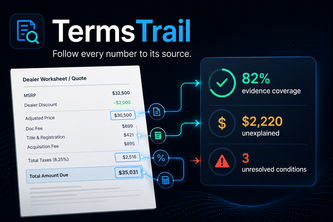
TermsTrail is a self-reported tool designed to analyze dealer advertisements, messages, PDFs, and worksheets related to vehicle purchases. It claims to parse these materials for key terms such as documented, missing, conditional, unexplained, or changed elements, and to provide buyers with evidence-linked clarification requests before they commit.
What changed
The project was submitted as an OpenAI Build Week hackathon entry, indicating a recent development phase focused on demonstrating core functionality within a constrained timeframe. It is described as a standalone project built from scratch during the event, not derived from any prior business or product line.
Single most important open question
Does TermsTrail’s approach to parsing and reconciling deal terms using AI and deterministic code actually work in practice, or does it remain an untested concept?
Note: This analysis is based solely on the self-reported description provided by the author. No external verification, traction data, revenue figures, customer base, or performance metrics are available.
What The Product Actually Is
The description states that TermsTrail:
- Processes dealer advertisements, screenshots, messages, PDFs, and worksheets.
- Identifies terms as:
- Documented
- Missing
- Conditional
- Unexplained
- Changed
- Recalculates quotes using deterministic code.
- Measures evidence coverage via explicit completeness rules.
- Links findings to source pages or excerpts.
- Generates precise clarification requests for buyers.
- Accepts later dealer responses and updates the trail accordingly.
It also states that:
- It does not decide whether a deal is fair, legal, or safe to sign.
- It shows what the supplied evidence supports and what still needs clarification.
- The public demonstration uses fictional dealerships, vehicles, buyers, and documents.
- It does not contact dealers automatically and does not process payments, credit applications, or real customer information.
Inference: Based on the author's own description, TermsTrail is a proof-of-concept tool intended to help consumers better understand vehicle purchase terms by linking claims back to their sources. Its architecture combines AI interpretation with deterministic code for arithmetic verification.
Positioning & Claim Evolution
The author states that:
- TermsTrail was inspired by the need for a simpler way to follow every important number back to its source before committing to a major purchase.
- It aims to show what is documented, missing, conditional, unexplained, or changed—so buyers know what to ask before they commit.
- The tool does not make decisions but provides clarity.
Inference: The positioning appears to be consumer-focused, emphasizing transparency and empowerment in high-stakes purchasing decisions. The evolution seems to have started with a hackathon project, suggesting it is early-stage and experimental.
Target Customer & ICP
The description states:
- The tool targets buyers of vehicles who receive information from dealers through ads, messages, PDFs, and worksheets.
- It focuses on helping them answer basic questions like:
- Which numbers are actually documented?
- Which discounts have conditions?
- Does the stated total match itemized charges?
- What important information is still missing?
- Did terms change after asking for clarification?
Inference: The primary customer segment appears to be individual consumers making large purchases (e.g., cars), particularly those who may lack technical or legal expertise to parse complex financial documents.
Business Model & Pricing Evidence
Not evidenced.
The description does not mention any pricing model, monetization strategy, or business model. It only describes the tool’s functionality and its use in a demo context.
Technical & Delivery Signals
The author states:
- Built with:
- API, ChatGPT, Codex, GPT-5.6, Next.js, OpenAI, Outputs, Playwright, React, Render, Responses, Structured, TypeScript, Vitest, Zod
- Uses Codex for repository structure, schemas, interface, reconciliation engine, tests, synthetic fixtures, and evaluation framework.
- GPT-5.6 uses OpenAI Responses API and Structured Outputs to interpret mixed PDFs, screenshots, and natural-language messages.
- Deterministic TypeScript code handles:
- Currency normalization
- Arithmetic verification
- Unexplained-dollar calculations
- Evidence Coverage
- Critical-field rules
- Revision comparison
- Evidence-reference validation
Inference: The technical stack suggests a hybrid approach combining AI interpretation with rule-based code for accuracy. The use of structured outputs and deterministic logic implies an attempt to reduce ambiguity in parsing.
Traction & Maturity Signals
Not evidenced.
There is no mention of users, customers, revenue, or adoption beyond the fictional demo context. No data on usage, engagement, or product maturity is provided.
Competitive Context
Not evidenced.
The description does not reference existing competitors, market size, or competitive positioning. It does not explain how TermsTrail compares to other tools or platforms in this space.
Open Questions & Risks
- Unproven concept: The tool is described as a hackathon project with no real-world testing or validation.
- No revenue or traction data: There are no signs of monetization, user base, or product traction.
- Limited scope: The demo uses fictional examples and does not process actual customer data.
- AI vs. code dependency: While the system separates AI interpretation from deterministic calculation, it’s unclear how well this separation works in practice.
- Lack of integration capability: It doesn’t appear to connect with dealers or real systems, limiting its utility beyond demonstration.
Questions the description leaves open
- What specific types of documents have been tested so far? Are there any real-world examples?
- How does the system handle ambiguity in language when extracting claims?
- Has there been any testing with actual users or dealers?
- What are the plans for scaling beyond the current demo scope?
- Is there a plan to integrate with real dealer systems or APIs?
- How is uncertainty represented and managed without inventing facts?
- What kind of feedback has been received from potential buyers during demos?
Overall Assessment
Not evidenced.
There is no indication of funding, valuation, or investment interest. The project is described as a hackathon submission with no mention of commercial viability, strategic partnerships, or investor engagement. It remains an unproven concept in early development.
User Stories BotA demo video on every pull request
Get a demo video on every new feature
GitHub App that watches your pull requests and records a narrated, captioned demo.
Save time on demo prep and make informed decisions faster with a video walkthrough of every new feature.
Source
Submitted to the OpenAI 2026 hackathon on Devpost. Project home on Devpost. Back to the full gallery on Devpost.
This competitive analysis was produced by top-founders.com (opens in a new tab)
Generated by a language model from this project's public Devpost page — its tagline, the author's own write-up and any built-with tags listed there — as captured in August 2026. Short quotations are the author's words. It is an opinion on the idea as a business, not on the people behind it, and it reflects the description as published then. If the project has moved on, request a correction below. The analysis is not independent research and contains no verified traction, revenue or customer data.
An independent guide by KFG International LLC — not affiliated with, endorsed by, or connected to Devpost or OpenAI.