

Archive position — measured, not model output
0 likes on Devpost
2,263 of the 7,850 archived projects have more likes, and 5,587 share exactly 0 — so this project's #3,268 place in the like-ranked listing is a tie-break inside that group, not a ranking.
Projects (log scale)
Likes on Devpost. ▲ marks this project's group.
Show the figures
| Likes | Projects | Share of archive |
|---|---|---|
| 0 | 5,587 | 71.2% |
| 1 | 1,758 | 22.4% |
| 2 | 284 | 3.6% |
| 3–4 | 132 | 1.7% |
| 5–9 | 75 | 1.0% |
| 10+ | 14 | 0.2% |
 User Stories BotA demo video on every pull request
Get a demo video on every new feature
GitHub App that watches your pull requests and records a narrated, captioned demo.
Save time on demo prep and make informed decisions faster with a video walkthrough of every new feature.
Executive Summary
What the company appears to be
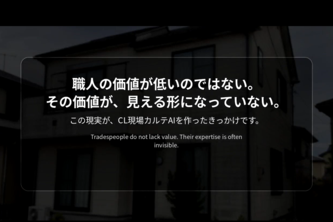
CL Field Report AI is a local-first browser-based tool designed for tradespeople to generate clear, photo-based inspection reports from field notes and photographs. It uses GPT-5.6 as an assistant to help translate tacit field knowledge into customer-friendly language while preserving human judgment in final decisions.
What changed
The project was developed during the OpenAI 2026 hackathon (Build Week), where it evolved from a prototype used in real field work into a more robust tool with improved safety, usability, and documentation. It includes enhancements to photo handling, PDF output, saving mechanisms, and consistency warnings.
The single most important open question
Is there evidence of real-world adoption or traction beyond the hackathon context? The description states that one ten-page report was completed in 40 minutes before Build Week, but no data on ongoing usage, customer base, or revenue is provided.
What The Product Actually Is
- The description states that CL Field Report AI is a local-first browser tool built with HTML, CSS, JavaScript, and uses LocalStorage and IndexedDB for data storage.
- It supports photo annotations, linking related photos to inspection findings, and generates structured PDF reports.
- It integrates GPT-5.6 as an assistant to help organize field notes into natural explanations for customers.
- The tool is designed for small construction and renovation companies, where one person handles all aspects of inspection, sales, and reporting.
- Input data is not sent automatically; users manually decide what information to share with GPT-5.6, review the output, and confirm before using it.
- AI does not determine diagnoses, urgency, materials, quantities, or final customer decisions — these remain under human control.
Note
The product is described as a browser-based tool, not a SaaS platform or cloud-hosted service. It is self-contained and runs locally in the browser.
Positioning & Claim Evolution
- The description states that the company aims to turn tradespeople’s tacit field knowledge into clear, photo-based inspection reports.
- It positions itself as a tool that helps professionals communicate their expertise effectively, rather than replacing it.
- The core claim is that AI should assist in making decisions understandable, not make them.
- The evolution from prototype to enhanced version during Build Week shows an emphasis on safety, usability, and integrity of human judgment.
Inference The positioning reflects a shift toward responsible AI use — focusing on augmentation over automation — which may appeal to small businesses seeking clarity without sacrificing control.
Target Customer & ICP
- The description states that the tool is intended for small construction and renovation companies, where one person handles inspection, sales, estimates, and reporting.
- It targets tradespeople who have field experience but struggle to communicate that knowledge clearly to customers.
- No explicit segmentation beyond this is provided.
Not evidenced There are no details about specific job functions (e.g., electricians, plumbers), geographic markets, or customer size ranges. The ICP remains broadly defined.
Business Model & Pricing Evidence
- The description does not mention any pricing model, revenue streams, or monetization strategy.
- It is unclear whether the tool will be sold as a SaaS product, a one-time license, or offered free to tradespeople.
- No evidence of customer acquisition plans, sales cycles, or distribution channels.
Not evidenced There is no indication of how the company intends to generate revenue or sustain its business model beyond the hackathon context.
Technical & Delivery Signals
- The application is built as a local-first browser tool, using HTML, CSS, JavaScript, LocalStorage, and IndexedDB.
- It supports photo annotations, linking related images to findings, and structured PDF output.
- AI integration uses GPT-5.6 for organizing field notes into customer-friendly language.
- The workflow is designed for real field use, not just technical demonstration.
- During Build Week, the team made 23 commits to improve safety, usability, recovery features, and compatibility with saved reports.
Inference The local-first architecture suggests low infrastructure costs and privacy benefits, which may appeal to small contractors concerned about data security.
Traction & Maturity Signals
- One real ten-page inspection report was completed in approximately 40 minutes before Build Week.
- During Build Week, the team improved safety, usability, saving mechanisms, photo relationships, PDF structure, and documentation.
- The tool has been used in real field work, indicating early adoption.
- No evidence of ongoing usage, customer retention, or growth metrics is provided.
Not evidenced There are no signs of sustained traction beyond the hackathon. No data on user engagement, repeat usage, or market expansion is available.
Competitive Context
- The description does not provide any information about competitors or existing solutions in the inspection report generation space.
- It does not reference similar tools or platforms used by tradespeople for documentation or reporting.
- No mention of how this tool differentiates from other AI-assisted reporting systems or traditional inspection software.
Not evidenced There is no competitive analysis, market positioning, or differentiation strategy described.
Open Questions & Risks
- The tool is a local-first browser app, which may limit scalability and ease of distribution.
- It relies heavily on manual input and human approval, which could slow adoption if users prefer fully automated workflows.
- The use of GPT-5.6 raises questions about data privacy, especially since the tool does not send data automatically but still requires user consent to share information with AI.
- No evidence of a go-to-market strategy, customer acquisition plan, or monetization model.
- The team size is listed as one person, which may pose challenges for product development, marketing, and scaling.
Inference If the tool becomes popular, it might face scalability issues due to its local-first design and limited team capacity.
Questions the description leaves open
- What specific feedback did you receive from tradespeople during real field use?
- How do you plan to scale beyond a single developer and reach small contractors?
- Are there any plans for cloud integration or multi-user support in the future?
- What are your thoughts on data privacy implications of using GPT-5.6 with field data?
- How do you intend to monetize this tool, and what is your pricing strategy?
- Have you considered how to ensure consistent quality across different users' inputs?
Overall Assessment
- The project is self-reported, unverified, and lacks any evidence of traction, revenue, or customer data.
- It demonstrates a clear problem-solution fit for small tradespeople needing better communication tools.
- The tool’s design prioritizes human judgment over AI autonomy, which may resonate with certain market segments.
- However, there is no indication of commercial viability, market validation, or sustainable business model.
Assessment This is an early-stage idea with potential but no demonstrated traction. It requires further due diligence to assess whether it can evolve into a scalable and profitable solution. The lack of evidence around customers, revenue, or growth makes it difficult to evaluate investment or partnership opportunities at this stage.
User Stories BotA demo video on every pull request
Get a demo video on every new feature
GitHub App that watches your pull requests and records a narrated, captioned demo.
Save time on demo prep and make informed decisions faster with a video walkthrough of every new feature.
Source
Submitted to the OpenAI 2026 hackathon on Devpost. Project home on Devpost. Back to the full gallery on Devpost.
This competitive analysis was produced by top-founders.com (opens in a new tab)
Generated by a language model from this project's public Devpost page — its tagline, the author's own write-up and any built-with tags listed there — as captured in August 2026. Short quotations are the author's words. It is an opinion on the idea as a business, not on the people behind it, and it reflects the description as published then. If the project has moved on, request a correction below. The analysis is not independent research and contains no verified traction, revenue or customer data.
An independent guide by KFG International LLC — not affiliated with, endorsed by, or connected to Devpost or OpenAI.