

Archive position — measured, not model output
0 likes on Devpost
2,263 of the 7,850 archived projects have more likes, and 5,587 share exactly 0 — so this project's #7,188 place in the like-ranked listing is a tie-break inside that group, not a ranking.
Projects (log scale)
Likes on Devpost. ▲ marks this project's group.
Show the figures
| Likes | Projects | Share of archive |
|---|---|---|
| 0 | 5,587 | 71.2% |
| 1 | 1,758 | 22.4% |
| 2 | 284 | 3.6% |
| 3–4 | 132 | 1.7% |
| 5–9 | 75 | 1.0% |
| 10+ | 14 | 0.2% |
 User Stories BotA demo video on every pull request
Get a demo video on every new feature
GitHub App that watches your pull requests and records a narrated, captioned demo.
Save time on demo prep and make informed decisions faster with a video walkthrough of every new feature.
Executive Summary
What the company appears to be
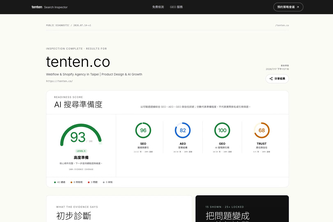
Tenten Search Inspector (BotScore) is a self-reported tool that audits public URLs across SEO, AEO, and GEO dimensions using headless Chromium and an LLM layer for narration but not decision-making. It was built in a single hackathon sprint with Codex and GPT-5.6.
What changed
The project description states it was built during the OpenAI 2026 hackathon, with no prior history or traction reported. The author claims to have used Codex for strategy and implementation, including architecture, documentation, and code.
Single most important open question
Is there any evidence of real-world usage, revenue, or customer adoption beyond the self-reported hackathon build?
Note: This analysis is based entirely on the self-reported project description provided by the caller. No external verification or historical data exists for this project. All claims are treated as stated by the author and not independently confirmed.
What The Product Actually Is
The description states that Tenten Search Inspector (BotScore) audits public URLs across three dimensions:
- SEO — HTTP behavior, redirects, robots policies, indexing directives, canonicals, sitemaps, initial HTML, structured data.
- AEO (Answer Engine Optimization) — answer summaries, section structure, definitions, sources, authors, dates: the semantics agents can act on.
- GEO (Generative Engine Optimization) — AI-crawler access (GPTBot, Claude-SearchBot, PerplexityBot), citable evidence, brand entities, summary control, server-rendered content.
It uses a durable job queue to dispatch independent workers that fetch raw and rendered HTML via headless Chromium. Findings are deterministic and reproducible, backed by a versioned rules engine. An LLM layer may narrate findings but never decides pass/fail.
The tool includes:
- A public results page offering free value.
- A lightweight email gate unlocking a prioritized fix plan (HubSpot sync, hashed 7-day report tokens).
- The tool is described as doubling as a qualified-lead funnel for agencies.
Inference: The product appears to be a web audit tool focused on how search and AI engines interact with content. It is not a commercial product yet, but a prototype built in a hackathon setting.
Positioning & Claim Evolution
The author states:
- Search is splitting into ranking engines (e.g., Google) and answer engines (e.g., ChatGPT, Gemini).
- Clients at their agency asked “why doesn’t AI cite us?” — a question they claim existing SEO tools do not answer.
- They wanted a tool that produces evidence, not AI-generated opinions.
This positions the product as filling a gap in SEO tools by focusing on readiness for AI answer engines.
Inference: The positioning is based on a perceived market need and a self-reported problem. No external validation or data supports this claim.
Target Customer & ICP
The description states:
- The tool doubles as a qualified-lead funnel for agencies.
- It audits public URLs, suggesting it targets businesses or content creators who want to understand how their site performs for AI crawlers and answer engines.
No explicit customer segments or personas are defined. The only hint is that the tool is intended for use by agencies or individuals seeking to improve AI visibility.
Inference: The ICP appears to be agencies or content creators, but this is inferred from the funnel claim and not explicitly stated.
Business Model & Pricing Evidence
The description states:
- A public results page gives real free value.
- A lightweight email gate unlocks a full prioritized fix plan.
- HubSpot sync and hashed 7-day report tokens are mentioned as part of the paid experience.
- The tool is described as a qualified-lead funnel for agencies.
No pricing details, revenue model, or monetization structure beyond the email gate and HubSpot integration are provided.
Inference: The business model seems to be freemium with a lead-generation funnel, but no concrete evidence of monetization exists.
Technical & Delivery Signals
The description states:
- Built with Codex running GPT-5.6 (gpt-5.6-sol) across three sessions.
- The stack includes Next.js, PostgreSQL, pg-boss, Playwright/Chromium, Docker Compose, Caddy, React, TypeScript, Vitest.
- A durable job queue supports restarts, atomic quotas, rate-limit salting, health endpoints, backup/restore docs.
- The rules engine is versioned and auditable.
The author claims that GPT-5.6 with Codex carried architecture, not just code completion.
Inference: The technical stack appears production-grade for a prototype, but no evidence of real-world deployment or scaling exists.
Traction & Maturity Signals
The description states:
- Built in one hackathon sprint.
- No mention of users, customers, revenue, or adoption.
- Demo videos are provided (English and Chinese).
- The tool is described as “not a demo” but a production-grade stack.
No evidence of traction, usage metrics, or customer feedback is provided.
Inference: There is no evidence of traction or maturity beyond the hackathon build.
Competitive Context
The description states:
- Existing SEO tools measure rankings.
- Nothing credibly measures readiness for answer engines (e.g., ChatGPT, Gemini, Perplexity).
No specific competitors are named, but the author implies a gap in the market for tools that assess AI engine compatibility.
Inference: The competitive context is inferred from the stated problem and lack of existing solutions. No actual competitive analysis or market data provided.
Open Questions & Risks
- Unverified claims: All assertions about market need, tool effectiveness, and positioning are self-reported.
- No traction or revenue: No evidence of users, customers, or monetization.
- Prototype only: Built in a hackathon, not tested in production.
- LLM dependency: The tool uses GPT-5.6 for strategy and implementation, but no evidence of LLM performance or reliability in real-world use.
- No external validation: No third-party reviews, testimonials, or audits.
Inference: The project is a prototype with no commercial traction or validation.
Questions the description leaves open
- What specific market problem are you solving, and how do you know it exists?
- Have you validated the need for this tool with real users or agencies?
- How does your rules engine handle edge cases or new crawler behaviors?
- Are there any plans to monetize beyond the email gate and HubSpot sync?
- What is the long-term vision for scaling this tool beyond a hackathon prototype?
- How do you plan to differentiate from existing SEO tools that claim to support AI readiness?
Overall Assessment
The project is described as a hackathon prototype built with Codex and GPT-5.6. There is no evidence of traction, revenue, or customer adoption.
Assessment: Not evidenced. The tool appears to be an experimental prototype with no commercial viability or market validation demonstrated. Any investment or partnership potential is speculative without further evidence of product-market fit, user engagement, or monetization.
User Stories BotA demo video on every pull request
Get a demo video on every new feature
GitHub App that watches your pull requests and records a narrated, captioned demo.
Save time on demo prep and make informed decisions faster with a video walkthrough of every new feature.
Source
Submitted to the OpenAI 2026 hackathon on Devpost. Project home on Devpost. Back to the full gallery on Devpost.
This competitive analysis was produced by top-founders.com (opens in a new tab)
Generated by a language model from this project's public Devpost page — its tagline, the author's own write-up and any built-with tags listed there — as captured in August 2026. Short quotations are the author's words. It is an opinion on the idea as a business, not on the people behind it, and it reflects the description as published then. If the project has moved on, request a correction below. The analysis is not independent research and contains no verified traction, revenue or customer data.
An independent guide by KFG International LLC — not affiliated with, endorsed by, or connected to Devpost or OpenAI.