

Archive position — measured, not model output
0 likes on Devpost
2,263 of the 7,850 archived projects have more likes, and 5,587 share exactly 0 — so this project's #7,190 place in the like-ranked listing is a tie-break inside that group, not a ranking.
Projects (log scale)
Likes on Devpost. ▲ marks this project's group.
Show the figures
| Likes | Projects | Share of archive |
|---|---|---|
| 0 | 5,587 | 71.2% |
| 1 | 1,758 | 22.4% |
| 2 | 284 | 3.6% |
| 3–4 | 132 | 1.7% |
| 5–9 | 75 | 1.0% |
| 10+ | 14 | 0.2% |
 User Stories BotA demo video on every pull request
Get a demo video on every new feature
GitHub App that watches your pull requests and records a narrated, captioned demo.
Save time on demo prep and make informed decisions faster with a video walkthrough of every new feature.
Executive Summary
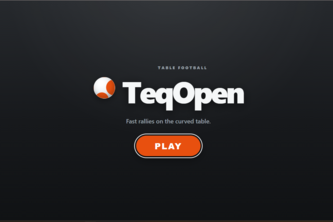
The company appears to be a solo developer project named TeqOpen, which builds a web-based 3D video game of the sport Teqball using Babylon.js, TypeScript, and Vite. The author states this is a hackathon submission for the OpenAI 2026 hackathon on Devpost. It is not evidenced that the project has any revenue, customers, or traction beyond the developer's own enjoyment of playing it.
What changed: The project was submitted to a hackathon and is described as a prototype game built in a short timeframe. No evidence suggests prior development, funding, or commercial activity.
The single most important open question: Is this project intended to evolve into a commercial product, or is it purely a personal hobby or learning exercise?
What The Product Actually Is
- The description states that TeqOpen is a web-based 3D video game of the sport Teqball.
- It supports multiple input methods: phone (touch), laptop (keyboard/mouse), and console (gamepad / DualSense, including PS5 browser).
- It features singles matches against an AI opponent, with a first-to-12 scoring system and serve changes every 2 points.
- The game is built using Babylon.js, TypeScript, and Vite.
Inference: The product is a browser-based 3D game prototype, likely for entertainment or learning purposes. It is not evidenced that it has been released to users beyond the developer's own use.
Positioning & Claim Evolution
- The author states that the inspiration came from watching Teqball videos and backflips, indicating a personal interest in the sport.
- The project is described as a hackathon submission for the OpenAI 2026 hackathon, suggesting it was built quickly and may not reflect long-term strategic intent.
- There is no evidence of positioning beyond the developer’s own description — no stated market, target audience, or differentiation from existing games.
Inference: The project is positioned as a personal or educational effort, possibly with potential for future expansion. No commercial positioning or claims are evident.
Target Customer & ICP
- The description does not state who the intended users are.
- It mentions support for touch, keyboard/mouse, and gamepad, suggesting a broad but unspecified audience.
- The game is described as a single-player experience against AI, with no mention of multiplayer or community features.
Inference: No clear ICP is evident. The target customer is not defined beyond the developer’s own use case.
Business Model & Pricing Evidence
- There is no evidence of any pricing model, monetization strategy, or business model.
- The project is described as a hackathon submission, implying no commercial intent at this stage.
Inference: No business model or pricing data is evident. The project may be in an exploratory phase with no revenue streams.
Technical & Delivery Signals
- Built using Babylon.js, TypeScript, and Vite.
- Supports multiple input methods: touch, keyboard/mouse, and gamepad.
- The author mentions learning 3D modeling, mocap, and animation, suggesting a focus on technical development rather than commercial delivery.
Inference: The project shows basic technical competence in 3D web development. No evidence of production-grade delivery or scalability.
Traction & Maturity Signals
- The project is described as a hackathon submission.
- The author states they are “very proud of what i built” and enjoy playing it, but no external metrics or adoption data are provided.
- There is no evidence of users, downloads, or engagement beyond the developer’s own use.
Inference: No traction or maturity signals are evident. It appears to be a prototype with no commercial or user adoption.
Competitive Context
- The description does not mention any competitors or existing products in the Teqball or 3D browser game space.
- There is no evidence of market analysis or competitive positioning.
Inference: No competitive context is evident. It is unclear whether this project addresses a known market gap or overlaps with existing solutions.
Open Questions & Risks
- The project is a single-person effort, which may limit scalability and long-term development.
- It is a hackathon submission, suggesting it may not be intended for commercial use or further development.
- No evidence of any monetization, user base, or revenue.
- The author’s own statement that they “really enjoy playing my own game” suggests personal interest over market demand.
Inference: Risk of limited scope and lack of commercial viability. No evidence of traction or sustainable business model.
Questions the description leaves open
- What is the intended long-term vision for this project?
- Are there any plans to monetize or scale the game beyond personal use?
- Has the developer considered market demand or competition in the 3D browser gaming space?
- Is there a roadmap for expanding features, such as multiplayer or mobile app versions?
- What is the current status of development and how much time has been invested?
Overall Assessment
- The project is described as a personal or educational hackathon effort with no evidence of commercial traction or business model.
- It is not evidenced that the project has any revenue, customers, or adoption beyond the developer’s own use.
- There is no indication of intent to scale or monetize, and no evidence of market validation.
Inference: At this stage, there is no compelling reason to pursue investment or partnership. The project appears to be a prototype with no commercial viability or traction.
User Stories BotA demo video on every pull request
Get a demo video on every new feature
GitHub App that watches your pull requests and records a narrated, captioned demo.
Save time on demo prep and make informed decisions faster with a video walkthrough of every new feature.
Source
Submitted to the OpenAI 2026 hackathon on Devpost. Project home on Devpost. Back to the full gallery on Devpost.
This competitive analysis was produced by top-founders.com (opens in a new tab)
Generated by a language model from this project's public Devpost page — its tagline, the author's own write-up and any built-with tags listed there — as captured in August 2026. Short quotations are the author's words. It is an opinion on the idea as a business, not on the people behind it, and it reflects the description as published then. If the project has moved on, request a correction below. The analysis is not independent research and contains no verified traction, revenue or customer data.
An independent guide by KFG International LLC — not affiliated with, endorsed by, or connected to Devpost or OpenAI.