

Archive position — measured, not model output
0 likes on Devpost
2,263 of the 7,850 archived projects have more likes, and 5,587 share exactly 0 — so this project's #3,266 place in the like-ranked listing is a tie-break inside that group, not a ranking.
Projects (log scale)
Likes on Devpost. ▲ marks this project's group.
Show the figures
| Likes | Projects | Share of archive |
|---|---|---|
| 0 | 5,587 | 71.2% |
| 1 | 1,758 | 22.4% |
| 2 | 284 | 3.6% |
| 3–4 | 132 | 1.7% |
| 5–9 | 75 | 1.0% |
| 10+ | 14 | 0.2% |
 User Stories BotA demo video on every pull request
Get a demo video on every new feature
GitHub App that watches your pull requests and records a narrated, captioned demo.
Save time on demo prep and make informed decisions faster with a video walkthrough of every new feature.
Executive Summary
What the company appears to be
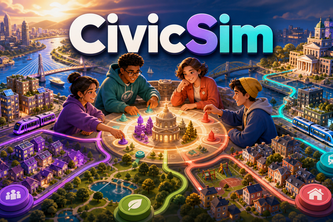
CivicSim is a self-reported multiplayer strategy game built as a prototype for the OpenAI 2026 hackathon. The description states it is a real-time civic simulation where players take on roles like Mayor or Urban Planner and negotiate city-building decisions in a fictional setting called Rivergate. It includes elements of competition, cooperation, and AI-assisted decision-making.
What changed
The project was submitted as a hackathon entry to the OpenAI 2026 hackathon, indicating it is currently in early-stage development with no evidence of commercial traction or production deployment beyond the prototype phase.
The single most important open question
Is there any evidence that CivicSim has achieved product-market fit, user adoption, or revenue generation — or even a clear path to monetization?
Note: This analysis is based entirely on the self-reported project description provided by the author. No third-party verification, archived data, or independent sources are available. All claims are stated by the author and not independently confirmed.
What The Product Actually Is
The description states that CivicSim is a "real-time multiplayer civic strategy game set in the fictional city of Rivergate." Players assume roles such as Mayor, Urban Planner, Environmental Advocate, or Community Organizer. It features:
- A Phaser 3-rendered interactive map with districts, buildings, and overlays.
- A React + Vite frontend for user interface and room flow.
- Express.js + Socket.IO for real-time multiplayer functionality.
- An optional integration with OpenAI API for decision support.
- A monorepo architecture using TypeScript and Zod schemas.
It is described as a playable prototype, not a production product. The game includes mechanics such as drafting proposals, negotiating actions, competing for influence, and cooperating to prevent city collapse.
Inference: The author claims the system is playable and includes full gameplay loops, but no evidence of actual users or live deployment exists.
Positioning & Claim Evolution
The description states that CivicSim was inspired by games like Catan and Risk, but replaces conquest with public leadership. It aims to make city planning understandable through play, allowing players to experience the tension behind real civic decisions — such as trade-offs between housing, mobility, and environment.
It positions itself as a civic learning platform, intended for students and adults, designed to simulate real-world decision-making in a safe, engaging format.
Claim: The product is positioned as an educational tool that teaches public policy through gameplay.
Inference: This is a stated goal, not yet validated by usage or impact metrics.
Target Customer & ICP
The description states that CivicSim targets both students and adults, with the goal of making city planning accessible and understandable. It includes features such as:
- Role-based gameplay
- Scenario-based learning
- Teacher dashboards (planned)
- Standards-aligned lesson plans (planned)
It also mentions classroom-ready capabilities, suggesting an institutional or educational target.
Claim: The primary audience is educators and students.
Inference: No evidence of actual users or customer feedback exists beyond the developer's own claims.
Business Model & Pricing Evidence
The description does not contain any information about pricing models, monetization strategies, or business models. It mentions future features such as:
- Authentication
- Database-backed match history
- Teacher dashboards
- CSV/JSON exports
But no indication of how these would be sold or whether there is a revenue stream.
Not evidenced: No mention of pricing, subscriptions, licensing, or commercial use cases.
Technical & Delivery Signals
The project is built using:
- Frontend: React, Vite, Phaser 3
- Backend: Express.js, Socket.IO
- AI: OpenAI API (optional)
- Deployment: Vercel (frontend), Render (backend)
- Architecture: Monorepo with shared TypeScript packages and Zod validation
It includes:
- Server-authoritative multiplayer logic
- AI integration for decision support without direct game state mutation
- Automated testing via Vitest
- Responsive UI and map rendering
Inference: The technical stack suggests a scalable architecture, but no evidence of performance or scalability in production.
Traction & Maturity Signals
The project is described as a hackathon submission to the OpenAI 2026 hackathon. It includes:
- A playable prototype
- Full gameplay loop
- Visual and interactive elements
- Automated validation systems
However, there is no evidence of:
- User base or adoption
- Revenue or monetization
- Production deployment
- Customer feedback or usage data
Not evidenced: No traction indicators beyond the prototype phase.
Competitive Context
The description does not mention any competitors. It references games like Catan and Risk as inspiration, but no direct comparison to existing civic simulation tools or educational platforms is made.
Not evidenced: No competitive landscape analysis or differentiation strategy provided.
Open Questions & Risks
Key risks include:
- Unproven market demand for a civic education game
- Limited evidence of user adoption or engagement
- No revenue model or monetization plan
- Prototype-only status, with no indication of production readiness
- Dependency on OpenAI API (optional, but could be a risk if not fully controlled)
- Single-person team, which may limit scalability and execution
Inference: The lack of traction, revenue, or customer data raises concerns about viability.
Questions the description leaves open
- What is the intended user acquisition strategy for this product?
- Are there any pilot programs or partnerships with schools or educational institutions?
- How do you plan to monetize this product beyond the prototype phase?
- What are your plans for scaling beyond a single-person development team?
- Have you conducted any user testing or feedback sessions with students or educators?
- How does the AI integration work in practice, and how is it validated for safety and fairness?
- What is the roadmap for moving from prototype to production-ready product?
Overall Assessment
Not evidenced: There is no evidence of revenue, customers, or traction to support an investment or partnership decision.
The project is described as a hackathon prototype, with no indication of commercial viability, user adoption, or monetization strategy. It is positioned as an educational tool but lacks any data on usage, impact, or market fit.
Confidence Level: Very low — based entirely on self-reported claims and no external validation.
User Stories BotA demo video on every pull request
Get a demo video on every new feature
GitHub App that watches your pull requests and records a narrated, captioned demo.
Save time on demo prep and make informed decisions faster with a video walkthrough of every new feature.
Source
Submitted to the OpenAI 2026 hackathon on Devpost. Project home on Devpost. Back to the full gallery on Devpost.
This competitive analysis was produced by top-founders.com (opens in a new tab)
Generated by a language model from this project's public Devpost page — its tagline, the author's own write-up and any built-with tags listed there — as captured in August 2026. Short quotations are the author's words. It is an opinion on the idea as a business, not on the people behind it, and it reflects the description as published then. If the project has moved on, request a correction below. The analysis is not independent research and contains no verified traction, revenue or customer data.
An independent guide by KFG International LLC — not affiliated with, endorsed by, or connected to Devpost or OpenAI.