

Archive position — measured, not model output
0 likes on Devpost
2,263 of the 7,850 archived projects have more likes, and 5,587 share exactly 0 — so this project's #3,264 place in the like-ranked listing is a tie-break inside that group, not a ranking.
Projects (log scale)
Likes on Devpost. ▲ marks this project's group.
Show the figures
| Likes | Projects | Share of archive |
|---|---|---|
| 0 | 5,587 | 71.2% |
| 1 | 1,758 | 22.4% |
| 2 | 284 | 3.6% |
| 3–4 | 132 | 1.7% |
| 5–9 | 75 | 1.0% |
| 10+ | 14 | 0.2% |
 User Stories BotA demo video on every pull request
Get a demo video on every new feature
GitHub App that watches your pull requests and records a narrated, captioned demo.
Save time on demo prep and make informed decisions faster with a video walkthrough of every new feature.
Executive Summary
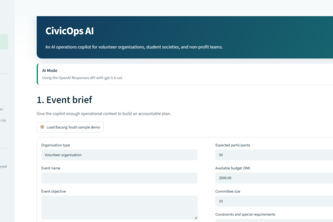
What the company appears to be: CivicOps AI is a self-reported AI-powered operations copilot designed for volunteer organisations, student societies, and non-profit teams. The author describes it as an application that converts event briefs into structured operational plans using GPT-5.6 Sol, with editable dashboards and progress review features.
What changed: The project was built by one individual (陈浚成 Chan) in the context of a hackathon submission. It represents a personal solution to a real-world problem encountered during volunteer work, with no evidence of prior traction or commercial deployment beyond the author's own use case.
The single most important open question: Is there sufficient evidence that this tool has been adopted or tested by actual users outside the author’s immediate circle, and whether it can scale beyond a single-person development effort?
This analysis is based entirely on the self-reported description provided by the author. No external verification, revenue data, customer names, or traction metrics are available.
What The Product Actually Is
The description states that CivicOps AI:
- Converts an event brief into a structured, editable operations plan
- Uses GPT-5.6 Sol for generating and reviewing plans
- Provides schema-validated outputs through Pydantic models
- Offers an editable dashboard where committee members can update task owners, deadlines, statuses, risks, priorities, and dependencies
- Can review the latest edited dashboard rather than the original generated plan
- Identifies urgent actions, blocked dependency chains, increasing operational risks, ownership gaps, and downstream effects of delayed prerequisites
- Exports plans as CSV or JSON
It is built in Python with Streamlit, integrates OpenAI Responses API, and includes automated tests covering core logic and reliability measures.
This is a self-reported product description. No independent confirmation of functionality or performance exists.
Positioning & Claim Evolution
The author positions CivicOps AI as:
- An AI operations copilot tailored for small volunteer teams
- A tool that turns basic event briefs into accountable working plans
- Designed to support committees without dedicated project management staff
- Grounded in real operational problems rather than hypothetical use cases
There is no indication of prior positioning or evolution beyond the initial hackathon submission. The claim is that it strengthens human accountability instead of replacing decision-making.
Claims are self-reported and unverified; there is no evidence of market positioning, branding, or prior product iterations.
Target Customer & ICP
The author identifies:
- Volunteer organisations
- Student societies
- Non-profit teams
These are described as groups that lack dedicated project-management staff but must deliver complex events.
No further segmentation within these categories is evident. No specific customer personas or ICP criteria beyond the general audience are stated.
Target customers are inferred from the author's context and not independently verified.
Business Model & Pricing Evidence
There is no evidence of:
- Revenue streams
- Pricing models
- Monetisation strategy
- Customer acquisition plans
- Sales process or go-to-market approach
The project description does not mention any commercial aspects beyond its personal development and hackathon submission.
No business model or pricing information is provided.
Technical & Delivery Signals
Key technical elements include:
- Built with Python, Streamlit, OpenAI Responses API (GPT-5.6 Sol)
- Structured outputs validated via Pydantic models
- Deterministic local workflow fallbacks for API failures
- Automated tests (39 total)
- Sanitized cloud diagnostics
- Controlled timeouts and retry handling
- Secure deployment practices (environment variables, no credential exposure)
The author mentions using Codex extensively during development.
Technical implementation is detailed in the self-report but lacks independent validation.
Traction & Maturity Signals
There is no evidence of:
- Customers or users beyond the author’s own experience
- Revenue or monetisation
- Product adoption or usage metrics
- Iteration history or version control beyond this single submission
- Market testing or feedback loops
The project was submitted to a hackathon and deployed publicly, but no indication of ongoing use or growth is present.
No traction or maturity signals are evidenced.
Competitive Context
There is no mention of:
- Competitors
- Market analysis
- Differentiation from existing tools
- Industry landscape
The author does not reference similar products or platforms in the space of event planning, project management, or AI-powered operations tools.
No competitive context is provided.
Open Questions & Risks
Potential risks include:
- Lack of independent validation of claims
- Single-person development limits scalability and long-term viability
- No evidence of user testing or feedback
- Unclear path to monetisation or commercial adoption
- Dependency on a single AI model (GPT-5.6 Sol) with limited control over output quality or availability
- Limited product features beyond MVP scope
Open questions:
- No revenue, customers, or traction data
- No indication of team expansion or institutional support
- Self-reported only; no third-party verification
Risks are inferred from lack of evidence and self-reporting nature.
Questions the description leaves open
- Has the tool been tested with actual users outside your personal network?
- What specific operational challenges did you observe in volunteer teams that led to this solution?
- How do you plan to scale beyond a single developer?
- Are there any plans for monetisation or commercial viability?
- Have you considered how to handle data privacy and security at scale?
- What are the limitations of GPT-5.6 Sol in real-world usage, especially around reliability and consistency?
- How would you integrate this into existing workflows used by non-profit teams?
These questions aim to probe beyond self-reported claims.
Overall Assessment
At this stage, there is insufficient evidence to support investment or partnership interest.
The project:
- Is a personal hackathon submission
- Lacks any commercial traction or revenue
- Has no verified users or market validation
- Depends on an unverified AI model and lacks institutional backing
- Shows strong technical execution but no signs of product-market fit or scalability
This is a very early-stage idea with limited evidence of viability or impact. Further due diligence would require proof of concept, user testing, and commercial planning.
User Stories BotA demo video on every pull request
Get a demo video on every new feature
GitHub App that watches your pull requests and records a narrated, captioned demo.
Save time on demo prep and make informed decisions faster with a video walkthrough of every new feature.
Source
Submitted to the OpenAI 2026 hackathon on Devpost. Project home on Devpost. Back to the full gallery on Devpost.
This competitive analysis was produced by top-founders.com (opens in a new tab)
Generated by a language model from this project's public Devpost page — its tagline, the author's own write-up and any built-with tags listed there — as captured in August 2026. Short quotations are the author's words. It is an opinion on the idea as a business, not on the people behind it, and it reflects the description as published then. If the project has moved on, request a correction below. The analysis is not independent research and contains no verified traction, revenue or customer data.
An independent guide by KFG International LLC — not affiliated with, endorsed by, or connected to Devpost or OpenAI.