

Archive position — measured, not model output
1 like on Devpost
505 of the 7,850 archived projects have more likes, and 1,758 share exactly 1 — so this project's #2,048 place in the like-ranked listing is a tie-break inside that group, not a ranking.
Projects (log scale)
Likes on Devpost. ▲ marks this project's group.
Show the figures
| Likes | Projects | Share of archive |
|---|---|---|
| 0 | 5,587 | 71.2% |
| 1 | 1,758 | 22.4% |
| 2 | 284 | 3.6% |
| 3–4 | 132 | 1.7% |
| 5–9 | 75 | 1.0% |
| 10+ | 14 | 0.2% |
 User Stories BotA demo video on every pull request
Get a demo video on every new feature
GitHub App that watches your pull requests and records a narrated, captioned demo.
Save time on demo prep and make informed decisions faster with a video walkthrough of every new feature.
Executive Summary
What the company appears to be
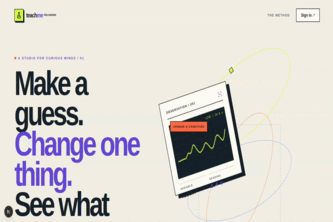
TeachMe is a self-reported educational platform built as a hackathon project, designed to help students visualize scientific concepts through AI-generated interactive simulations. The author states it aims to make practical learning accessible by replacing traditional textbook memorization with visual and hands-on experiences.
What changed
The project was submitted to the OpenAI 2026 hackathon on Devpost. It is described as a prototype, not yet a product in production or with customers.
The single most important open question
Is there evidence of any traction, revenue, or customer validation beyond the author’s self-reported description?
Note: This analysis is based solely on the self-reported and unverified account provided by the author. No third-party verification, archived data, or independent sources are available. All claims are stated by the author and not confirmed.
What The Product Actually Is
The description states that TeachMe is a platform where students can turn curiosity into visual understandings through simulation, experiments, and guided conversations. It uses AI to generate interactive simulations that allow users to visualize scientific concepts in seconds, transforming passive learning into an engaging, hands-on experience.
It was built using JavaScript, Next.js, Node.js, OpenAI, Supabase, and TypeScript. The author describes it as a tool for turning abstract ideas into interactive experiences, particularly for science education.
Claim: TeachMe is a platform that uses AI to create simulations for students.
Evidence: Author's own write-up.
Inference: The product appears to be an educational simulation tool.
Label: Inferred from the description.
Positioning & Claim Evolution
The author positions TeachMe as a way to make practical learning accessible, especially in environments where real-world experiments are not feasible due to lack of resources. It is framed as a solution to traditional textbook-based memorization, aiming instead for exploration and understanding through visualization.
The project evolved from the author’s personal experience as a student who wanted to see concepts in action rather than just read about them. The positioning emphasizes accessibility, engagement, and AI-driven learning.
Claim: TeachMe is positioned to replace or supplement traditional textbook learning with visual simulations.
Evidence: Author's own write-up.
Inference: The platform targets students seeking deeper understanding through experimentation.
Label: Inferred from the description.
Target Customer & ICP
The author states that the target customer is students who want to learn by exploring, experimenting, and visualizing concepts instead of just memorizing them. The goal is to make quality practical learning available to every student, regardless of their school's resources.
Claim: The primary user is a student seeking interactive, visual learning experiences.
Evidence: Author's own write-up.
Inference: The platform may be aimed at K-12 or higher education students in under-resourced schools.
Label: Inferred from the description.
Business Model & Pricing Evidence
There is no evidence of a business model or pricing structure in the provided description. The author does not mention monetization, subscriptions, licensing, or any revenue-generating mechanism.
Claim: No information on business model or pricing.
Evidence: Not evidenced.
Technical & Delivery Signals
The project was built using JavaScript, Next.js, Node.js, OpenAI, Supabase, and TypeScript. It is described as a hackathon submission, suggesting it is a prototype or proof-of-concept rather than a production-ready product.
Claim: The platform uses modern web technologies including AI integration.
Evidence: Author's own write-up.
Inference: The project is likely in early development and not yet deployed for public use.
Label: Inferred from the description.
Traction & Maturity Signals
There is no evidence of traction, customers, or adoption beyond the author’s self-reported account. The project is described as a hackathon submission and not yet a product in production. No data on usage, engagement, or user feedback is available.
Claim: No traction or maturity signals.
Evidence: Not evidenced.
Competitive Context
The description does not provide any information about competitors or the competitive landscape. It does not mention existing platforms or tools that offer similar simulations or educational experiences.
Claim: No competitive context provided.
Evidence: Not evidenced.
Open Questions & Risks
- The project is described as a hackathon submission, which suggests it is not yet a product in production.
- There is no evidence of revenue, customers, or traction.
- The author is the sole team member, raising questions about scalability and execution capability.
- No business model or pricing structure is evident.
- The lack of third-party verification makes it difficult to assess the validity of claims.
Claim: Risk factors include lack of traction, no business model, and limited team size.
Evidence: Not evidenced directly, but inferred from absence of data.
Questions the description leaves open
- What is the current stage of development beyond the hackathon?
- Have you tested the platform with any real students or educators?
- Are there plans to monetize or scale the product?
- How do you intend to differentiate from existing educational tools or platforms?
- What are your long-term goals for the platform?
Inference: These questions aim to uncover gaps in the self-reported description.
Label: Inferred.
Overall Assessment
There is no evidence of revenue, customers, or traction to support an investment or partnership decision. The project is described as a hackathon submission and lacks any indication of product-market fit or commercial viability.
Claim: No basis for investment or partnership.
Evidence: Not evidenced.
Inference: The project may be too early-stage to evaluate for commercial due diligence.
Label: Inferred from the description.
User Stories BotA demo video on every pull request
Get a demo video on every new feature
GitHub App that watches your pull requests and records a narrated, captioned demo.
Save time on demo prep and make informed decisions faster with a video walkthrough of every new feature.
Source
Submitted to the OpenAI 2026 hackathon on Devpost. Project home on Devpost. Back to the full gallery on Devpost.
This competitive analysis was produced by top-founders.com (opens in a new tab)
Generated by a language model from this project's public Devpost page — its tagline, the author's own write-up and any built-with tags listed there — as captured in August 2026. Short quotations are the author's words. It is an opinion on the idea as a business, not on the people behind it, and it reflects the description as published then. If the project has moved on, request a correction below. The analysis is not independent research and contains no verified traction, revenue or customer data.
An independent guide by KFG International LLC — not affiliated with, endorsed by, or connected to Devpost or OpenAI.