

Archive position — measured, not model output
1 like on Devpost
505 of the 7,850 archived projects have more likes, and 1,758 share exactly 1 — so this project's #2,050 place in the like-ranked listing is a tie-break inside that group, not a ranking.
Projects (log scale)
Likes on Devpost. ▲ marks this project's group.
Show the figures
| Likes | Projects | Share of archive |
|---|---|---|
| 0 | 5,587 | 71.2% |
| 1 | 1,758 | 22.4% |
| 2 | 284 | 3.6% |
| 3–4 | 132 | 1.7% |
| 5–9 | 75 | 1.0% |
| 10+ | 14 | 0.2% |
 User Stories BotA demo video on every pull request
Get a demo video on every new feature
GitHub App that watches your pull requests and records a narrated, captioned demo.
Save time on demo prep and make informed decisions faster with a video walkthrough of every new feature.
Executive Summary
What the company appears to be
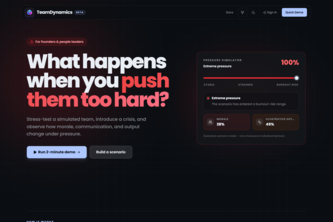
TeamDynamics is a self-reported multi-agent AI crisis simulation platform designed for organizational decision-makers. The author states it enables users to construct virtual teams, introduce crises, and observe how AI agents respond under pressure—using personality-weighted traits and state transitions—to rehearse difficult decisions before real-world consequences arise.
What changed
The project was built as a solo effort over time, incorporating AI engineering tools like Codex and TestSprite for development and testing. It includes a full-stack architecture with frontend (Next.js), backend (FastAPI), database (PostgreSQL), and real-time communication (WebSockets). It supports document upload and analysis to generate crisis scenarios and team roles.
Single most important open question
Does TeamDynamics offer a meaningful or actionable rehearsal environment for organizational decision-making, or is it primarily a conceptual prototype with limited practical utility?
Note: All claims are self-reported by the author. No independent verification of traction, revenue, customers, or performance exists beyond what is described.
What The Product Actually Is
The description states that TeamDynamics is a multi-agent AI crisis simulation platform. It allows users to:
- Assemble a virtual team composed of AI agents with defined roles, expertise, motivations, and personality traits.
- Introduce a predefined or custom crisis scenario into the simulation.
- Observe how agents behave in response to events using a real-time, Slack-inspired interface.
- Interact through interventions that can pause, preview, apply, inspect, and undo changes during the simulation.
- Receive an executive report summarizing outcomes tied to decisions, agent behavior, and metric shifts.
The system is described as stateful rather than a collection of isolated chatbot calls. It uses a five-phase crisis model and integrates personality-weighted state transitions, agent memory, hidden motivations, individual objectives, hierarchy-weighted decisions, random events, and persistent organizational world states.
Claim: TeamDynamics simulates organizational behavior using AI agents.
Evidence: The description explicitly describes the architecture and functionality of the simulation engine.
Positioning & Claim Evolution
The author positions TeamDynamics as a tool for "decision-rehearsal environment" that applies Stoic philosophy—specifically Premeditatio Malorum—to organizational crisis preparation. It is framed not as a predictive system but as an exploratory one: “a safe place to explore possible reactions, trade-offs, and failure patterns before making decisions that affect a real team.”
It targets founders, engineering managers, HR leaders, and team leads who need to reason about difficult organizational decisions.
Claim: TeamDynamics applies Stoic philosophy to AI-driven organizational decision-making.
Evidence: The author explicitly links Premeditatio Malorum to the product’s architecture and workflow.
Target Customer & ICP
The description states that TeamDynamics is intended for:
- Founders
- Engineering managers
- HR leaders
- Team leads
These users are described as needing to reason about difficult organizational decisions before stakes become real.
Claim: The target customer base includes decision-makers in organizations.
Evidence: The write-up identifies specific roles and their use cases.
Business Model & Pricing Evidence
There is no evidence provided regarding a business model or pricing structure. The description does not mention monetization, subscriptions, licensing, or any commercial offering beyond the demo.
Claim: No information on business model or pricing.
Evidence: Not evidenced.
Technical & Delivery Signals
TeamDynamics is built as a full-stack system with:
- Frontend: Next.js 16, React 19, TypeScript, Tailwind CSS, shadcn/ui, Framer Motion, Recharts
- Backend: Python, FastAPI, Uvicorn, PostgreSQL, asyncpg
- Real-time communication: WebSockets
- AI integration: OpenAI, Google Gemini, OpenRouter (Bring Your Own AI)
- Deployment: Vercel (frontend), Railway (backend and DB)
It supports document processing for PDF, DOCX, CSV, and XLSX files to extract context and identify risks.
Claim: TeamDynamics is a full-stack application with real-time simulation capabilities.
Evidence: The write-up details the tech stack and delivery architecture.
Traction & Maturity Signals
The project has earned third place in the international TestSprite Hackathon Season 2, competing among 45 projects. It was recognized by Telkom University.
It also includes a public no-login Quick Demo that uses deterministic responses to allow judges to experience the product without external API costs.
Claim: The project received recognition from a hackathon and university.
Evidence: The description mentions TestSprite winner announcement and university recognition.
Competitive Context
There is no mention of existing competitive products or market positioning in the provided description. No competitors, substitutes, or differentiation strategies are described.
Claim: No competitive context provided.
Evidence: Not evidenced.
Open Questions & Risks
- Solo developer constraint: The project was built by two individuals, which may limit scalability and long-term maintenance.
- Limited validation: There is no evidence of real-world usage or feedback from target users beyond the author’s own claims.
- AI simulation limitations: The description notes that human teams are more complex than AI agents, raising questions about how accurately simulations reflect reality.
- No commercialization path: No indication of monetization strategy or customer acquisition plan.
Inference: Lack of traction and commercial viability raises concerns about product-market fit and sustainability.
Evidence: Not evidenced directly, but implied by absence of revenue, customers, or business model.
Questions the description leaves open
- What specific organizational decisions are users trying to rehearse? Are there known use cases?
- How do you plan to validate that the simulation outcomes are useful for real-world decision-making?
- What is your roadmap for scaling beyond a solo developer team?
- Have you tested TeamDynamics with actual organizational leaders or teams?
- Is there any data on how often users intervene, and what impact those interventions have?
- How do you intend to monetize this platform if it remains primarily a simulation tool?
Note: These questions are based on the lack of evidence around traction, validation, and commercialization.
Overall Assessment
There is insufficient evidence to assess whether TeamDynamics has investment or partnership potential. The project appears to be an ambitious prototype built by a small team, with some recognition in a hackathon setting. However, there is no demonstrated traction, revenue, customer base, or clear commercialization path.
Claim: No investment or partnership viability assessed due to lack of evidence.
Evidence: Not evidenced.
User Stories BotA demo video on every pull request
Get a demo video on every new feature
GitHub App that watches your pull requests and records a narrated, captioned demo.
Save time on demo prep and make informed decisions faster with a video walkthrough of every new feature.
Source
Submitted to the OpenAI 2026 hackathon on Devpost. Project home on Devpost. Back to the full gallery on Devpost.
This competitive analysis was produced by top-founders.com (opens in a new tab)
Generated by a language model from this project's public Devpost page — its tagline, the author's own write-up and any built-with tags listed there — as captured in August 2026. Short quotations are the author's words. It is an opinion on the idea as a business, not on the people behind it, and it reflects the description as published then. If the project has moved on, request a correction below. The analysis is not independent research and contains no verified traction, revenue or customer data.
An independent guide by KFG International LLC — not affiliated with, endorsed by, or connected to Devpost or OpenAI.