

Archive position — measured, not model output
0 likes on Devpost
2,263 of the 7,850 archived projects have more likes, and 5,587 share exactly 0 — so this project's #4,011 place in the like-ranked listing is a tie-break inside that group, not a ranking.
Projects (log scale)
Likes on Devpost. ▲ marks this project's group.
Show the figures
| Likes | Projects | Share of archive |
|---|---|---|
| 0 | 5,587 | 71.2% |
| 1 | 1,758 | 22.4% |
| 2 | 284 | 3.6% |
| 3–4 | 132 | 1.7% |
| 5–9 | 75 | 1.0% |
| 10+ | 14 | 0.2% |
 User Stories BotA demo video on every pull request
Get a demo video on every new feature
GitHub App that watches your pull requests and records a narrated, captioned demo.
Save time on demo prep and make informed decisions faster with a video walkthrough of every new feature.
Executive Summary
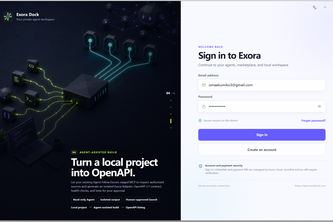
What the company appears to be: Exora Dock is a self-reported marketplace for machine-readable capabilities that agents can invoke. It allows developers to package existing code (local or cloud-based) into reusable, paid services without building a full SaaS product. The system supports API-only interactions and includes a human-in-the-loop component for sensitive decisions.
What changed: The author states they shifted from thinking about agents on both sides of transactions to focusing on enabling useful autonomy within boundaries—where agents can access specialized capabilities safely and instantly, but with clear limits on what they can do autonomously.
Single most important open question: Is there a real market need for this type of capability marketplace, or is it an idea that has not yet been validated by users?
Note: This analysis is based entirely on the self-reported description provided by the author. No external verification, traction data, revenue figures, customer names, or independent sources are available.
What The Product Actually Is
The description states:
- Exora Dock is an API-only marketplace.
- It enables developers to turn existing code (functions, CLIs, local programs, HTTP services, public APIs) into paid, machine-readable capabilities.
- Sellers can use their own agents (e.g., Codex, Claude Code, Cursor) to inspect authorized projects and create isolated adapters around them.
- These adapters describe what the capability does, inputs/outputs, usage measurement, and verification methods.
- Capabilities can run locally via
local_dockor through cloud services viacloud_direct. - Exora Cloud handles discovery, invocation, long-running jobs, billing, reputation, refunds, and disputes.
- Human involvement is required for key decisions like pricing, credential selection, publishing listings, and approving execution.
Inference: The system appears to be a developer tool that facilitates the monetization of small-scale code assets through an agent-driven marketplace. It does not appear to have a consumer-facing interface or traditional storefront.
Confidence Level: Low — based on one self-reported source with no external corroboration.
Positioning & Claim Evolution
The author claims:
- Exora is not another place for agents to talk, but rather “a pair of hands that lets them reach beyond what they can currently do.”
- It aims to make the exchange of capabilities feel natural.
- The goal is to allow small tools to help thousands of workflows and enable agents to encounter a door instead of a wall when their abilities are limited.
Inference: The positioning evolved from imagining a future with unlimited agent autonomy to one where useful autonomy is constrained by trust, safety, and human oversight. This shift reflects an understanding that friction in real-world usage must be addressed.
Confidence Level: Low — claims are self-reported without evidence of prior versions or market feedback.
Target Customer & ICP
The description states:
- Sellers are developers who want to monetize existing code (local tools, CLI scripts, HTTP services).
- Buyers are agents that need access to specific capabilities not built into the agent itself.
- The system supports both local and cloud-based execution of capabilities.
Inference: The primary customer segment is individual developers or small teams with useful but unmonetized code assets. The buyer persona is an AI agent capable of invoking external tools, likely in a development or automation workflow.
Confidence Level: Low — no explicit segmentation or targeting data provided beyond self-description.
Business Model & Pricing Evidence
The description states:
- Capabilities are paid and machine-readable.
- Usage-based pricing is supported.
- Billing, refunds, and dispute resolution are handled by Exora Cloud.
- The system includes mechanisms for verifying usage and handling large input/output artifacts.
- Pricing limits and verified usage are mentioned as part of the design.
Inference: The business model appears to be a marketplace with usage-based monetization, where sellers set prices and Exora handles billing and verification. However, there is no evidence of actual pricing tiers, revenue streams, or monetization metrics.
Confidence Level: Very low — no concrete financial details or pricing examples are given.
Technical & Delivery Signals
The description states:
- Built with technologies including Go, TypeScript, React, Electron, PostgreSQL, OpenAPI, and USDC.
- Uses a protocol called MCP (Model Context Protocol).
- Supports local_dock and cloud_direct execution modes.
- Adapters describe capabilities using machine-readable contracts.
- Includes human-in-the-loop gates for critical decisions.
- Handles artifact checks, automatic refunds, and objective failure detection.
Inference: The technical architecture suggests a modular, API-first approach with support for both local and remote execution. It integrates with existing developer tools and agents via standardized protocols.
Confidence Level: Medium — some technical details are provided, but no live product or deployment evidence exists.
Traction & Maturity Signals
The description states:
- The project was submitted to the OpenAI 2026 hackathon.
- It is a solo effort (team size: 1).
- The author describes iterative development and learning from hard problems.
- No mention of users, customers, or revenue.
Inference: There is no evidence of traction, adoption, or user base. The project appears to be in early stages, possibly prototype-level.
Confidence Level: Very low — no signs of product-market fit or real-world usage.
Competitive Context
The description states:
- No direct competitors are named.
- The author references the idea of “borrowing exactly one tool from a workshop on the other side of the internet.”
- Mentions analogies to physical world APIs (restaurants, hotels, gyms) as future directions.
Inference: There is no clear competitive landscape described. The concept aligns with emerging trends in agent-based workflows and capability markets, but no known competitors or market positioning are mentioned.
Confidence Level: Low — no competitive analysis or market data provided.
Open Questions & Risks
The description states:
- Trust issues were a major challenge during development.
- Questions around offline machines, long-running jobs, large file transfers, and responsibility for failures were central to the design.
- Human involvement is required for sensitive decisions.
Inference: Key risks include:
- Lack of real-world testing or user feedback.
- Unclear scalability of local execution models.
- Potential complexity in handling trust, accountability, and disputes.
- Dependency on developer adoption and willingness to use agent tools.
- Risk that the idea may not resonate with actual users or developers.
Confidence Level: Medium — risks are implied by the author’s own account but not quantified.
Questions the description leaves open
- What specific use cases have you identified for sellers and buyers?
- Have you tested the marketplace concept with real developers or agents?
- How do you plan to onboard sellers and ensure quality control of capabilities?
- What are your assumptions about pricing models and how they will be validated?
- How do you intend to scale beyond a single developer’s workflow?
- Are there any existing partnerships or integrations with agent platforms like Claude, Cursor, or Codex?
- What is the timeline for moving from prototype to market-ready product?
Note: These questions are based on the self-reported nature of the information and aim to probe deeper into unverified claims.
Overall Assessment
The description states:
- Exora Dock is a solo project submitted to a hackathon.
- It has no revenue, customers, or traction data.
- The author describes iterative development and learning from difficult problems.
- The vision includes expanding beyond digital work into physical world APIs.
Inference: At this stage, the project lacks commercial viability indicators. It is an experimental idea with potential conceptual appeal but no demonstrated market demand, user base, or monetization path.
Confidence Level: Very low — no evidence of product-market fit, revenue, or scalable business model.
User Stories BotA demo video on every pull request
Get a demo video on every new feature
GitHub App that watches your pull requests and records a narrated, captioned demo.
Save time on demo prep and make informed decisions faster with a video walkthrough of every new feature.
Source
Submitted to the OpenAI 2026 hackathon on Devpost. Project home on Devpost. Back to the full gallery on Devpost.
This competitive analysis was produced by top-founders.com (opens in a new tab)
Generated by a language model from this project's public Devpost page — its tagline, the author's own write-up and any built-with tags listed there — as captured in August 2026. Short quotations are the author's words. It is an opinion on the idea as a business, not on the people behind it, and it reflects the description as published then. If the project has moved on, request a correction below. The analysis is not independent research and contains no verified traction, revenue or customer data.
An independent guide by KFG International LLC — not affiliated with, endorsed by, or connected to Devpost or OpenAI.