

Archive position — measured, not model output
0 likes on Devpost
2,263 of the 7,850 archived projects have more likes, and 5,587 share exactly 0 — so this project's #4,012 place in the like-ranked listing is a tie-break inside that group, not a ranking.
Projects (log scale)
Likes on Devpost. ▲ marks this project's group.
Show the figures
| Likes | Projects | Share of archive |
|---|---|---|
| 0 | 5,587 | 71.2% |
| 1 | 1,758 | 22.4% |
| 2 | 284 | 3.6% |
| 3–4 | 132 | 1.7% |
| 5–9 | 75 | 1.0% |
| 10+ | 14 | 0.2% |
 User Stories BotA demo video on every pull request
Get a demo video on every new feature
GitHub App that watches your pull requests and records a narrated, captioned demo.
Save time on demo prep and make informed decisions faster with a video walkthrough of every new feature.
Executive Summary
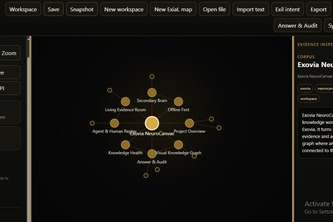
What the company appears to be: Exovia NeuroCanvas is a self-reported offline-first web application that visualizes knowledge as an infinite canvas. The author describes it as a tool for navigating knowledge like a "living neural map", integrating documents, conversations, code, and agent events into an interactive visual memory system.
What changed: The project emerged from prior research within Exovia, described as years of experimentation in visual workspaces, local-first AI systems, agent communication, and compact machine languages. It was consolidated during OpenAI Build Week into a working prototype with offline capabilities and integration of concepts like ExiaL (agent pulses), EXIR (intermediate representation), Exil (intent layer), and FAPI (capability plane).
Single most important open question: Is there evidence of actual usage or adoption beyond the author's own development work, and does the described functionality translate into a viable product for users outside the creator?
What The Product Actually Is
The description states that Exovia NeuroCanvas is an "infinite, inspectable knowledge canvas" built as an offline-first web application using HTML5 Canvas, JavaScript, CSS, and local semantic heuristics. It transforms documents, conversations, code, notes, and structured agent events into an interactive visual memory.
Key features described include:
- Importing or pasting long-form text
- Automatic division into traceable source fragments
- Hierarchical knowledge tree exploration
- Neural graph visualization of cross-topic relationships
- Pan and zoom through infinite canvas
- Semantic search using "Zoom to Answer"
- Inspection of exact original source text behind every node
- Import/export of complete knowledge maps as JSON
- Local processing without API credits
- Visualization of compact ExiaL agent pulses
- Inspection of FAPI capabilities (routing, health, streaming, generation, warmup, budget control)
- Preview of safe Exil intentions before graph mutation or executable action
The visualization is described as a "doorway into structured, verifiable memory", not the memory itself.
Evidence: Self-reported by author. No independent verification or usage data provided.
Positioning & Claim Evolution
The project positions itself as a tool for navigating knowledge like a "living neural map". The author frames it as addressing the limitation of current knowledge navigation methods — flat documents, endless chat histories, disconnected dashboards, and isolated agent logs.
It evolved from years of experimentation inside Exovia, with specific concepts recovered and rebuilt during OpenAI Build Week. The positioning emphasizes:
- Visual exploration of knowledge
- Integration of agent activity and system events
- Preservation of source evidence
- Offline-first design for privacy and accessibility
The author claims this represents a shift from merely displaying relationships to answering five key questions about AI interfaces:
- What does the system know?
- Where did that knowledge come from?
- Which agent or process produced it?
- What intention or action changed it?
- Can a human inspect and verify the complete path?
Evidence: Self-reported claims about positioning, evolution, and interface design. No external validation or market feedback.
Target Customer & ICP
The description states that Exovia NeuroCanvas can support:
- Software development teams
- AI agent builders
- Researchers
- Educators
- Consultants
- Small businesses
- Organizations with fragmented institutional memory
- People managing years of conversations, documents, and projects
It also mentions that for Exovia, this project is a foundation for creating practical AI tools to help small businesses and community projects access capabilities normally available only to large organizations.
Evidence: Self-reported target segments. No evidence of actual customers or user feedback.
Business Model & Pricing Evidence
Not evidenced. The description does not contain any information about pricing models, monetization strategies, revenue streams, or business model assumptions.
Technical & Delivery Signals
The current Build Week implementation is described as an offline-first web application built with:
- HTML5 Canvas
- JavaScript
- CSS
- Local semantic heuristics
Processing pipeline includes:
- Text normalization
- Structural and paragraph-aware chunking
- Keyword extraction
- Weighted similarity scoring
- Topic grouping
- Hierarchical tree generation
- Semantic edge generation
- Canvas layout
- Source-preserving inspection
- Search-driven camera navigation
The project integrates concepts from previous Exovia research:
- ExiaL (compact pulse format for agent communication)
- EXIR (canonical intermediate representation)
- Exil (intent layer)
- FAPI (capability and routing plane)
It uses GPT-5.6 as a product reasoning and architecture partner, and Codex-oriented workflows for implementation planning.
Evidence: Self-reported technical details and development process. No evidence of production deployment or scalability.
Traction & Maturity Signals
Not evidenced. The description does not contain any information about:
- Revenue
- Customers
- User adoption
- Product usage metrics
- Market traction
- Product maturity beyond prototype stage
The project is described as a working offline-first infinite knowledge canvas, but no evidence of real-world usage or impact.
Competitive Context
Not evidenced. The description does not mention any competitors, market positioning relative to existing tools, or competitive landscape analysis.
Open Questions & Risks
- Single-person team: Only one member listed (Lu Rastellino), which raises questions about scalability and long-term maintenance.
- Prototype stage: Described as a Build Week prototype with no evidence of production deployment or user testing.
- No revenue or traction data: No information on monetization, customers, or usage metrics.
- Self-reported functionality: All described features are claims made by the author without independent verification.
- Unproven market demand: No evidence that target users actually need or would use this tool.
- High technical complexity: Integrates multiple research concepts (ExiaL, EXIR, Exil, FAPI) with unclear validation status.
- Offline-first design limitations: May limit integration with cloud-based AI services and collaborative features.
Questions the description leaves open
- What specific user problems are you solving, and how do you know these exist?
- Have you conducted any user interviews or usability testing beyond your own development work?
- How do you plan to validate the technical claims about offline processing and semantic similarity scoring?
- What is your roadmap for moving from prototype to product, including scalability and feature prioritization?
- Are there any existing tools in this space that you're aware of, and how does your solution differ?
- How do you intend to monetize this product, and what are your assumptions about pricing?
- What are the risks associated with integrating GPT-5.6 and other AI models into a local-first experience?
- Can you provide evidence of any real-world usage or feedback from potential users beyond yourself?
Overall Assessment
Not evidenced. The description provides no information about:
- Financial performance
- Customer acquisition
- Market opportunity size
- Competitive advantages
- Team track record
- Strategic fit for investors or partners
The project is described as a prototype developed during OpenAI Build Week, with no evidence of traction, revenue, or market validation.
Confidence level: Low. The entire analysis is based on self-reported information without any external corroboration. The lack of evidence regarding users, customers, revenue, or product-market fit makes it impossible to assess viability or investment potential.
User Stories BotA demo video on every pull request
Get a demo video on every new feature
GitHub App that watches your pull requests and records a narrated, captioned demo.
Save time on demo prep and make informed decisions faster with a video walkthrough of every new feature.
Source
Submitted to the OpenAI 2026 hackathon on Devpost. Project home on Devpost. Back to the full gallery on Devpost.
This competitive analysis was produced by top-founders.com (opens in a new tab)
Generated by a language model from this project's public Devpost page — its tagline, the author's own write-up and any built-with tags listed there — as captured in August 2026. Short quotations are the author's words. It is an opinion on the idea as a business, not on the people behind it, and it reflects the description as published then. If the project has moved on, request a correction below. The analysis is not independent research and contains no verified traction, revenue or customer data.
An independent guide by KFG International LLC — not affiliated with, endorsed by, or connected to Devpost or OpenAI.