

Archive position — measured, not model output
0 likes on Devpost
2,263 of the 7,850 archived projects have more likes, and 5,587 share exactly 0 — so this project's #4,014 place in the like-ranked listing is a tie-break inside that group, not a ranking.
Projects (log scale)
Likes on Devpost. ▲ marks this project's group.
Show the figures
| Likes | Projects | Share of archive |
|---|---|---|
| 0 | 5,587 | 71.2% |
| 1 | 1,758 | 22.4% |
| 2 | 284 | 3.6% |
| 3–4 | 132 | 1.7% |
| 5–9 | 75 | 1.0% |
| 10+ | 14 | 0.2% |
 User Stories BotA demo video on every pull request
Get a demo video on every new feature
GitHub App that watches your pull requests and records a narrated, captioned demo.
Save time on demo prep and make informed decisions faster with a video walkthrough of every new feature.
Executive Summary
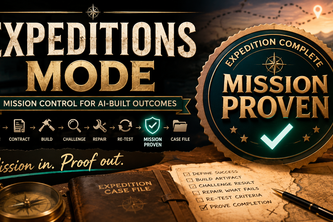
What the company appears to be: Expeditions Mode is a self-reported AI-assisted development workflow system designed to move from human intent toward a shipped, tested, proven outcome. It is described as a "Mission Control for AI-Built Outcomes" that implements a proof loop: Fail -> Fix -> Re-test -> Prove.
What changed: The project description states this is a v1.0 prototype built during an OpenAI hackathon. It represents a conceptual evolution from typical AI tools that stop at generation, toward systems that continue until outcomes are challenged, repaired, re-tested, and proven.
Single most important open question: Does Expeditions Mode have any evidence of traction, revenue, customers or adoption beyond the author's own prototype demonstration?
What The Product Actually Is
The description states that Expeditions Mode is a workflow system for moving from human intent toward a shipped, tested, proven outcome. It is described as "Mission Control for AI-Built Outcomes" and implements a proof loop: Fail -> Fix -> Re-test -> Prove.
The prototype demonstrates this through a mission to build a mobile-friendly neighborhood heatwave emergency resource site. The workflow moves through:
- Mission -> Contract -> Build -> Challenge -> Repair -> Re-test -> Mission Proven -> Case File
- Or shorter: Fail -> Fix -> Re-test -> Prove
The artifact is the heatwave site, and Expeditions Mode is described as "the machine around it."
The system includes:
- A mission definition phase that defines who is being served, what must be built, requirements, and how success will be proven
- An inspection phase where the artifact is challenged against requirements
- Repair and re-test phases to address failures
- A final Expedition Case File that preserves evidence of the entire process
The v1.0 interface shows crew roles as demo-mode representations, not live autonomous agents.
Evidence: Self-reported by author. Not independently verified.
Positioning & Claim Evolution
The description states that Expeditions Mode was inspired by the question: "what if the system did not stop at creation, but continued until the result had been challenged, repaired, re-tested, and proven?"
It positions itself as a departure from typical AI tools that stop at generation. The author claims:
- "Expeditions Mode does not treat generation as the finish line"
- "A mission is not proven because something was generated. It is proven when the requirements have evidence."
- "Mission in. Proof out."
The positioning evolved from a hackathon prototype to a vision of a system that can define success before building, challenge results, repair failures, re-test requirements, and preserve evidence.
Evidence: Self-reported by author. Not independently verified.
Target Customer & ICP
The description states that Expeditions Mode is designed for users who bring a mission and want more than generated output — they want an artifact accompanied by a transparent record of what was requested, built, challenged, repaired, re-tested, proven, and delivered.
It is described as a system where "a user can bring a mission and receive more than generated output."
The author notes that the v1.0 crew roles shown in the interface are demo-mode representations, not live autonomous agents, suggesting the intended audience may be developers or product teams who want to orchestrate AI-assisted workflows with accountability.
Evidence: Self-reported by author. Not independently verified.
Business Model & Pricing Evidence
The description does not contain any information about pricing, monetization, or business model.
Evidence: Not evidenced.
Technical & Delivery Signals
The prototype was built as a standalone web application using HTML, CSS, and JavaScript.
GPT-5.6 helped define and refine the mission, product concept, Mission Contract framing, workflow, success criteria, product language, proof-loop structure, and key product decisions.
Codex materially helped build and polish the prototype, including:
- Interface
- Proof-state behavior
- Repair and re-test flow
- Heatwave artifact
- Visual refinement
- Documentation
- Release checks
- Screenshots
- Demo preparation
- Submission packaging
The author intentionally designed the prototype around an explicit proof loop: Fail -> Fix -> Re-test -> Prove.
The product architecture and decisions remained human-directed while GPT-5.6 and Codex served distinct AI-assisted roles in helping define, build, refine, and prepare the prototype.
Evidence: Self-reported by author. Not independently verified.
Traction & Maturity Signals
The description states that this is a v1.0 prototype built during an OpenAI 2026 hackathon on Devpost.
There is no evidence of revenue, customers, or adoption beyond the author's own demonstration.
The author notes that the demo needed to be public-safe, under three minutes, and transparent about the boundary between the real AI-assisted development process and the demo-mode crew roles represented in the interface.
Evidence: Self-reported by author. Not independently verified.
Competitive Context
The description states that prompt-to-app tools and agent orchestration already exist, so the author did not want to claim novelty simply for generating software or representing agent roles.
It does not mention specific competitors or market positioning beyond this general context.
Evidence: Self-reported by author. Not independently verified.
Open Questions & Risks
- No evidence of traction or adoption: The project is described as a v1.0 prototype with no indication of revenue, customers, or usage beyond the author's own demonstration.
- Unproven business model: No information about pricing, monetization, or how the product would be sold or delivered to users.
- Self-reported only: All claims are from the author and not independently verified.
- Limited scope: The prototype is described as a demonstration of a workflow concept, not a fully functional system.
- No team or organizational structure: Only one member (abigail Prophete) is listed, with no indication of additional team members or support structure.
Evidence: Self-reported by author. Not independently verified.
Questions the description leaves open
- What specific user problems does Expeditions Mode solve that current AI tools do not?
- How does the system handle edge cases or complex requirements in real-world applications?
- What is the plan for transitioning from this v1.0 prototype to a production-ready product?
- Are there any existing users or pilot customers who have provided feedback on the workflow?
- How will the system be monetized, and what is the go-to-market strategy?
- What are the technical limitations of the current proof-loop implementation that might affect scalability?
- How does Expeditions Mode integrate with existing development tools or workflows?
Evidence: Based on self-reported description only.
Overall Assessment
The description states that this is a v1.0 prototype built during an OpenAI 2026 hackathon. There is no evidence of traction, revenue, customers, or adoption beyond the author's own demonstration.
The project is described as a conceptual exploration of a proof-loop workflow for AI-assisted development, but there is no indication that it has moved beyond the prototype stage or has any commercial viability or market demand.
Evidence: Self-reported by author. Not independently verified.
Confidence Level: Low — based entirely on self-reported information without any external validation or evidence of traction, revenue, or customer adoption.
User Stories BotA demo video on every pull request
Get a demo video on every new feature
GitHub App that watches your pull requests and records a narrated, captioned demo.
Save time on demo prep and make informed decisions faster with a video walkthrough of every new feature.
Source
Submitted to the OpenAI 2026 hackathon on Devpost. Project home on Devpost. Back to the full gallery on Devpost.
This competitive analysis was produced by top-founders.com (opens in a new tab)
Generated by a language model from this project's public Devpost page — its tagline, the author's own write-up and any built-with tags listed there — as captured in August 2026. Short quotations are the author's words. It is an opinion on the idea as a business, not on the people behind it, and it reflects the description as published then. If the project has moved on, request a correction below. The analysis is not independent research and contains no verified traction, revenue or customer data.
An independent guide by KFG International LLC — not affiliated with, endorsed by, or connected to Devpost or OpenAI.