

Archive position — measured, not model output
0 likes on Devpost
2,263 of the 7,850 archived projects have more likes, and 5,587 share exactly 0 — so this project's #4,016 place in the like-ranked listing is a tie-break inside that group, not a ranking.
Projects (log scale)
Likes on Devpost. ▲ marks this project's group.
Show the figures
| Likes | Projects | Share of archive |
|---|---|---|
| 0 | 5,587 | 71.2% |
| 1 | 1,758 | 22.4% |
| 2 | 284 | 3.6% |
| 3–4 | 132 | 1.7% |
| 5–9 | 75 | 1.0% |
| 10+ | 14 | 0.2% |
 User Stories BotA demo video on every pull request
Get a demo video on every new feature
GitHub App that watches your pull requests and records a narrated, captioned demo.
Save time on demo prep and make informed decisions faster with a video walkthrough of every new feature.
Executive Summary
What the company appears to be
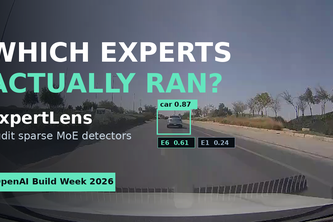
ExpertLens: SparseSight Studio is a developer-facing tool designed to visualize and analyze the internal behavior of sparse expert models in object detection. It presents side-by-side detection results, routing metrics, performance comparisons, and structured AI analysis using GPT-5.6.
What changed
The project was built as part of an OpenAI 2026 hackathon submission. It is described as a self-contained, offline-first application that bundles evidence for analysis by GPT-5.6 without relying on private research infrastructure or unverified claims.
Single most important open question — the commercial due-diligence read
Is there a viable market need for this type of sparse-model observability tooling in developer or engineering teams working with sparse expert systems, and can it be scaled beyond a hackathon prototype?
Note: This analysis is based entirely on the self-reported description provided by the author. No external verification or historical data are available.
What The Product Actually Is
The description states that ExpertLens: SparseSight Studio:
- Displays dense and sparse detection results side-by-side using bundled, redistribution-safe road scenes.
- Shows top two selected experts per scene along with routing weights.
- Visualizes routing-health metrics such as expert utilization, effective expert count, load balance, expert-pair coverage, top-k margin, and FP16/FP32 agreement.
- Compares latency, stored and active parameter counts, checkpoint size, and single-seed pilot AP across dense and sparse configurations.
- Sends a limited, public JSON evidence payload to GPT-5.6 for structured findings and one recommended next experiment.
- Calculates a checksum for the exact JSON payload so users can verify what evidence was analyzed.
- Provides a deterministic, evidence-aware report when an OpenAI key or network connection is unavailable.
Inference: The tool appears to be a visualization and analysis platform tailored for sparse expert model debugging and observability. It integrates with GPT-5.6 via structured inputs but also supports offline functionality.
Positioning & Claim Evolution
The description states:
- The product was built to make internal behavior of sparse-expert models visible.
- It addresses an "observability challenge" introduced by sparse-expert models, where dashboards show only final bounding boxes and not model internals.
- It aims to help developers or hackathon judges understand what happens inside the model without needing deep technical knowledge.
Inference: The positioning appears focused on solving a niche problem in AI engineering — specifically, making sparse routing behavior interpretable for researchers and engineers. It positions itself as a tool for transparency rather than performance optimization.
Target Customer & ICP
The description states:
- The intended audience includes developers or hackathon judges who need to understand internal model behavior.
- It is designed to be accessible within a few minutes, suggesting a low-barrier entry point.
Inference: The initial target customer seems to be technical users in AI research or engineering roles — particularly those working with sparse expert models. There is no indication of broader market segmentation beyond this use case.
Business Model & Pricing Evidence
Not evidenced.
The description does not mention any pricing model, monetization strategy, or business model. It describes a hackathon project with no commercial intent or revenue streams.
Technical & Delivery Signals
The description states:
- Built with Streamlit for UI.
- Uses Pillow for detection overlays.
- Charts and components use custom HTML/CSS.
- Lightweight Python layer handles validation, logic, and asset access control.
- Integrates OpenAI Responses API with GPT-5.6 using Pydantic structured outputs.
- Includes a deterministic fallback when no credentials or network are available.
- Uses SHA-256 checksums to validate JSON payloads sent to AI.
Inference: The technical stack is minimal and self-contained, suggesting a lightweight, portable solution. It emphasizes security through validation and offline support, which may indicate an engineering-first approach.
Traction & Maturity Signals
Not evidenced.
There is no mention of users, customers, revenue, usage metrics, or adoption data beyond the hackathon submission. The project is described as a prototype with no traction indicators.
Competitive Context
Not evidenced.
The description does not reference existing tools or competitors in the sparse-model observability space. No competitive landscape is provided.
Open Questions & Risks
- Niche market: Sparse expert models are a specialized area; there may be limited demand outside of specific research or engineering teams.
- Prototype nature: The tool was built for a hackathon and lacks evidence of scalability, long-term development, or production readiness.
- Dependency on GPT-5.6: Reliance on a proprietary AI model with unclear access terms or availability could pose risks if access changes.
- No commercial viability: No evidence of monetization or business model beyond the hackathon context.
Questions the description leaves open
- What is the actual scope of the sparse expert model use case you're targeting? Is it limited to a specific domain or application?
- How do you plan to transition from a hackathon prototype to a scalable product?
- Are there any plans for monetization or commercial licensing?
- Have you identified any early adopters or potential customers beyond internal research teams?
- What are the implications of relying on GPT-5.6 for analysis, especially in terms of access, cost, and control?
Overall Assessment
Not evidenced.
There is no evidence of funding, valuation, or investment interest. The project is described as a hackathon submission with no indication of future commercialization plans or strategic partnerships. Any potential for investment or partnership would depend on further development and demonstration of market demand.
User Stories BotA demo video on every pull request
Get a demo video on every new feature
GitHub App that watches your pull requests and records a narrated, captioned demo.
Save time on demo prep and make informed decisions faster with a video walkthrough of every new feature.
Source
Submitted to the OpenAI 2026 hackathon on Devpost. Project home on Devpost. Back to the full gallery on Devpost.
This competitive analysis was produced by top-founders.com (opens in a new tab)
Generated by a language model from this project's public Devpost page — its tagline, the author's own write-up and any built-with tags listed there — as captured in August 2026. Short quotations are the author's words. It is an opinion on the idea as a business, not on the people behind it, and it reflects the description as published then. If the project has moved on, request a correction below. The analysis is not independent research and contains no verified traction, revenue or customer data.
An independent guide by KFG International LLC — not affiliated with, endorsed by, or connected to Devpost or OpenAI.