

Archive position — measured, not model output
0 likes on Devpost
2,263 of the 7,850 archived projects have more likes, and 5,587 share exactly 0 — so this project's #5,974 place in the like-ranked listing is a tie-break inside that group, not a ranking.
Projects (log scale)
Likes on Devpost. ▲ marks this project's group.
Show the figures
| Likes | Projects | Share of archive |
|---|---|---|
| 0 | 5,587 | 71.2% |
| 1 | 1,758 | 22.4% |
| 2 | 284 | 3.6% |
| 3–4 | 132 | 1.7% |
| 5–9 | 75 | 1.0% |
| 10+ | 14 | 0.2% |
 User Stories BotA demo video on every pull request
Get a demo video on every new feature
GitHub App that watches your pull requests and records a narrated, captioned demo.
Save time on demo prep and make informed decisions faster with a video walkthrough of every new feature.
Executive Summary
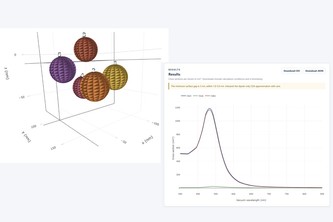
The company appears to be a solo developer project named Plasmonic Coupling Simulator, self-described as a local, bilingual web application for simulating optical spectra from gold nanoparticle assemblies. The author states it uses Mie and Coupled Dipole Approximation methods with QCM tunnel parameter tables, and is built using Python, FastAPI, JavaScript, and Plotly.js.
The project is described as a tool for students and early-stage researchers to explore geometry-dependent optical responses before moving to higher-fidelity numerical methods. It supports 1–20 Au nanospheres, offers 3D visualization, and allows users to vary gaps and wavelengths.
What changed: The author reports iterative development using GPT-5.6 and Codex for analysis, implementation, testing, and documentation, with human review maintaining scientific scope and product decisions.
The single most important open question: Is there any evidence of user adoption or commercial traction beyond the author’s own use-case? The description states no revenue, customers, or usage data exist.
Note: This is a self-reported, unverified account. All claims are based on the author's own description and have not been independently corroborated.
What The Product Actually Is
- The description states that Plasmonic Coupling Simulator is a local, offline-capable web application.
- It is designed for assemblies of 1 to 20 Au nanospheres.
- Users can start from editable presets (dimer, trimer, random cluster), inspect geometry in a real-diameter 3D preview, and calculate extinction, scattering, and absorption spectra.
- Results can be downloaded as CSV or JSON, including metadata like calculation conditions, timestamps, warnings, and QCM provenance.
- The interface supports English and Japanese with state persistence across language switches.
- It uses Mie calculations for single-particle reference and a retarded Coupled Dipole Approximation (CDA) for multi-particle assemblies.
- For surface gaps from 0.5 to 1.0 nm, it selects a limited Quantum Corrected Model (QCM) path.
- The QCM tunnel parameter table is described as a manual digitization of Esteban et al. (2012), Fig. 2d, with estimated reading uncertainty.
- It blocks gaps below 0.5 nm and distinguishes QCM status from classical CDA warning ranges.
- The stack includes: Python, FastAPI, JavaScript, Plotly.js, Server-Sent Events.
- The app binds only to localhost and works offline after setup.
Inference: The tool is a research or educational aid, not a commercial product. It does not appear to be a SaaS offering or a product for general public use.
Positioning & Claim Evolution
- The author states the goal is not to replace rigorous methods like BEM, DDA, FDTD, or TDDFT.
- Instead, it helps users inspect particle layouts, vary gaps and wavelengths, and make model assumptions visible.
- It is positioned as a lightweight local tool for early-stage exploration before moving to higher-fidelity numerical methods.
- The author describes the tool as a way to “move quickly from an intuitive geometry” to reproducible spectrum calculation.
- The project was submitted to the OpenAI 2026 hackathon, suggesting it is a prototype or proof-of-concept.
Claim: The tool is for students and early-stage researchers.
Inference: It is not positioned as a commercial product or enterprise solution.
Target Customer & ICP
- The description states the tool is intended for students and early-stage researchers.
- It is designed to help users move from intuitive geometry to reproducible spectrum calculation.
- No specific customer segments, personas, or use cases beyond academic or research settings are described.
- There is no evidence of targeting commercial customers, institutions, or end-users outside of the research domain.
Not evidenced: No explicit ICP (Ideal Customer Profile) or defined buyer personas.
Business Model & Pricing Evidence
- The description does not mention any pricing, licensing, or monetization strategy.
- It is described as a local, offline-capable web application that binds only to localhost.
- No evidence of a SaaS model, subscription, or paid features is present.
- There is no indication of revenue streams or commercial viability.
Not evidenced: No business model or pricing information.
Technical & Delivery Signals
- The tool uses Mie calculations, retarded Coupled Dipole Approximation (CDA), and a limited Quantum Corrected Model (QCM) for surface gaps.
- It includes 3D visualization using real-diameter mesh-based preview in nanometre coordinates.
- The UI supports browser-side CSV/JSON export.
- It uses GPT-5.6 and Codex for iterative development, analysis, testing, and documentation.
- Human review remains responsible for scientific scope, physical-model limits, product decisions, and final acceptance.
- The application is built with Python, FastAPI, JavaScript, Plotly.js, Server-Sent Events.
- It works offline after setup and binds only to localhost.
Inference: The tool is a technical prototype with strong engineering execution but not yet a commercial product.
Traction & Maturity Signals
- The project was submitted to the OpenAI 2026 hackathon, indicating it is a prototype or proof-of-concept.
- No evidence of user adoption, customer base, or usage metrics beyond the author’s own use-case.
- There is no mention of revenue, customers, or product traction.
- The author reports iterative development and browser testing issues that were resolved.
Not evidenced: No traction, adoption, or maturity indicators beyond self-reported development process.
Competitive Context
- The description does not reference any direct competitors.
- It is positioned as a tool for early-stage exploration, not replacement of rigorous numerical methods like BEM, DDA, FDTD, or TDDFT.
- No mention of existing tools in the plasmonics simulation or nanophotonics space.
Not evidenced: No competitive landscape or market positioning beyond self-description.
Open Questions & Risks
- The tool is described as a solo developer project, with no team or organizational structure.
- It is not a SaaS product and does not appear to be monetized.
- There is no evidence of user adoption or commercial traction.
- The tool is local-only, which limits scalability or distribution.
- The author explicitly states that AI-generated output was not treated as evidence for physics, experimental values, or literature claims — raising questions about scientific rigor.
Inference: The project may be a research prototype with limited commercial potential or scalability.
Questions the description leaves open
- What is the intended user base beyond personal use?
- Are there any plans to commercialize this tool, and if so, how?
- How does the tool’s accuracy compare to established solvers like FDTD or BEM?
- Has the author considered broader material support or size-dependent damping?
- Is there a plan for automated UI testing or browser compatibility beyond local development?
- What are the limitations of the QCM model used, and how were they validated?
Note: These questions are based on the self-reported description and aim to uncover gaps in evidence.
Overall Assessment
- The project is described as a solo developer prototype for academic or research use.
- It does not appear to be a commercial product or scalable SaaS offering.
- There is no evidence of revenue, customers, or traction.
- The tool is local-only, and the author has not indicated any intention to monetize it.
- It was submitted as part of a hackathon, suggesting it is a proof-of-concept.
Assessment: Not a viable investment or partnership opportunity at this stage. The project lacks commercial traction, scalability, or evidence of market demand. It may be an interesting academic tool but not a product-ready for investment or strategic partnership.
User Stories BotA demo video on every pull request
Get a demo video on every new feature
GitHub App that watches your pull requests and records a narrated, captioned demo.
Save time on demo prep and make informed decisions faster with a video walkthrough of every new feature.
Source
Submitted to the OpenAI 2026 hackathon on Devpost. Project home on Devpost. Back to the full gallery on Devpost.
This competitive analysis was produced by top-founders.com (opens in a new tab)
Generated by a language model from this project's public Devpost page — its tagline, the author's own write-up and any built-with tags listed there — as captured in August 2026. Short quotations are the author's words. It is an opinion on the idea as a business, not on the people behind it, and it reflects the description as published then. If the project has moved on, request a correction below. The analysis is not independent research and contains no verified traction, revenue or customer data.
An independent guide by KFG International LLC — not affiliated with, endorsed by, or connected to Devpost or OpenAI.