

Archive position — measured, not model output
0 likes on Devpost
2,263 of the 7,850 archived projects have more likes, and 5,587 share exactly 0 — so this project's #7,127 place in the like-ranked listing is a tie-break inside that group, not a ranking.
Projects (log scale)
Likes on Devpost. ▲ marks this project's group.
Show the figures
| Likes | Projects | Share of archive |
|---|---|---|
| 0 | 5,587 | 71.2% |
| 1 | 1,758 | 22.4% |
| 2 | 284 | 3.6% |
| 3–4 | 132 | 1.7% |
| 5–9 | 75 | 1.0% |
| 10+ | 14 | 0.2% |
 User Stories BotA demo video on every pull request
Get a demo video on every new feature
GitHub App that watches your pull requests and records a narrated, captioned demo.
Save time on demo prep and make informed decisions faster with a video walkthrough of every new feature.
Executive Summary
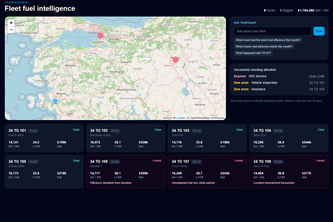
TankGuard is a self-reported tool built for fleet managers in Turkey, designed to detect unexplained fuel loss and suspicious transactions by integrating GPS pings, tank level readings, and fuel card data. It applies three predefined rules to identify anomalies and uses GPT-5.6 to investigate each case, offering explanations, alternative causes, and next steps without assigning blame. The system includes a query box for plain-language interaction.
The author states that the tool was built in one continuous session using Codex and a spec-driven workflow, with no revenue, customers or traction data provided. It is presented as a prototype for a side project, not yet deployed to real-world use.
Key open question
Does TankGuard have any evidence of being used by fleet managers beyond the author's own side project?
What The Product Actually Is
The description states that TankGuard:
- Takes GPS pings, tank level readings, and fuel card transactions.
- Runs three predefined rules on the data to detect anomalies.
- Uses GPT-5.6 to investigate each anomaly, explaining what the data shows, listing possible causes (e.g., leak or broken sensor), and suggesting next steps.
- Includes a query box for managers to ask questions in plain language.
The system is described as a standalone assistant for fleet managers, intended to help them track fuel loss by combining data from separate systems.
Not evidenced: whether the tool actually integrates with real systems or if it only processes seeded data. The author notes that synthetic data was used for demo purposes and that the build was not deployed to production.
Positioning & Claim Evolution
The author positions TankGuard as a solution for fleet managers in Turkey who struggle with fuel loss, where GPS and fuel data are stored separately, making detection difficult.
Claims:
- It is a standalone assistant that helps fleet managers track fuel loss.
- It uses GPT-5.6 to investigate anomalies without blaming individuals.
- It combines data from multiple sources (GPS, tank levels, fuel cards) into one view.
- It allows managers to ask questions in plain language.
The author describes the tool as a prototype for a side project and not yet deployed to real-world use.
Not evidenced: whether this is a new positioning or an evolution of prior claims. No evidence of prior versions or market positioning beyond this self-reported description.
Target Customer & ICP
The description states:
- The target customer is fleet managers in Turkey.
- The tool addresses the problem of fuel loss, which is common in that market.
Not evidenced: whether this is a defined ICP (Ideal Customer Profile) or if there are other potential use cases or markets. No evidence of segmentation beyond geography or industry.
Business Model & Pricing Evidence
The description does not state:
- Whether TankGuard has a business model.
- Whether pricing information is available.
- Whether the tool is offered as a SaaS product, freemium, or other monetization strategy.
Not evidenced: no commercial details are provided beyond the author's own side project use case.
Technical & Delivery Signals
The description states:
- The system was built using Codex and a spec-driven workflow.
- It uses technologies including React, Next.js, OpenAI API, SQLite, Tailwind CSS, TypeScript, Vercel, Leaflet.js, Recharts, and others.
- The author used a PROJECT_SPEC.md file as a guide for Codex.
- Challenges included issues with synthetic data, React Strict Mode race conditions, and deploying SQLite to Vercel’s read-only filesystem.
Inferences:
- The tool is built using AI-assisted development tools (Codex).
- It integrates multiple data sources and uses GPT for interpretation.
- It was built in a single continuous session, suggesting a rapid prototyping approach.
Not evidenced: no evidence of production deployment or scalability beyond the author’s demo setup.
Traction & Maturity Signals
The description states:
- The tool is a prototype for a side project.
- It was built for a hackathon (OpenAI 2026).
- The author notes that it was not deployed to real-world use and that the build stayed honest when an API key was missing.
Not evidenced: no evidence of traction, revenue, customers, or adoption beyond the author’s own use case. No data on usage, retention, or user feedback.
Competitive Context
The description does not state:
- Whether TankGuard competes with existing fleet management or fuel analytics tools.
- What the competitive landscape looks like in Turkey or globally.
- How it differentiates from other solutions.
Not evidenced: no mention of competitors or market positioning beyond the author’s own claims.
Open Questions & Risks
Inferences based on the description:
- The tool is a prototype, not yet deployed to real-world use.
- It was built using AI-assisted development tools (Codex), which may limit scalability or maintainability.
- The system uses seeded data for demo purposes, raising questions about its ability to work with real data.
- There are no clear commercial signals or evidence of traction.
Open questions:
- No evidence of revenue, customers, or market adoption.
- No indication that the tool is used beyond the author’s side project.
- The use of synthetic data may indicate a lack of real-world validation.
Questions the description leaves open
- What is the current status of the tool? Is it being used by fleet managers in Turkey?
- How does TankGuard plan to scale from a prototype to a production-ready product?
- What are the technical limitations or scalability concerns with the current architecture?
- Are there any plans for monetization or commercial deployment?
- How does the system handle real-time data feeds, and what is the expected latency?
- Has the tool been tested with actual fleet managers or only simulated use cases?
Overall Assessment
Not evidenced: no information on whether TankGuard has any investment or partnership interest, or if it meets criteria for either.
The description indicates that TankGuard is a prototype built for a hackathon and a side project. There is no evidence of traction, revenue, customers, or commercial viability beyond the author’s own use case. The tool is not yet deployed to real-world use.
Confidence level Low — based on self-reported, unverified information with no external validation or commercial signals.
User Stories BotA demo video on every pull request
Get a demo video on every new feature
GitHub App that watches your pull requests and records a narrated, captioned demo.
Save time on demo prep and make informed decisions faster with a video walkthrough of every new feature.
Source
Submitted to the OpenAI 2026 hackathon on Devpost. Project home on Devpost. Back to the full gallery on Devpost.
This competitive analysis was produced by top-founders.com (opens in a new tab)
Generated by a language model from this project's public Devpost page — its tagline, the author's own write-up and any built-with tags listed there — as captured in August 2026. Short quotations are the author's words. It is an opinion on the idea as a business, not on the people behind it, and it reflects the description as published then. If the project has moved on, request a correction below. The analysis is not independent research and contains no verified traction, revenue or customer data.
An independent guide by KFG International LLC — not affiliated with, endorsed by, or connected to Devpost or OpenAI.