

Archive position — measured, not model output
0 likes on Devpost
2,263 of the 7,850 archived projects have more likes, and 5,587 share exactly 0 — so this project's #7,129 place in the like-ranked listing is a tie-break inside that group, not a ranking.
Projects (log scale)
Likes on Devpost. ▲ marks this project's group.
Show the figures
| Likes | Projects | Share of archive |
|---|---|---|
| 0 | 5,587 | 71.2% |
| 1 | 1,758 | 22.4% |
| 2 | 284 | 3.6% |
| 3–4 | 132 | 1.7% |
| 5–9 | 75 | 1.0% |
| 10+ | 14 | 0.2% |
 User Stories BotA demo video on every pull request
Get a demo video on every new feature
GitHub App that watches your pull requests and records a narrated, captioned demo.
Save time on demo prep and make informed decisions faster with a video walkthrough of every new feature.
Executive Summary
What the company appears to be
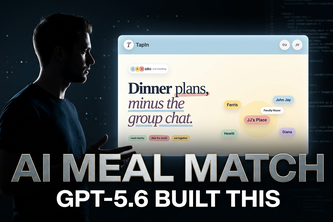
TapIn is a self-reported coordination tool for campus meal-swipe sharing, built as a hackathon project. It uses GPT-5.6 to interpret natural-language availability and requests, then applies deterministic logic to match users and enable booking. The system does not process payments or manage meal plans; it facilitates in-person meetups between meal-plan holders and guests.
What changed
The project was developed over a hackathon period using AI (GPT-5.6) and modern web technologies (React, Cloudflare D1, TypeScript). It transitions from informal group chats to structured booking via an interface that parses multilingual, contextual messages.
Single most important open question
Is there real-world demand for this system beyond the initial Columbia communities, and can it scale or be adapted to other campuses without significant re-engineering?
Note: This analysis is based entirely on the self-reported project description provided by the author. No external verification, traction data, revenue figures, or customer information are available.
What The Product Actually Is
The description states that TapIn:
- Converts informal, multilingual messages into structured availability using GPT-5.6.
- Matches meal requests with provider availability through natural language processing.
- Locks reservations and enables coordination between users.
- Does not process payments or manage meal plans.
- Provides filters for date, time, dining hall, capacity, and crowd levels.
- Imports existing group-chat messages into structured supply/demand data.
It is described as a "coordination layer" for in-person meetups and permitted guest access.
Inference: The product appears to be a minimal viable product (MVP) built in a short timeframe, with AI integration focused on parsing human communication rather than full automation.
Positioning & Claim Evolution
The description claims:
- TapIn turns chaotic group chats into structured booking systems.
- It supports multilingual and shorthand expressions common in campus communities.
- The system uses GPT-5.6 for intent-aware matching, not just chatbot-style interaction.
- It is grounded in real demand from existing Columbia meal-swipe coordination groups.
Claim vs Fact: These are self-reported claims about functionality, user behavior, and AI performance. No independent validation or evidence of actual usage exists beyond the authors’ account.
Target Customer & ICP
The description states:
- The primary users are undergraduate students with unused meal swipes and graduate students or guests seeking dining access.
- It targets Columbia University specifically, though the authors mention potential expansion to other campuses.
- Users interact via group chats, suggesting a community-driven adoption model.
Inference: The ICP seems to be campus-based, informal, and reliant on existing social networks. There is no evidence of formal targeting or segmentation beyond this context.
Business Model & Pricing Evidence
The description states:
- TapIn does not process payments.
- It does not sell meal plans or transfer IDs.
- It functions as a coordination layer only.
- No pricing model or monetization strategy is described.
Not evidenced: There is no mention of any business model, revenue streams, or pricing structure. The project appears to be a prototype with no commercial implementation.
Technical & Delivery Signals
The description reports:
- Built using TypeScript, React, Cloudflare D1, and OpenAI Responses API.
- GPT-5.6 powers two workflows: availability extraction and intent-aware matching.
- Evaluation dataset created from anonymized real community messages.
- Achieved 89.2% exact-match accuracy on evaluation set.
- Product includes filters, crowd indicators, email verification, booking management, and group-chat importer.
Inference: The technical stack suggests a modern, cloud-native approach with AI integration. However, the lack of production data or scalability metrics limits confidence in delivery readiness.
Traction & Maturity Signals
The description states:
- More than 680 people participate in two Columbia meal-swipe coordination groups.
- The system is deployed and functional.
- Real-world testing was conducted across mobile and desktop devices.
- Aims to test with existing communities and measure outcomes like successful reservations and no-shows.
Not evidenced: No actual usage data, customer feedback, or performance metrics beyond the evaluation accuracy are provided. The project remains in early-stage testing.
Competitive Context
The description does not mention any competitors. It implies that current solutions rely on scattered group chats, Reddit posts, and direct messages, but no comparison to existing tools or platforms is made.
Not evidenced: No competitive landscape analysis is available. The authors do not reference similar systems or market positioning.
Open Questions & Risks
- Unproven demand: While there are 680+ people in two groups, this does not confirm adoption of TapIn itself.
- AI dependency without robustness: GPT-5.6 is used for core functionality; if it fails or becomes unreliable, the system breaks.
- No monetization path: No indication of how TapIn would generate revenue or sustain operations.
- Limited scalability: The system is tied to a single campus and relies on local evaluation sets.
- Lack of data privacy or trust features: Email verification is mentioned, but no deeper identity or security mechanisms are described.
Inference: The project lacks commercial viability indicators and may not be ready for broader deployment without significant development.
Questions the description leaves open
- How many people actually use TapIn today, versus those who are just in the group chats?
- What is the current accuracy rate of matching in real-world usage vs. the 89.2% on the evaluation set?
- Are there any known edge cases or failures in AI interpretation that have caused booking issues?
- How do you plan to onboard new campuses and adapt the system to different meal-access rules?
- What are your thoughts on integrating trust features, such as user verification or ratings?
- Is there a plan for monetization beyond potential future expansion or partnerships?
Overall Assessment
Not evidenced: There is no evidence of revenue, customers, or traction to support an investment or partnership decision.
Assessment: Based on the self-reported description alone, TapIn appears to be a functional prototype with strong initial design and AI integration. However, it lacks commercial viability indicators, scalability planning, and clear monetization strategies. It is not ready for investment or strategic partnership without further development and validation in real-world use cases.
User Stories BotA demo video on every pull request
Get a demo video on every new feature
GitHub App that watches your pull requests and records a narrated, captioned demo.
Save time on demo prep and make informed decisions faster with a video walkthrough of every new feature.
Source
Submitted to the OpenAI 2026 hackathon on Devpost. Project home on Devpost. Back to the full gallery on Devpost.
This competitive analysis was produced by top-founders.com (opens in a new tab)
Generated by a language model from this project's public Devpost page — its tagline, the author's own write-up and any built-with tags listed there — as captured in August 2026. Short quotations are the author's words. It is an opinion on the idea as a business, not on the people behind it, and it reflects the description as published then. If the project has moved on, request a correction below. The analysis is not independent research and contains no verified traction, revenue or customer data.
An independent guide by KFG International LLC — not affiliated with, endorsed by, or connected to Devpost or OpenAI.