

Archive position — measured, not model output
1 like on Devpost
505 of the 7,850 archived projects have more likes, and 1,758 share exactly 1 — so this project's #1,242 place in the like-ranked listing is a tie-break inside that group, not a ranking.
Projects (log scale)
Likes on Devpost. ▲ marks this project's group.
Show the figures
| Likes | Projects | Share of archive |
|---|---|---|
| 0 | 5,587 | 71.2% |
| 1 | 1,758 | 22.4% |
| 2 | 284 | 3.6% |
| 3–4 | 132 | 1.7% |
| 5–9 | 75 | 1.0% |
| 10+ | 14 | 0.2% |
 User Stories BotA demo video on every pull request
Get a demo video on every new feature
GitHub App that watches your pull requests and records a narrated, captioned demo.
Save time on demo prep and make informed decisions faster with a video walkthrough of every new feature.
Executive Summary
What the company appears to be
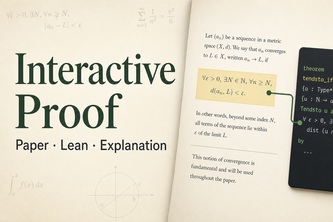
Interactive Proof is a self-reported educational tool that uses AI to explain mathematical proofs in papers, with an interface that allows users to select text and receive interactive, source-aware explanations. It integrates with uploaded PDFs and optionally Lean files, and uses OpenAI's GPT-5.6 as its explanation engine.
What changed
The project was built as a hackathon submission for the OpenAI 2026 hackathon. The author describes it as an MVP demonstrating interaction and evidence boundaries, not yet validated for educational efficacy or broad mathematical accuracy.
Single most important open question
Is there any evidence of traction, revenue, or customer adoption beyond the self-reported hackathon build?
Note: This analysis is based entirely on the self-reported project description provided by the caller. No independent verification, archived data, or third-party sources are available. All claims are attributed to the author’s own account and should be treated as unverified.
What The Product Actually Is
The description states that Interactive Proof is a tool designed for students, educators, and self-directed learners who want to understand mathematical papers and proofs through interactive AI explanations of each proof step. It supports uploading PDFs and optionally Lean files, and allows users to select text and get contextual explanations from GPT-5.6.
It uses:
- PDF.js for reading uploaded papers.
- GPT-5.6 as the explanation engine via OpenAI’s API.
- Next.js 16, React 19, TypeScript, Node.js 24, and other web technologies.
- Lean 4 for optional formal proof integration.
- Codex to assist in building and reviewing code.
The system is described as a browser-based interface where users can:
- Upload a paper (PDF).
- Select a passage.
- Get an explanation from GPT-5.6, with source citations.
- Optionally add a Lean file for context.
- Ask follow-ups without losing their place.
Inference: The product is not yet a full-fledged SaaS offering but rather a prototype or MVP built for demonstration purposes in a hackathon setting.
Positioning & Claim Evolution
The author positions Interactive Proof as a tool that helps users understand mathematical papers by reducing context switches and improving the path from confusion to focused questions. It aims to support classroom use, independent study, and Lean onboarding.
It is not claiming:
- Measurable learning gains or retention.
- Broad corpus accuracy.
- Mathematical correctness across many proofs.
- Educational efficacy through controlled studies.
The author explicitly states that this is a hackathon build, demonstrating interaction and its evidence boundaries. The educational impact needs later learner studies.
Inference: This is a proof-of-concept product, not a validated solution or scalable offering.
Target Customer & ICP
The description identifies three main user types:
- Students.
- Educators.
- Self-directed learners.
These users are described as those who understand most of an argument but get stuck on locally compressed steps in mathematical papers.
There is no mention of specific customer segments beyond these broad categories. No segmentation by academic level, institution type, or use case (e.g., classroom vs. personal study) is provided.
Inference: The ICP is not clearly defined beyond general education roles; no evidence of a refined buyer persona or market targeting strategy exists.
Business Model & Pricing Evidence
There is no evidence of any business model, pricing structure, monetization plan, or revenue streams described in the project write-up. The tool appears to be an open-source prototype with no indication of how it would generate income.
The author notes that:
- The application requires an API key for live explanations.
- It can run locally without one, but live features fail without a key.
- No mention is made of subscriptions, usage fees, or licensing models.
Inference: There is no evidence of a business model or pricing strategy beyond the basic technical setup.
Technical & Delivery Signals
The project was built using:
- Next.js 16, React 19, TypeScript, Node.js 24
- OpenAI API (GPT-5.6) for explanations
- PDF.js for PDF reading
- Lean 4 integration
- Codex used to assist in development workflow
The author describes a concrete workflow:
- Use Codex to turn requirements into PRD and delivery plan.
- Codex helps implement architecture, tests, documentation.
- Human judgment guides product direction, curation, and validation.
The application supports:
- Temporary file upload workspace.
- Streaming explanations from GPT-5.6.
- Bounded context for explanations.
- Browser-based testing with Vitest, Playwright, ESLint.
- Responsive UI and accessibility features.
Inference: The technical stack is modern and well-integrated; however, the product is clearly a prototype built in a short timeframe (hackathon), not a production-ready system.
Traction & Maturity Signals
There is no evidence of any traction, customers, or adoption beyond the author’s own development and testing. The project was submitted to a hackathon and is described as an MVP.
The author explicitly states:
- No learner outcome metrics.
- No broad-corpus mathematical accuracy.
- No formal evaluation or validation.
- No user studies or feedback loops.
It is also noted that:
- The repository fixture is for deterministic validation, not public upload flow.
- Conversations are bounded to browser state; no accounts or history.
- No accounts, saved highlights, or durable history exist.
Inference: There is no evidence of traction, adoption, or maturity beyond a hackathon prototype.
Competitive Context
The description does not provide any information about competitors or the competitive landscape. It does not mention existing tools for explaining mathematical proofs or educational AI platforms.
No comparison to other products, services, or market players is made.
Inference: No evidence of competitive positioning or awareness of similar offerings exists.
Open Questions & Risks
- Unverified claims: The tool is described as a hackathon prototype with no validation of effectiveness.
- No traction or revenue: No evidence of users, customers, or monetization.
- Limited scope: No accounts, history, or persistent user data; all interactions are browser-bound.
- Educational efficacy unknown: No learner outcome metrics or studies.
- Technical limitations: Lean integration is unverified; paper-to-Lean mappings are curated manually.
- No business model: No indication of how the tool would be monetized or scaled.
Inference: The project lacks commercial viability, traction, and a clear path to market adoption.
Questions the description leaves open
- What is your plan for validating educational efficacy?
- Have you conducted any user testing or feedback sessions with students or educators?
- How do you intend to scale beyond the current prototype?
- Is there any intention to monetize this tool, and if so, what model are you considering?
- What are the long-term plans for Lean integration and automated proof mapping?
- Are there any partnerships or institutional use cases in mind?
- How do you plan to handle licensing and intellectual property of uploaded papers?
Overall Assessment
Not evidenced: There is no evidence of traction, revenue, customers, or a validated business model. The project is described as a hackathon prototype with no indication of commercial viability or scalability.
The author states that the tool is not yet validated for learning gains, retention, or mathematical correctness, and that it was built to demonstrate interaction and its evidence boundaries.
Confidence level: Very low — this is a self-reported, unverified prototype with no measurable impact or business signals. It does not meet minimum criteria for due-diligence readiness in any commercial context.
Conclusion: This project is not ready for investment or partnership consideration at this time. It requires significant development and validation before any commercial traction can be assessed.
User Stories BotA demo video on every pull request
Get a demo video on every new feature
GitHub App that watches your pull requests and records a narrated, captioned demo.
Save time on demo prep and make informed decisions faster with a video walkthrough of every new feature.
Source
Submitted to the OpenAI 2026 hackathon on Devpost. Project home on Devpost. Back to the full gallery on Devpost.
This competitive analysis was produced by top-founders.com (opens in a new tab)
Generated by a language model from this project's public Devpost page — its tagline, the author's own write-up and any built-with tags listed there — as captured in August 2026. Short quotations are the author's words. It is an opinion on the idea as a business, not on the people behind it, and it reflects the description as published then. If the project has moved on, request a correction below. The analysis is not independent research and contains no verified traction, revenue or customer data.
An independent guide by KFG International LLC — not affiliated with, endorsed by, or connected to Devpost or OpenAI.