

Archive position — measured, not model output
0 likes on Devpost
2,263 of the 7,850 archived projects have more likes, and 5,587 share exactly 0 — so this project's #5,168 place in the like-ranked listing is a tie-break inside that group, not a ranking.
Projects (log scale)
Likes on Devpost. ▲ marks this project's group.
Show the figures
| Likes | Projects | Share of archive |
|---|---|---|
| 0 | 5,587 | 71.2% |
| 1 | 1,758 | 22.4% |
| 2 | 284 | 3.6% |
| 3–4 | 132 | 1.7% |
| 5–9 | 75 | 1.0% |
| 10+ | 14 | 0.2% |
 User Stories BotA demo video on every pull request
Get a demo video on every new feature
GitHub App that watches your pull requests and records a narrated, captioned demo.
Save time on demo prep and make informed decisions faster with a video walkthrough of every new feature.
Executive Summary
Company: Mastery Ledger
Self-reported basis: The analysis is based entirely on the author-supplied project description, tagline, write-up and technology tags — all self-reported and unverified. No archived evidence, third-party sources or independent verification are available.
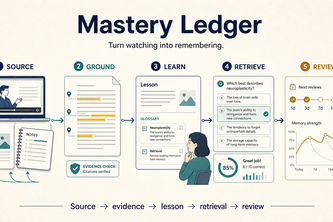
What it appears to be: A tool for converting content (videos, articles, documents) into structured learning courses with retrieval-based feedback loops and spaced review mechanisms.
What changed: The author states they built this to address a personal gap in retention after passive consumption of educational material.
Single most important open question: Is there evidence of user adoption or engagement beyond the single founder’s use case?
What The Product Actually Is
The description states that Mastery Ledger "turns a source such as a video, article, document, notes, or transcript into a structured learning course." It supports:
- Short lessons
- Glossary terms
- Multiple-choice and short-answer questions
- Final exams
- Source citations and evidence records
- Learner attempts and progress tracking
- Scheduled reviews
The tool is described as creating a "durable learning workspace" where the source, extracted notes, lessons, questions, exams, attempts, and review history are connected within a portable course folder.
Inference: The product appears to be a learning management system (LMS) or content conversion tool that uses spaced repetition and retrieval practice principles.
Not evidenced: No information on how the tool extracts or structures content, whether it integrates with existing platforms, or if it supports collaborative features.
Positioning & Claim Evolution
The author states:
“Instead of passively consuming content, learners continuously strengthen their understanding until knowledge becomes long-term memory.”
This positions Mastery Ledger as a tool for active learning, focused on retention and mastery rather than consumption.
It also claims to address the gap between understanding during consumption and forgetting later, suggesting a solution to common problems in online education.
Inference: The product is positioned as an educational tool that leverages cognitive science (retrieval practice, spaced repetition) to improve long-term memory retention.
Not evidenced: No evidence of market positioning beyond the author’s personal experience, no competitor comparisons, or claims about effectiveness metrics.
Target Customer & ICP
The description states:
“I built Mastery Ledger because I often experience the gap between understanding something while watching it and remembering it later.”
This suggests a personal use case for individuals who consume educational content passively and struggle with retention.
It also implies an audience of self-directed learners, especially those using platforms like LinkedIn Learning.
Inference: The primary customer is likely a self-learner or student who wants to improve retention from passive consumption.
Not evidenced: No evidence of target personas, segment size, or whether the tool is intended for educators, institutions, or corporate training.
Business Model & Pricing Evidence
The description does not state anything about pricing, monetization, or business model.
Not evidenced: No information on how the product would be sold, if it's free, subscription-based, or one-time purchase.
Inference: If this is a personal project, it may not have a defined business model yet.
Technical & Delivery Signals
The author states that the tool was built with:
- Technologies: ai, codex, css, html, python, typescript
- Context: Submitted to OpenAI 2026 hackathon
Inference: The tool likely uses AI for content processing and may be a web-based application.
Not evidenced: No information on platform architecture, scalability, or technical infrastructure.
Traction & Maturity Signals
The description states:
- Team size: 1
- Built by: ZHIHAO DENG
- Context: Hackathon submission
There is no evidence of user adoption, customer base, revenue, or usage metrics beyond the author’s personal experience.
Not evidenced: No data on users, engagement, retention, or product maturity.
Inference: The tool appears to be in early-stage development, possibly a prototype or proof-of-concept.
Competitive Context
The description does not mention any competitors or similar tools.
Not evidenced: No information on existing solutions in the spaced repetition, active learning, or educational content conversion space.
Open Questions & Risks
- Single founder: The tool is built by one person, which raises questions about scalability and long-term maintenance.
- No user data: There is no evidence of real-world usage or feedback from users beyond the author.
- Unproven market fit: The product is described as solving a personal problem; there’s no indication that others share this need or are willing to pay for it.
- No monetization strategy: No business model or pricing information provided.
Questions the description leaves open
- What specific problems do you observe in current learning tools that Mastery Ledger aims to solve?
- Have you tested the tool with others, and what feedback did you get?
- How do you plan to scale beyond a single user or personal use case?
- Are there any existing educational platforms or tools you are integrating with or competing against?
- What is your roadmap for product development and monetization?
Overall Assessment
Not evidenced: No financials, traction, or strategic fit to assess investment potential.
Inference: Given the lack of user data, revenue, or scalability signals, this appears to be an early-stage idea or prototype. It may have potential if it can demonstrate real-world adoption and a clear path to monetization, but currently lacks evidence to support a commercial due-diligence read beyond its conceptual stage.
User Stories BotA demo video on every pull request
Get a demo video on every new feature
GitHub App that watches your pull requests and records a narrated, captioned demo.
Save time on demo prep and make informed decisions faster with a video walkthrough of every new feature.
Source
Submitted to the OpenAI 2026 hackathon on Devpost. Project home on Devpost. Back to the full gallery on Devpost.
This competitive analysis was produced by top-founders.com (opens in a new tab)
Generated by a language model from this project's public Devpost page — its tagline, the author's own write-up and any built-with tags listed there — as captured in August 2026. Short quotations are the author's words. It is an opinion on the idea as a business, not on the people behind it, and it reflects the description as published then. If the project has moved on, request a correction below. The analysis is not independent research and contains no verified traction, revenue or customer data.
An independent guide by KFG International LLC — not affiliated with, endorsed by, or connected to Devpost or OpenAI.