

Archive position — measured, not model output
0 likes on Devpost
2,263 of the 7,850 archived projects have more likes, and 5,587 share exactly 0 — so this project's #5,169 place in the like-ranked listing is a tie-break inside that group, not a ranking.
Projects (log scale)
Likes on Devpost. ▲ marks this project's group.
Show the figures
| Likes | Projects | Share of archive |
|---|---|---|
| 0 | 5,587 | 71.2% |
| 1 | 1,758 | 22.4% |
| 2 | 284 | 3.6% |
| 3–4 | 132 | 1.7% |
| 5–9 | 75 | 1.0% |
| 10+ | 14 | 0.2% |
 User Stories BotA demo video on every pull request
Get a demo video on every new feature
GitHub App that watches your pull requests and records a narrated, captioned demo.
Save time on demo prep and make informed decisions faster with a video walkthrough of every new feature.
Executive Summary
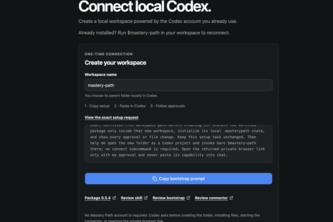
The company appears to be a solo project called Mastery Path, self-described as a web app that integrates with a local Codex environment to help users explore, learn, and master topics using AI. The author states this is an experimental prototype built during a hackathon, with no evidence of revenue, customers or traction.
What changed: The project description shows a shift from general AI education concepts to a specific tooling approach involving Codex integration and browser-based workflows. It also reflects a move toward more structured learning paths using "studios" (Compass, Explore, Library) rather than just chat-based interaction.
The single most important open question: Is there any evidence of user adoption or feedback beyond the author's own experience? The description contains no data on actual users, usage patterns, or product-market fit — only claims about functionality and intent.
What The Product Actually Is
- The description states that Mastery Path is a web app that connects to a local Codex environment.
- It provides three main studios:
- Compass: captures learning preferences and career direction
- Explore: generates topic feeds based on user context
- Library: turns conversation material into editable study cards and spaced-repetition sessions
- The tool is described as being built entirely in Codex, using technologies like Next.js, Playwright, shadcn, Tailwind, TypeScript, Vercel, and Vitest.
- It aims to make learning with AI feel less like repeated chats and more like a connected, evolving system.
Not evidenced: No information on how the product functions beyond the author's description. No screenshots, demos, or technical architecture details are provided.
Positioning & Claim Evolution
- The author positions Mastery Path as a tool for "supercharged pathway from exploration to mastery".
- It is described as a "bring-your-own-codex web app harness", suggesting it's designed to work with existing Codex setups rather than replacing them.
- The project evolved from general thoughts on future education and AI’s role in learning into a specific prototype focused on workflow abstraction.
- Key claims include:
- Learning should abstract away chores without overfitting to learner archetypes
- Documentation, long-running goals, and subagents are powerful for agentic engineering
Inferred: The positioning seems to be evolving from an exploratory idea into a structured learning system. However, there is no evidence of how this compares to existing tools or whether it addresses a real market need.
Target Customer & ICP
- The description does not clearly define the target customer.
- It implies that users are individuals who:
- Want to learn with AI
- Prefer flexible, non-rigid learning workflows
- Are comfortable using Codex environments
- The author mentions a focus on "interest discovery", "researching what you don't know", and "coming up with good ideas for projects", suggesting a self-directed learner or student.
Not evidenced: No explicit customer personas, user segments, or market targeting data are provided. The ICP is inferred from the stated goals but not defined.
Business Model & Pricing Evidence
- There is no mention of pricing, monetization, or business model.
- The author states that the tool allows people to use it "for free on the browser without installing an extra native application, signing up for an account or paying for API usage."
- This suggests a potential freemium or open-source approach, but no further details are given.
Not evidenced: No evidence of revenue streams, pricing tiers, or commercial viability beyond the author’s own use case.
Technical & Delivery Signals
- The project was built entirely in Codex using:
- Codex (5.6 Sol and 5.6 Terra)
- Next.js, Playwright, shadcn, Tailwind, TypeScript, Vercel, Vitest
- The author used
/goal modeand documentation files to guide development. - Challenges included bridging the connection between a local Codex app and a web interface.
- The solution involved using the Codex App Server to enable browser-based access without requiring additional installations.
Inferred: The technical stack and delivery approach suggest a developer-focused, experimental prototype. However, no production-ready features or scalability evidence is present.
Traction & Maturity Signals
- The project was submitted as part of the OpenAI 2026 hackathon, indicating it's an early-stage prototype.
- The author notes that they spent most time building the prototype and implementing features, leaving little time for optimization or better studio lifecycles.
- No evidence of user feedback, retention metrics, or usage data is provided.
Not evidenced: There are no signs of traction, adoption, or product maturity beyond the initial hackathon submission.
Competitive Context
- The description does not reference any competitors.
- It implies that the tool is distinct from traditional AI chatbots by offering structured workflows (Compass, Explore, Library) instead of just conversation-based learning.
- It also suggests integration with Codex environments, which may differentiate it from other educational platforms.
Not evidenced: No competitive analysis or market positioning relative to existing tools is available.
Open Questions & Risks
- The project is a solo effort with no team beyond the author.
- It was built in a hackathon setting and lacks long-term development or user testing.
- The tool relies heavily on Codex, which may limit its accessibility or scalability.
- There is no evidence of product-market fit, customer feedback, or commercial viability.
- The author notes that the project might be better suited as a native application or with account login — suggesting potential architectural limitations in its current form.
Inferred: The lack of traction, team size, and clear business model raises concerns about scalability and long-term viability.
Questions the description leaves open
- What specific problems are you trying to solve for learners, and how do you know these are real?
- Have you tested this with any users beyond yourself? If so, what were the results?
- How does your solution differ from existing AI learning tools or platforms?
- What is your plan for scaling beyond a single developer prototype?
- Do you have any plans to monetize or generate revenue from this tool?
- Are there any technical dependencies (like Codex) that could become barriers to adoption?
Overall Assessment
- Not evidenced: No data on financials, traction, or team strength supports an investment or partnership decision.
- The project is currently a prototype built by one person in a hackathon environment.
- It shows potential in concept but lacks evidence of real-world application, user feedback, or commercial viability.
Assessment: Based solely on the self-reported description, there is insufficient evidence to support an investment or partnership decision. This appears to be an early-stage idea with no demonstrated traction or market validation.
User Stories BotA demo video on every pull request
Get a demo video on every new feature
GitHub App that watches your pull requests and records a narrated, captioned demo.
Save time on demo prep and make informed decisions faster with a video walkthrough of every new feature.
Source
Submitted to the OpenAI 2026 hackathon on Devpost. Project home on Devpost. Back to the full gallery on Devpost.
This competitive analysis was produced by top-founders.com (opens in a new tab)
Generated by a language model from this project's public Devpost page — its tagline, the author's own write-up and any built-with tags listed there — as captured in August 2026. Short quotations are the author's words. It is an opinion on the idea as a business, not on the people behind it, and it reflects the description as published then. If the project has moved on, request a correction below. The analysis is not independent research and contains no verified traction, revenue or customer data.
An independent guide by KFG International LLC — not affiliated with, endorsed by, or connected to Devpost or OpenAI.