

Archive position — measured, not model output
0 likes on Devpost
2,263 of the 7,850 archived projects have more likes, and 5,587 share exactly 0 — so this project's #5,171 place in the like-ranked listing is a tie-break inside that group, not a ranking.
Projects (log scale)
Likes on Devpost. ▲ marks this project's group.
Show the figures
| Likes | Projects | Share of archive |
|---|---|---|
| 0 | 5,587 | 71.2% |
| 1 | 1,758 | 22.4% |
| 2 | 284 | 3.6% |
| 3–4 | 132 | 1.7% |
| 5–9 | 75 | 1.0% |
| 10+ | 14 | 0.2% |
 User Stories BotA demo video on every pull request
Get a demo video on every new feature
GitHub App that watches your pull requests and records a narrated, captioned demo.
Save time on demo prep and make informed decisions faster with a video walkthrough of every new feature.
Executive Summary
What the company appears to be
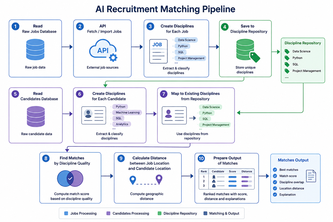
Match2 – AI Recruitment Agent is a self-reported AI-powered recruitment matching engine built by one developer (Dov G.) as part of an OpenAI 2026 hackathon submission. The system claims to match job opportunities with candidates using structured business rules, AI-assisted classification, and explainable outputs.
What changed
The project was submitted as a hackathon entry, indicating it is in early-stage development or prototype form. No evidence of commercial traction, funding, or customer adoption exists beyond the author’s own description.
Single most important open question
Is there any evidence that this system has been tested in real-world recruitment workflows, and if so, how does it perform against manual matching or existing tools?
What The Product Actually Is
The description states that Match2 is an AI-powered recruitment matching engine. It processes raw job data from databases and APIs, standardizes records, extracts skills and disciplines, and maps them to a discipline repository.
It then compares candidate profiles with jobs based on:
- Discipline compatibility
- Mandatory skills
- Professional experience
- Seniority
- Role level
- Industry relevance
- Geographic distance
The system is said to produce ranked matches with explanations for each recommendation. It includes mechanisms such as duplicate detection, multilingual mapping, and mandatory requirement validation.
Evidence
- The author describes the workflow in Python using structured business rules and AI models (e.g., Codex, OpenAI).
- It reads job data from external sources and candidate CVs.
- It uses a discipline repository to map roles and candidates consistently.
- It evaluates multiple factors including seniority, industry relevance, and geographic distance.
Inference The system appears to be a prototype or proof-of-concept for AI-assisted recruitment matching, not yet deployed in production.
Positioning & Claim Evolution
The author positions Match2 as an AI recruitment agent that improves upon basic keyword matching by incorporating structured logic and explainability. It is described as helping recruiters focus on relevant candidates instead of manually reviewing all profiles.
Claims made
- The system goes beyond simple keyword matching.
- It evaluates whether a candidate is realistically suitable for a role.
- It provides explanations for match/rejection decisions.
- It includes mechanisms to prevent misleading matches (e.g., seniority gaps, industry mismatches).
Evidence
- The author explicitly states these claims in the write-up.
Inference The positioning suggests a move toward explainable AI in recruitment, but no evidence of market testing or user feedback is provided.
Target Customer & ICP
The description implies that Match2 targets recruiters or hiring managers who need to sift through large volumes of candidate profiles and want more efficient, consistent matching.
Evidence
- The system is designed to help recruiters focus on relevant candidates.
- It includes features like ranked outputs and explanations tailored for human decision-makers.
Inference The ICP likely includes small-to-medium-sized companies or teams with limited recruitment resources who are looking for automation tools that reduce manual effort without fully replacing human judgment.
Business Model & Pricing Evidence
There is no evidence of a business model or pricing structure in the description. The project was submitted as a hackathon entry, and there is no mention of monetization, licensing, or customer acquisition strategies.
Evidence
- No revenue streams, pricing tiers, or sales processes are described.
- The system is presented as a prototype with future development plans.
Inference If commercialized, the business model may involve SaaS subscriptions or integration with existing ATS platforms, but this remains speculative.
Technical & Delivery Signals
The project was built in Python and uses AI tools such as Codex and OpenAI models for classification, reasoning, and explanation generation. It includes structured workflows for job data processing, candidate mapping, and matching logic.
Evidence
- Built with Python.
- Uses Codex and OpenAI models for development support and AI tasks.
- Implements business rules to prevent misleading matches.
- Standardizes location data and handles multilingual inputs.
Inference The technical stack suggests a hybrid approach combining rule-based logic and AI, which is typical for early-stage AI systems aiming for reliability and explainability.
Traction & Maturity Signals
There is no evidence of traction, customers, or adoption beyond the author’s own description. The project was submitted to a hackathon and has not been deployed in production or tested with real users.
Evidence
- Submitted as a hackathon project.
- No mention of users, clients, or performance metrics.
- No revenue or headcount data provided.
Inference The system is at an early stage of development, likely a prototype or MVP. It has not yet demonstrated real-world utility or scalability.
Competitive Context
No competitive landscape or market positioning relative to existing recruitment platforms (e.g., LinkedIn Talent, Indeed, BambooHR) is described in the project write-up.
Evidence
- No mention of competitors.
- No comparison with existing tools or platforms.
Inference Match2 may compete with AI-powered ATS or matching tools, but its exact competitive positioning cannot be determined without external data.
Open Questions & Risks
Several risks and open questions emerge from the lack of evidence:
- No real-world testing: The system is a hackathon submission with no proven performance or user feedback.
- Single-person team: A team size of one raises concerns about scalability, maintenance, and feature development.
- Unverified claims: All features and capabilities are self-reported without independent validation.
- Limited maturity: No evidence of production deployment, data pipelines, or integration capabilities.
Evidence
- Team size: 1 person.
- Submitted to a hackathon.
- No mention of testing, feedback, or commercial use.
Inference The project is in an exploratory phase and lacks the infrastructure or validation needed for commercial viability.
Questions the description leaves open
- Has this system been tested with actual recruiters or hiring teams? If so, what were the results?
- What data sources does it currently support, and how is data quality managed?
- How are the discipline definitions in the repository created and maintained?
- Are there any plans to integrate with existing ATS or HR systems?
- What is the expected timeline for moving from prototype to production-ready product?
Overall Assessment
Assessment Not evidenced.
There is no evidence of revenue, traction, or customer validation to support an investment or partnership decision. The project is a hackathon submission with no commercial history or demonstrated market fit.
Confidence Level Low This analysis is based entirely on the self-reported description provided by the author. No independent verification or external data exists to confirm any claims or assess performance.
User Stories BotA demo video on every pull request
Get a demo video on every new feature
GitHub App that watches your pull requests and records a narrated, captioned demo.
Save time on demo prep and make informed decisions faster with a video walkthrough of every new feature.
Source
Submitted to the OpenAI 2026 hackathon on Devpost. Project home on Devpost. Back to the full gallery on Devpost.
This competitive analysis was produced by top-founders.com (opens in a new tab)
Generated by a language model from this project's public Devpost page — its tagline, the author's own write-up and any built-with tags listed there — as captured in August 2026. Short quotations are the author's words. It is an opinion on the idea as a business, not on the people behind it, and it reflects the description as published then. If the project has moved on, request a correction below. The analysis is not independent research and contains no verified traction, revenue or customer data.
An independent guide by KFG International LLC — not affiliated with, endorsed by, or connected to Devpost or OpenAI.