

Archive position — measured, not model output
0 likes on Devpost
2,263 of the 7,850 archived projects have more likes, and 5,587 share exactly 0 — so this project's #5,170 place in the like-ranked listing is a tie-break inside that group, not a ranking.
Projects (log scale)
Likes on Devpost. ▲ marks this project's group.
Show the figures
| Likes | Projects | Share of archive |
|---|---|---|
| 0 | 5,587 | 71.2% |
| 1 | 1,758 | 22.4% |
| 2 | 284 | 3.6% |
| 3–4 | 132 | 1.7% |
| 5–9 | 75 | 1.0% |
| 10+ | 14 | 0.2% |
 User Stories BotA demo video on every pull request
Get a demo video on every new feature
GitHub App that watches your pull requests and records a narrated, captioned demo.
Save time on demo prep and make informed decisions faster with a video walkthrough of every new feature.
Executive Summary
What the company appears to be
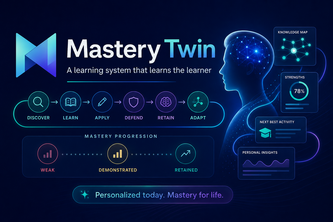
Mastery Twin is a self-reported AI learning twin designed for professionals in fast-changing domains. It claims to maintain a persistent, evidence-based model of a learner’s knowledge, goals, and demonstrated abilities, and to continuously adapt learning based on external changes and real application.
What changed
The project description shows an author-driven conceptualization of a system that moves beyond content consumption to require real-world application, defense, and delayed recall for mastery. It is presented as a novel approach to AI-powered learning, distinct from typical chatbots or quiz generators.
Single most important open question
Does the described system actually function as claimed, or is it a conceptual framework without execution?
Note
This analysis is based entirely on the self-reported project description provided by the author. No external verification, traction data, revenue figures, or customer evidence are available. All claims in this report are labeled as "the description states" and are unverified.
What The Product Actually Is
The description states that Mastery Twin is a continuously updating AI learning twin for professionals working in fast-changing domains. It maintains a living, evidence-based model of the learner’s goals, existing knowledge, demonstrated abilities, skill gaps, prior evidence, and retention state.
It connects this model with changes in the outside world through a process that includes:
- Understanding the learner
- Discovering relevant information
- Prioritizing personal impact
- Creating adaptive learning experiences
- Integrating external learning
- Requiring real application
- Conducting grounded defense
- Distinguishing demonstration from retention
- Adapting future learning
The system is described as not being a chatbot, content feed, summarizer, or quiz generator but rather a continuous system that tracks what the learner knows, observes what changes, identifies what matters, adapts how it is taught, requires evidence of application, verifies reasoning, tests retention, and recalculates next steps from new evidence.
Inference The product appears to be an AI-driven learning platform with a strong emphasis on mastery-based progression and real-world application. However, the description does not confirm whether this system has been built or tested beyond a prototype or hackathon submission.
Positioning & Claim Evolution
The description states that Mastery Twin is not another chatbot, content feed, summarizer, or quiz generator, but instead a continuous system focused on evidence-backed mastery transitions. It positions itself as:
- Starting from a living learner model and current external information
- Evaluating credibility, novelty, relevance, and personal impact
- Filtering information through the learner’s goals and skill gaps
- Requiring applied learner-created evidence
- Conducting grounded adaptive defense
- Tracking evidence-backed mastery transitions
It contrasts itself with typical AI learning products that start from static or generic content, measure lesson completion, accept one answer, and produce opaque scores.
Inference The positioning is a clear shift from traditional learning tools toward a model of mastery that emphasizes evidence production, application, and retention testing. However, the description does not provide evidence of how this system would scale or function outside of a prototype context.
Target Customer & ICP
The description states that Mastery Twin is designed for professionals working in fast-changing domains. It is intended to help learners:
- Understand what has changed
- Decide what information is trustworthy
- Identify meaningful skill gaps
- Apply new knowledge in practice
- Retain it over time
It mentions a senior developer as an example user who wants to adopt Codex reliably across a team, suggesting that the target includes technical professionals with specific goals and existing experience.
Inference The ICP appears to be technical professionals (e.g., developers, engineers) in fast-moving fields who are already consuming large volumes of information but struggle with filtering, applying, and retaining it. However, no explicit segmentation or persona data is provided.
Business Model & Pricing Evidence
Not evidenced.
Note
The description does not contain any information about pricing, monetization strategy, or business model. There is no mention of subscriptions, enterprise licensing, freemium tiers, or revenue streams.
Technical & Delivery Signals
The description states that the system was built using:
- AI agents (including GPT-5.6)
- LangChain, LangGraph, LangSmith
- OpenAI API
- Next.js, React, Node.js, TypeScript
- PostgreSQL, Supabase, Playwright, Vitest, Zod
- Tool-calling, structured outputs, row-level security
It also mentions that GPT-5.6 is natively integrated into the intelligence layer for reasoning-intensive parts such as:
- Onboarding analysis
- Research synthesis
- Source relevance analysis
- Learning-plan generation
- Artifact-grounded defense
- Criterion-level evaluation
Inference The technical stack suggests a modern, AI-integrated platform built with full-stack development and strong emphasis on structured data and AI orchestration. However, no evidence of actual product delivery or user-facing functionality is provided.
Traction & Maturity Signals
Not evidenced.
Note
There is no mention of users, customers, revenue, ARR, headcount, or any traction metrics. The project was submitted to a hackathon and is described as a vertical slice implementation, suggesting it is in early development.
Competitive Context
The description states that Mastery Twin is different from typical AI learning products because:
- It starts from a living learner model rather than static content
- It evaluates credibility, novelty, relevance, and personal impact
- It filters information through the learner’s goals and skill gaps
- It requires applied learner-created evidence
- It conducts grounded adaptive defense
- It tracks evidence-backed mastery transitions
- It ends when the session ends vs. returning later to verify retention
It contrasts Mastery Twin with:
| Typical AI Learning Product | Mastery Twin |
|-----------------------------|--------------|
| Starts from static or generic content | Starts from a living learner model and current external information |
| Summarizes whatever it finds | Evaluates credibility, novelty, relevance, and personal impact |
| Recommends more material | Filters information through the learner’s goals and skill gaps |
| Measures lesson or quiz completion | Requires applied learner-created evidence |
| Accepts one answer | Conducts a grounded adaptive defense |
| Produces an opaque score | Attaches criterion-level evidence and contradiction results |
| Ends when the session ends | Returns later to verify retention |
| Tracks activity | Tracks evidence-backed mastery transitions |
| Follows a fixed course | Recalculates the next best action from new evidence |
Inference The positioning suggests Mastery Twin is attempting to differentiate itself in a crowded AI learning space by emphasizing mastery-based progression, real-world application, and retention testing. However, no competitive analysis or market positioning data is provided.
Open Questions & Risks
- Unproven execution: The system is described as a vertical slice from a hackathon submission; there is no evidence of full functionality or real-world use.
- Overly ambitious claims: The description makes strong claims about mastery, retention, and defense without demonstrating how these are implemented in practice.
- No traction or monetization strategy: There is no evidence of users, revenue, or business model.
- High technical complexity with unclear delivery: While the stack is modern and AI-integrated, there is no indication that the system has been built or tested beyond a prototype.
- Unclear scalability: The described process involves deterministic validation and adaptive learning, but how this scales to many users or domains is not explained.
Inference The project appears conceptually strong but lacks execution proof. It may be more of a visionary idea than a working product.
Questions the description leaves open
- What is the current state of development? Is this a prototype, MVP, or full product?
- How does the system handle real-world data inputs and user feedback?
- Can you demonstrate how the deterministic validation works in practice?
- What are the actual use cases or domains where this has been tested?
- How is retention verified—what mechanisms ensure long-term mastery?
- What is the plan for scaling beyond a single-user model?
- Are there any existing partnerships, pilot users, or early adopters?
- How does the system differentiate between credible and non-credible sources in practice?
Overall Assessment
Not evidenced.
Note
No financial data, funding rounds, or investment history are provided. The project is described as a hackathon submission with no indication of commercial traction or investor interest. The description does not support any conclusion about whether this is a viable investment or partnership opportunity.
User Stories BotA demo video on every pull request
Get a demo video on every new feature
GitHub App that watches your pull requests and records a narrated, captioned demo.
Save time on demo prep and make informed decisions faster with a video walkthrough of every new feature.
Source
Submitted to the OpenAI 2026 hackathon on Devpost. Project home on Devpost. Back to the full gallery on Devpost.
This competitive analysis was produced by top-founders.com (opens in a new tab)
Generated by a language model from this project's public Devpost page — its tagline, the author's own write-up and any built-with tags listed there — as captured in August 2026. Short quotations are the author's words. It is an opinion on the idea as a business, not on the people behind it, and it reflects the description as published then. If the project has moved on, request a correction below. The analysis is not independent research and contains no verified traction, revenue or customer data.
An independent guide by KFG International LLC — not affiliated with, endorsed by, or connected to Devpost or OpenAI.